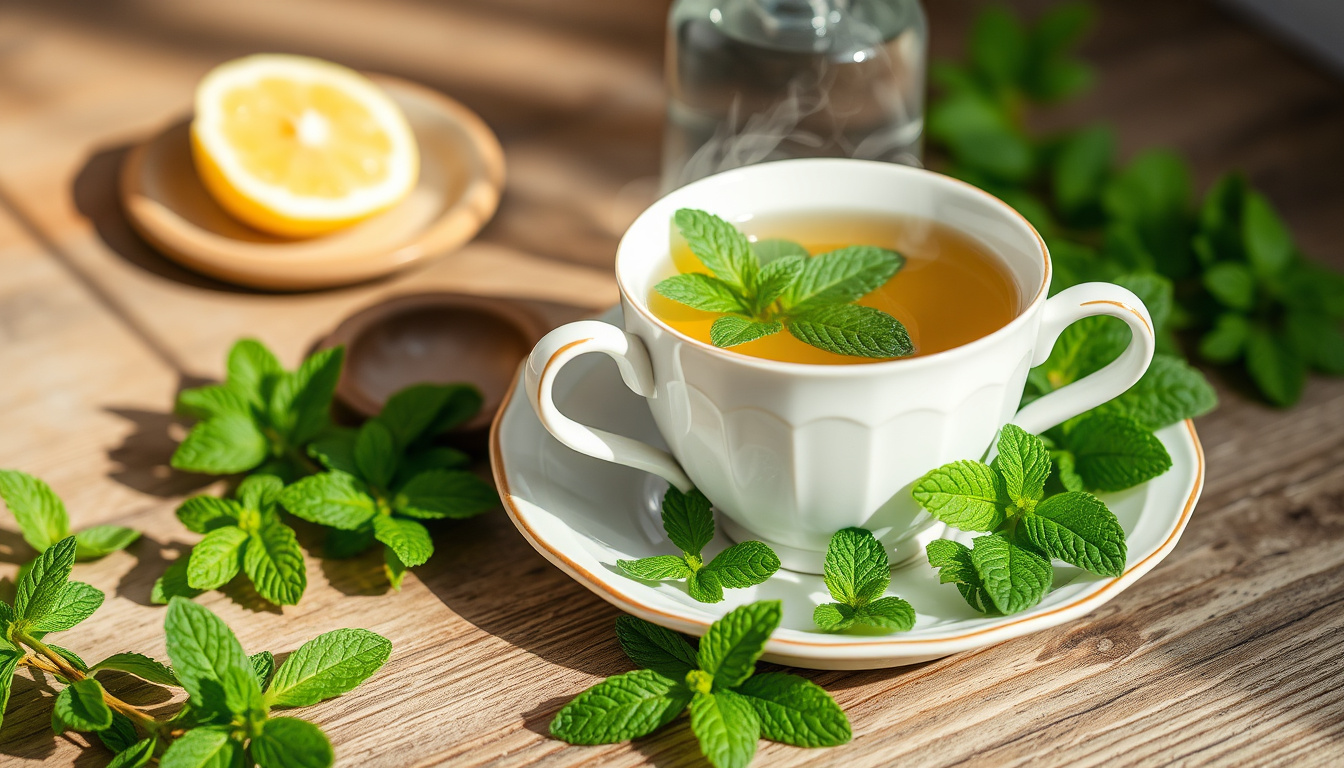

Few everyday drinks carry as many promises as peppermint tea. It’s caffeine-free, naturally sweet, and has been used for thousands of years to soothe stomachs and freshen breath, but here’s what the research actually says about the benefits — and where the claims fall short.
Caffeine content per cup: 0 mg ·
Calories per cup: ~2 kcal ·
Active compound: Menthol (~0.4% in leaves) ·
Published studies on PubMed: >1,200 ·
Typical steep time: 5–10 minutes
Quick snapshot
- Improves digestion and reduces bloating (PubMed (McKay & Blumberg, 2006))
- Zero caffeine per cup (University Hospitals (Cleveland-based health system))
- Menthol has antispasmodic properties (PubMed (peer-reviewed review))
- Stomach flattening — no evidence for fat loss (WebMD (medical reference publisher))
- Toxin flushing — liver and kidneys handle that naturally (WebMD (medical reference publisher))
- Significant metabolism boost — unproven in tea form (WebMD (medical reference publisher))
- Ancient Greece/Rome — used for digestive and respiratory ailments
- 2006 — first major peer-reviewed review (McKay & Blumberg) published (PubMed)
- 2020s — surging wellness interest for gut health and stress relief
- More human clinical trials on tea vs. oil needed (PubMed) (PubMed Central (NIH database))
- Cognition research expanding (PubMed Central (NIH database))
- Safety guidelines for specific populations still emerging (PubMed Central (NIH database))
Five key facts, one pattern: peppermint tea is a low-risk, caffeine-free herbal beverage with real but modest evidence for digestive comfort and mental alertness.
| Fact | Value |
|---|---|
| Caffeine | 0 mg per 8 oz cup |
| Calories | ~2 kcal per cup (unsweetened) |
| Active compound | Menthol (~0.4% in leaf) |
| Steep time | 5–10 minutes |
| Daily safe intake | Up to 4–5 cups for most adults |
What happens if I drink peppermint tea every day?
For most adults, daily consumption is safe and may offer mild, cumulative benefits — but the evidence base is thinner than you might expect.
What are the long-term effects of daily peppermint tea?
- Regular intake may improve digestion and reduce bloating thanks to menthol’s muscle-relaxant effect on the gastrointestinal tract (University Hospitals (Cleveland-based health system)).
- A 2024 randomized placebo-controlled trial found that 200 mL of peppermint tea improved cognition and cerebral blood flow in healthy adults (PubMed Central (NIH database)).
- The same trial reported greater improvements in memory and attention compared with placebo (PubMed Central (NIH database)).
Can drinking peppermint tea daily cause side effects?
- No caffeine tolerance builds up — it is naturally caffeine-free (University Hospitals).
- Potential mild interaction with acid reflux: peppermint may relax the lower esophageal sphincter, worsening GERD symptoms in some people (WebMD (medical reference publisher)).
- Antioxidant benefits are plausible: in vitro research shows peppermint has strong antioxidant activity (PubMed (McKay & Blumberg, peer-reviewed review)).
Daily drinkers get a caffeine-free ritual with real — if modest — cognitive and digestive upside. The risk is low, but the evidence is still catching up with the reputation.
The implication: peppermint tea works best as a gentle, long-term habit rather than a quick fix. Its benefits accumulate slowly, and for most people, the biggest risk is expecting too much too fast.
Will peppermint tea flatten your stomach?
This is one of the most persistent claims online — and one of the least supported by evidence. Peppermint tea may reduce bloating, but that is not the same as losing abdominal fat.
Does peppermint tea with lemon help with weight loss?
- No scientific evidence shows peppermint tea flattens the stomach or reduces abdominal fat (WebMD (medical reference publisher)).
- Lemon adds vitamin C but has no direct fat-burning effect.
- A 2024 trial reported improved cerebral blood flow from peppermint tea, but no weight-related outcomes (PubMed Central (NIH database)).
Which tea burns the most fat?
- Green tea has stronger evidence for metabolism support due to its EGCG content (Healthline (editorial health publisher)).
- Peppermint tea contains rosmarinic acid — an antioxidant — but not the catechins linked to thermogenesis.
- Animal studies suggest peppermint may relax gastrointestinal tissue, but this does not translate to fat loss (PubMed (McKay & Blumberg review)).
The “stomach flattening” claim confuses temporary bloating relief with permanent fat loss. Peppermint tea can make your stomach feel less distended after a meal — but it does not change your body composition.
What this means: if you enjoy peppermint tea, drink it for the taste and the gentle digestive comfort. For weight loss, green tea or a calorie deficit backed by evidence is a more realistic bet.
What does peppermint tea do for the female body?
Peppermint tea’s antispasmodic properties make it a popular choice for menstrual discomfort, but claims about hormonal effects need careful unpacking.
Benefits of peppermint tea for menstrual cycle
- Menthol acts as a muscle relaxant, which may reduce menstrual cramp severity (PubMed (McKay & Blumberg, peer-reviewed review)).
- No direct hormonal effects have been demonstrated — peppermint does not alter estrogen or progesterone levels.
- May help with nausea during pregnancy, but consult a doctor before regular use (University Hospitals (Cleveland-based health system)).
How does peppermint tea affect hormones?
- Current evidence shows peppermint tea is hormone-neutral — no anti-androgenic or estrogenic effects in humans.
- Animal studies have suggested possible mild anti-androgenic effects from very high doses of peppermint leaf extract, but these are not relevant to tea consumption.
- May support digestive comfort during PMS when bloating and cramping are common (Healthline (editorial health publisher)).
Women looking for a natural, non-pharmaceutical option for period pain have a safe, low-risk tool in peppermint tea — but it is a complement, not a replacement for medical care when cramps are severe.
The pattern: the evidence is strongest for symptomatic relief during menstruation and weakest for any systemic hormonal effect. Drink it for the comfort, not the chemistry.
What is better, peppermint or green tea?
This is the wrong question — they serve different purposes. The right question is which one suits your goal.
Caffeine content comparison
- Peppermint tea contains 0 mg of caffeine per cup (University Hospitals (Cleveland-based health system)).
- Green tea contains roughly 30 mg per 8 oz cup, depending on steep time and leaf quality.
Antioxidant levels comparison
- Green tea’s main antioxidant is EGCG (epigallocatechin gallate), widely studied for metabolism and disease prevention.
- Peppermint tea contains rosmarinic acid, a polyphenol with antioxidant and anti-inflammatory activity in lab studies (PubMed (McKay & Blumberg, peer-reviewed review)).
- Both offer different antioxidant profiles with distinct health implications.
Which is better for weight loss?
- Green tea has more clinical evidence for modest metabolism support via caffeine and EGCG.
- Peppermint tea has no direct weight-loss evidence, though it can replace sugary drinks at zero calories.
- A 2024 trial suggests peppermint tea improves cognitive function but does not affect metabolic rate (PubMed Central (NIH database)).
Green tea wins on metabolism research; peppermint tea wins on caffeine-free flexibility and digestive comfort. Neither is “better” — they are tools for different jobs.
The takeaway: choose peppermint when you want a soothing, caffeine-free option for digestion or evening relaxation. Choose green tea when you need a gentle energy lift and metabolism support.
Five features, one contrast: peppermint and green tea overlap on being low-calorie and antioxidant-rich, but diverge sharply on caffeine, active compounds, and primary benefits.
| Feature | Peppermint Tea | Green Tea |
|---|---|---|
| Caffeine per 8 oz | 0 mg | ~30 mg |
| Main antioxidant | Rosmarinic acid | EGCG |
| Key benefit | Digestion & bloating relief | Metabolism & weight loss |
| Best time to drink | Evening / before bed | Morning / afternoon |
| Calories (unsweetened) | ~2 kcal | ~2 kcal |
When not to drink peppermint tea?
Peppermint tea is safe for most people, but there are specific situations where it can do more harm than good.
Side effects of peppermint tea
- May worsen GERD symptoms by relaxing the lower esophageal sphincter (WebMD (medical reference publisher)).
- Allergic reactions — though rare — can occur, especially in people with sensitivity to menthol or other mint species.
- May interact with medications metabolized by the liver’s cytochrome P450 enzyme system (PubMed (McKay & Blumberg, peer-reviewed review)).
Who should avoid peppermint tea?
- People with GERD or hiatal hernia — peppermint can relax the esophageal sphincter and trigger acid reflux (WebMD (medical reference publisher)).
- Infants and young children — menthol can cause breathing difficulties and should be avoided (University Hospitals (Cleveland-based health system)).
- Anyone with hiatal hernia or severe acid reflux should test tolerance carefully or avoid altogether.
If you take prescription medications for blood pressure, cholesterol, or anxiety, check with your pharmacist about peppermint’s potential interaction with CYP450 enzymes — the risk is low but real.
The catch: peppermint’s muscle-relaxant properties are a double-edged sword. They soothe the gut but can also relax the valve that keeps stomach acid where it belongs.
Confirmed facts vs. what remains unclear
Confirmed facts
- Peppermint tea improves digestion and reduces bloating — clinical evidence from human and animal studies (PubMed)
- Peppermint tea is caffeine-free (University Hospitals)
- Menthol has antispasmodic properties (PubMed)
What’s unclear
- Peppermint tea flattens the stomach — no evidence for fat loss (WebMD)
- Peppermint tea flushes out toxins — liver and kidneys do this naturally
- Peppermint tea significantly boosts metabolism — unproven in tea form
What the experts say
“Peppermint tea may ease bloating and indigestion.”
University Hospitals (Cleveland-based health system), 28 June 2024
“Peppermint tea is naturally sweet and free of caffeine. It may be linked to improving digestion, boosting focus, and relieving headaches.”
“In vitro, peppermint has significant antimicrobial and antiviral activities, strong antioxidant and antitumor actions.”
Peppermint tea has been a trusted remedy for centuries, and modern science is slowly catching up. The evidence is strongest for digestive comfort, cognitive alertness, and as a safe caffeine-free alternative to tea or coffee. The myths — stomach flattening, detox flushing, metabolism boosting — are not supported by data. For the average drinker, the choice is straightforward: enjoy peppermint tea for what it is — a soothing, low-risk herbal infusion — not for what marketing wants it to be. For anyone with GERD, on liver-metabolized medications, or caring for young children, the trade-off is equally clear: test carefully, or skip it.
For those interested in how different teas support wellness, exploring green tea for weight management offers a useful comparison to peppermint tea’s digestive benefits.
Frequently asked questions
Can peppermint tea help with headaches?
Topical peppermint oil has evidence for tension headache relief, but the evidence for drinking peppermint tea for headaches is weaker. The menthol may help via its muscle-relaxant and mild analgesic properties (University Hospitals).
Does peppermint tea affect blood pressure?
No direct evidence shows peppermint tea significantly alters blood pressure in humans. Some animal studies suggest a mild relaxing effect on blood vessels, but this has not been confirmed in clinical trials (PubMed).
Is peppermint tea safe during pregnancy?
Moderate consumption is generally considered safe during pregnancy, and it may help with nausea and digestive discomfort. Always consult a healthcare provider before regular use during pregnancy (University Hospitals).
Can I drink peppermint tea if I have acid reflux?
It depends. Peppermint can relax the lower esophageal sphincter and worsen GERD symptoms in some people. If you have acid reflux, test with a small amount first or avoid it (WebMD).
Does peppermint tea interact with medications?
Peppermint may interact with drugs metabolized by the liver’s cytochrome P450 enzyme system, including certain statins, antifungals, and blood pressure medications. Check with your pharmacist if you take prescription drugs (PubMed).
How much peppermint tea should I drink per day?
Most adults can safely drink 4–5 cups per day. Higher amounts may increase the risk of side effects like heartburn or allergic reactions, though these are rare.
Can peppermint tea help with nausea?
Yes, peppermint tea is commonly used for mild nausea, thanks to menthol’s calming effect on the stomach muscles. Evidence is strongest for post-surgery nausea and motion sickness, though tea is milder than oil-based preparations (Healthline).

Sophie Larkin is Culture & Events Editor at UrbanMixr.uk, covering UK culture, events, festivals, arts and pop culture.