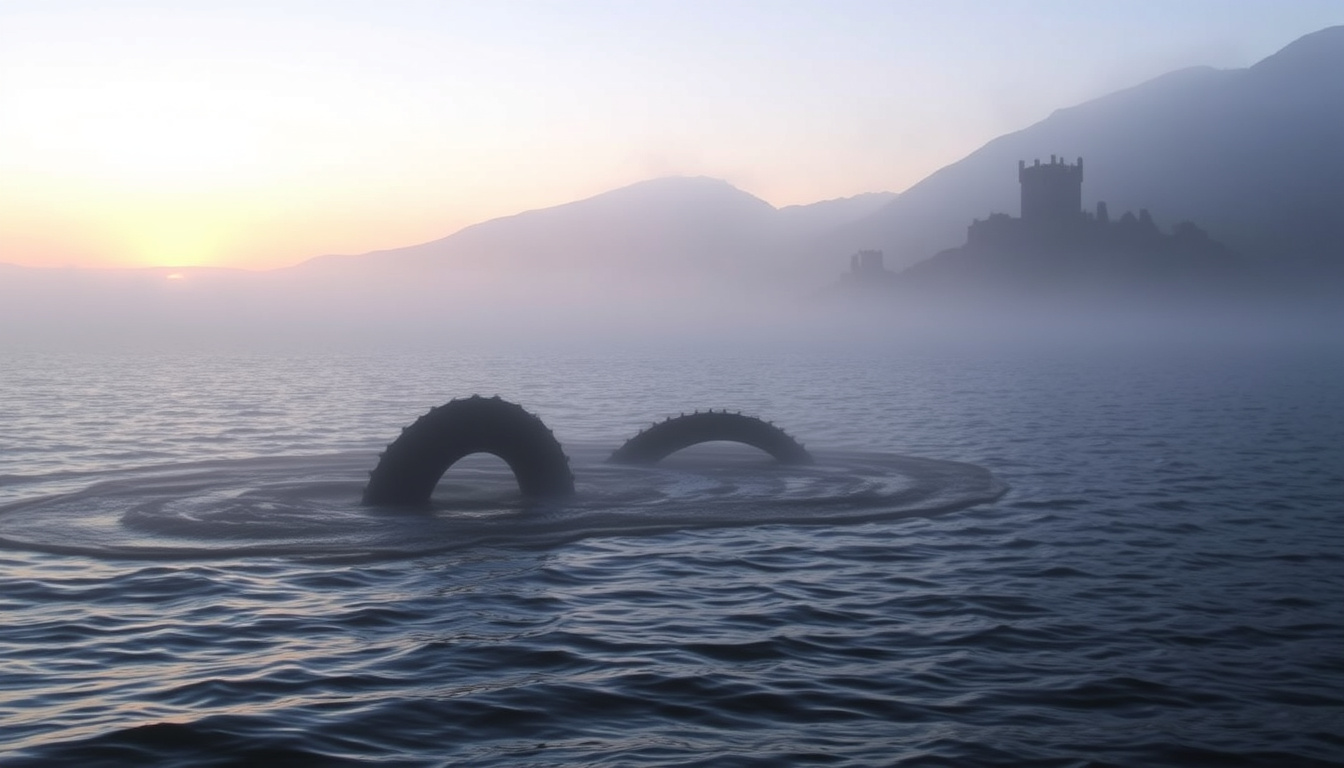
Most legends fade once you dig into the evidence. The Loch Ness Monster has spent over a century resisting that fate — not because of proof, but because of persistence. More than 1,100 sightings fill the official register, yet every major search has come up empty or explained. This gap between eyewitness conviction and scientific silence is exactly what makes Nessie worth taking seriously as a phenomenon, even if the creature itself remains unconfirmed.
Location: Loch Ness, Scotland · Reported Sightings: 1,162 · First Modern Sighting: 1933 · Common Description: Long-necked creature
Quick snapshot
- Surgeon’s Photograph (1934) exposed as hoax using toy submarine (Britannica)
- No physical remains or DNA evidence of reptile found in over 250 water samples (Inverness Palace Hotel)
- Loch Ness formed 10,000 years ago post-Ice Age — plesiosaurs extinct 65 million years earlier (The Lovat)
- Unexplained sonar contacts persist across multiple searches at 78–180m depth (Loch Ness Sightings)
- Eyewitness reliability remains contested — pareidolia accounts for many reports (YouTube Investigation)
- Giant eel theory unproven despite dominant eel DNA in 2018 study (Inverness Palace Hotel)
- St. Columba sighting claimed in 565 A.D. near Loch Ness (The Lovat)
- Modern era ignited in 1933 after newspaper report and Hugh Gray’s first photograph (EGU Blogs)
- August 2023 survey with drones and hydrophones detected anomalous sounds (Inverness Palace Hotel)
- Loch produces 200+ sightings annually vs. 8–12 at other monster lakes (YouTube Investigation)
- Latest confirmed sighting on May 23, 2025, of “something long and thin” in Urquhart Bay (Inverness Palace Hotel)
- Tourism and cultural investment ensure the legend outlives any scientific verdict (University of Colorado)
Six decades of scientific searches produced two dozen major claims — most debunked, some unexplained.
| Fact | Detail |
|---|---|
| Nickname | Nessie |
| Habitat Depth | Up to 230m |
| Famous Photo | Surgeon’s Photograph (1934, hoaxed) |
| Sighting Peak | 1930s–1960s |
| DNA Study | Professor Neil Gemmell, 2018 |
| Sonar Targets (Deepscan) | 3 unexplained at 78–180m depth |
Is the Loch Ness monster a true story?
The legend predates modern media by over a millennium. Saint Columba’s 565 A.D. account in the Life of Saint Columba describes the Irish missionary ordering a creature in the River Ness to stop attacking a swimmer — the beast reportedly retreated on command. Whether this constitutes a “true story” depends entirely on how much weight you give medieval hagiography versus contemporary eyewitness standards.
Early sightings
The Loch Ness Phenomena Investigation Bureau formed in 1962 with volunteers systematically monitoring the loch and disbanded in 1972 with inconclusive results. The organization established protocols for credible reporting but never secured physical evidence. Adrian Shine later led the Loch Ness Project, applying stricter scientific methodology to the same question.
The gap between 565 A.D. and 1933 contains very few documented sightings — suggesting the legend needed specific cultural conditions to ignite, not just the creature’s presence.
Scientific investigations
Professor Gordon Tucker’s 1968 sonar investigations made positive contacts, while 1972 underwater photos by the Academy of Applied Science showed diamond-shaped flippers. Both results remained unexplained but fell short of proof. The pattern would repeat for decades: instruments detect anomalies, experts cannot identify sources.
What this means: Six decades of organized searching produced instruments that detected something — but never artifacts that could be independently verified. The gap between detection and proof proved larger than any technology could bridge.
Is the Loch Ness Monster still alive?
Strictly speaking, no verified specimen exists. The scientific consensus, as documented by Science Focus, holds that no evidence confirms Nessie’s existence — all surveys have been inconclusive or produced natural explanations. Yet the question assumes binary categories that the data resists answering cleanly.
Recent sightings
The Official Loch Ness Monster Sightings Register records 1,162 total sightings as of May 2025. The latest confirmed sighting occurred on May 23, 2025, when a witness reported “something long and thin” in Urquhart Bay. The consistency of reports — long necks, humped backs, powerful tails — suggests either a real creature producing these impressions or a remarkably stable set of misidentifications.
G.R. Zug Ph.D. of the Smithsonian stated that sonar data indicate “large animals in Loch Ness, but are insufficient to identify them.” That uncertainty cuts both ways — it doesn’t confirm Nessie, but it doesn’t eliminate large unconventional fauna either.
DNA surveys
Professor Neil Gemmell’s landmark 2018 DNA study analyzed 250 water samples and identified approximately 3,000 species. The finding that shocked believers: “There is absolutely no evidence of any reptilian sequences,” Gemmell stated. The study found abundant eel DNA, sparking theories that giant eels account for some sightings. The plesiosaur hypothesis effectively collapsed under geological and genetic scrutiny — Loch Ness formed 10,000 years ago post-Ice Age while plesiosaurs went extinct 65 million years earlier.
What this means: DNA technology provided the most comprehensive biological census of the loch in history, ruling out the most popular monster theories while leaving unexplained signals that science cannot yet categorize.
Where is the Loch Ness Monster located?
The monster inhabits Loch Ness, a freshwater loch in the Scottish Highlands near Inverness. At 23 miles long and up to 230 meters deep, it holds more water than all English and Welsh lakes combined. The loch’s unusual physics — including thermoclines and acoustic properties — produce roughly 200+ sightings annually, compared to just 8–12 at other famous monster lakes worldwide.
Loch Ness geography
The loch stretches along the Great Glen fault line, connecting the North Sea to the Atlantic. Its depth creates a stable, cold environment that could theoretically sustain large cold-water species. Unlike oceans, the enclosed freshwater ecosystem limits what creatures could survive here long-term.
Search hotspots
Urquhart Bay and the areas near Foyers have generated the most consistent reports. Boat tours operating year-round cater specifically to monster-spotting tourists, with captains actively watching for surface disturbances. This tourist infrastructure creates a self-reinforcing loop: more eyes on the water produce more sightings, which attracts more visitors.
Professor Neil Gemmell himself cautioned: “A lack of evidence is not necessarily evidence of absence.” The Loch Ness environment could theoretically sustain unknown species that evade standard sampling methods — but those species would need food sources, breeding populations, and fossil records that match the loch’s 10,000-year history.
Is the Loch Ness Monster a dinosaur?
The popular image of Nessie borrows heavily from plesiosaur anatomy — a long neck, barrel body, and flippers. This connection became culturally dominant after the 1934 Surgeon’s Photograph showed a creature matching that description. However, the plesiosaur theory faces fundamental biological and geological obstacles.
Plesiosaur theory
Plesiosaurs were marine reptiles that breathed air and gave birth to live young in open ocean environments. They could not have survived in freshwater Loch Ness, which filled with glacialmeltoff only 10,000 years ago — a geological eyeblink compared to the 65 million years since the last plesiosaur died out. A breeding population would require multiple individuals, and no fossils or bones have ever surfaced.
Extinction evidence
The 2023 discovery of a plesiosaur fossil in Morocco supporting a sea-dwelling origin actually strengthened the case against freshwater Nessie. While the plesiosaur family tree gained clarity, the timeline gap between marine reptiles and Scottish glacial lakes widened.
How old is the Loch Ness Monster?
The monster itself has no biological age — the question typically asks how old the legend is or how old believers consider the creature to be. The legend traces to 565 A.D., making Nessie roughly 1,460 years old as a cultural phenomenon. Ancient creature claims typically invoke Mesozoic-era lifespans, but no verified lineage connects modern sightings to prehistoric fauna.
Legend origins
The Saint Columba account represents the earliest recorded reference, appearing in documents written roughly a century after the claimed event. Medieval Scottish folklore brimmed with water creatures and shape-shifters, providing narrative templates that later sightings could slot into. The 565 A.D. date carries medium confidence given the documentary gap — but it remains the most established anchor point.
Reported lifespan
Supernatural theories sometimes assign Nessie multi-century or multi-millennium lifespans, borrowing from dragon mythology. Scientifically, no known freshwater species approaches such longevity. The giant eel hypothesis maxes out at roughly 80–100 years based on European eel data, while unidentified large animals would face standard biological constraints.
Timeline signal
- — Saint Columba sighting claim near River Ness
- — Hugh Gray’s photograph near Foyers; first claimed image
- — Surgeon’s Photograph by Robert Kenneth Wilson
- — Loch Ness Phenomena Investigation Bureau formed
- — Operation Deepscan; 24 boats detect three sonar targets
- — Project Urquhart detects strong sonar echo
- — Professor Gemmell’s DNA study; no reptilian DNA found
- — Latest confirmed sighting in Urquhart Bay
Clarity check
Confirmed
- Surgeon’s Photograph (1934) was a hoax using toy submarine
- No physical remains found in over 60 years of searching
- Loch Ness formed 10,000 years ago — plesiosaurs extinct 65 million years earlier
- 2018 DNA study found no reptilian DNA sequences
Unproven
- Sonar contacts remain unexplained but inconclusive
- Eyewitness reliability varies widely
- Giant eel theory unconfirmed despite dominant eel DNA
- No breeding population evidence exists
“There is absolutely no evidence of any reptilian sequences.”
— Professor Neil Gemmell, University of Otago
“I believe that these data indicate the presence of large animals in Loch Ness, but are insufficient to identify them.”
— G.R. Zug Ph.D., Smithsonian Curator
Related reading: Alien Earth Release Date · Venomous Blue Dragons
While exposed hoaxes dominate the narrative, Nessie facts and theories delves into 1,400 years of sightings, sonar anomalies, and persistent folklore from Scotland’s depths.
Frequently asked questions
What does the Loch Ness Monster look like?
Most descriptions describe a long-necked creature with humps protruding from the water, a small head, and powerful flippers. The canonical image comes from the 1934 Surgeon’s Photograph, which was later exposed as a hoax using a plastic head on a toy submarine.
Has the Loch Ness Monster ever been photographed?
Over 1,100 times according to the Official Sightings Register. However, every photograph with sufficient clarity for analysis has been either debunked as hoax or explained as known animals, boat wakes, floating debris, or optical illusions.
Why do people believe in Nessie?
The loch’s unique acoustics and thermocline create genuine visual distortions. Additionally, pareidolia — the human tendency to recognize familiar patterns in ambiguous stimuli — makes long-necked shapes easy to perceive. Adrian Shine of the Loch Ness Project has documented how easily the human eye misidentifies common objects as monsters.
What scientific searches have been done?
Major efforts include the Loch Ness Phenomena Investigation Bureau (1962–1972), Operation Deepscan (1987 with 24 boats), Project Urquhart (1992 with sonar), the BBC’s 600-beam sonar sweep (2003), and Professor Gemmell’s DNA study (2018). All produced either natural explanations or unexplained anomalies lacking proof value.
Can you visit Loch Ness to see Nessie?
Yes, boat tours operate year-round from Drumnadrochit, Inverness, and other points along the loch. The Loch Ness Centre and Exhibition provides educational context, while the surrounding area offers hiking, castles, and standard Highland tourism experiences.
Are there tours for spotting the monster?
Dedicated monster-spotting cruises run regularly, with captains trained to point out historically significant sighting locations. Crucially, these tours maintain high visitor volumes regardless of scientific consensus — the legend drives significant tourism revenue for the region.
What is the most famous Nessie hoax?
The Surgeon’s Photograph from 1934, taken by Robert Kenneth Wilson, remained the iconic image for six decades. It was revealed as a hoax in 1994 — orchestrated by Marmaduke Wetherell using a plastic monster head mounted on a toy submarine. Wilson had reportedly known it was fake when he sold the image to newspapers.
For tourists visiting the Scottish Highlands, the practical choice is straightforward: enjoy the loch’s dramatic scenery and rich folklore, keep eyes open for interesting ripples, but don’t plan the holiday around Nessie confirmation. The legend will almost certainly outlast any scientific resolution — and that longevity says something about human psychology as much as Scottish lakes.

Sophie Larkin is Culture & Events Editor at UrbanMixr.uk, covering UK culture, events, festivals, arts and pop culture.