
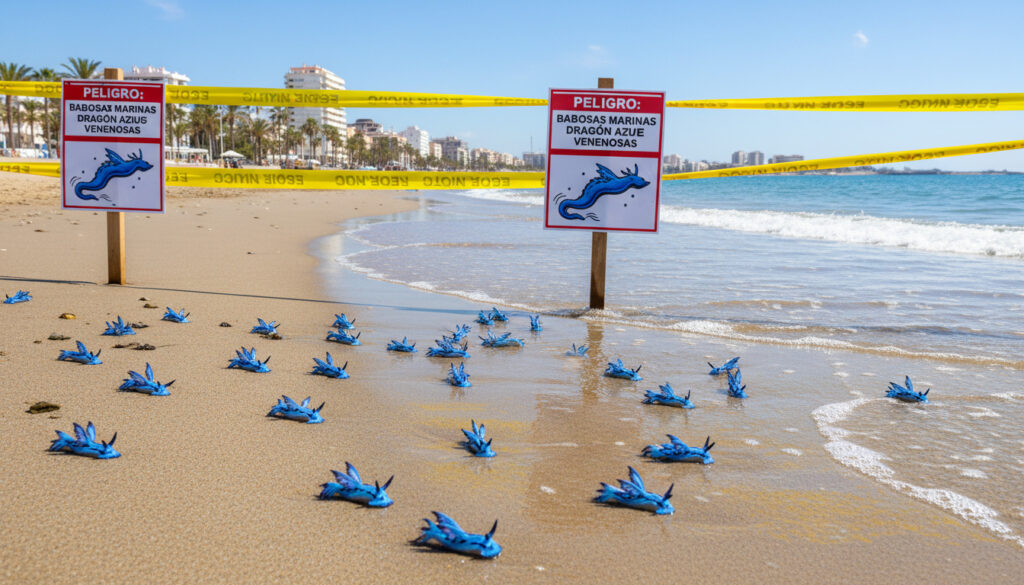
Glaucus atlanticus, commonly called the blue dragon, has triggered multiple beach closures along Spain’s eastern coastline after venomous specimens washed ashore in Alicante province. The creatures, measuring up to four centimeters in length, display striking blue and silver coloration but carry concentrated stinging cells capable of delivering painful burns to humans.
Authorities raised red flags at Guardamar del Segura and surrounding Costa Blanca beaches in August 2025 after lifeguards spotted the pelagic sea slugs floating in shallow waters. The sightings prompted immediate swimming prohibitions across seven miles of coastline, marking one of the most significant marine wildlife safety events in the region in recent years.
What Are Venomous Blue Dragons?
- Floats upside down using surface tension
- Feeds exclusively on Portuguese man o’ war jellyfish
- Steals and stores prey’s venomous stinging cells
- Camouflages with blue dorsal side upward
- Pelagic species rarely found near coastlines
- Exceptional sightings reported in Spanish waters
| Characteristic | Description |
|---|---|
| Scientific Name | Glaucus atlanticus |
| Common Names | Blue dragon, sea swallow, blue angel |
| Maximum Size | 4 cm (1.6 inches) |
| Coloration | Vibrant blue and silver |
| Feeding Strategy | Preys on Portuguese man o’ war |
| Defense Mechanism | Concentrated nematocysts |
| Buoyancy | Floats upside down on surface |
| Typical Range | Temperate Atlantic and Pacific |
Scientific name and appearance
Marine biologists classify the blue dragon as a nudibranch, a group of soft-bodied mollusks renowned for vivid coloration. University of Cádiz expert Juan Lucas Cervera notes that unlike the approximately 300 sea slug species inhabiting the Iberian Peninsula, Glaucus atlanticus maintains a strictly pelagic lifestyle, drifting on open ocean currents rather than crawling along seabeds.
The creature’s cerata—finger-like projections resembling wings—extend outward in a configuration various news outlets have described as “Pokémon-like” or alien in appearance. Images published by El País courtesy of photographer Pedro Sánchez demonstrate the species’ distinctive silhouette against coastal waters.
Diet and behavior
These slugs feed primarily on the Portuguese man o’ war, a venomous siphonophore drifting in warm ocean currents. During consumption, Glaucus atlanticus isolates and concentrates the prey’s nematocysts—specialized stinging cells—within its own tissues, repurposing the venom for defense against predators.
The species employs countershading camouflage: the blue dorsal surface faces skyward, blending with ocean water when viewed from above, while the silver-white underside faces downward, mimicking sunlight filtering through waves. This orientation explains why beachgoers encounter the creatures floating upside down on the surface film.
Are Blue Dragons Dangerous in Alicante?
Sting effects on humans
Contact with a blue dragon triggers immediate skin irritation, burning sensations, and painful dermatological reactions. Medical authorities classify the sting as milder than that of the Portuguese man o’ war, though individual sensitivity varies and allergic reactions remain possible.
Even specimens washed ashore and apparently dead retain active nematocysts capable of envenomation. Authorities emphasize that handling, touching, or stepping on beached blue dragons poses significant risk of painful stings.
Fox Weather reports that the Cruz Roja and local lifeguards have issued specific warnings against contact after multiple specimens appeared along the Valencian Community coastline in August 2025.
Medical advice
Standard first aid protocols for marine stings apply: rinse affected areas with seawater (never freshwater), remove visible tentacle fragments carefully without rubbing, and seek medical attention for severe reactions. Beach patrols coordinate with emergency services during closure periods to monitor for sting incidents.
Where Have Blue Dragons Been Spotted in Alicante?
Key beach locations
Guardamar del Segura, located near Villajoyosa on the Costa Blanca, emerged as the primary hotspot during the August 2025 influx. Lifeguards identified two specimens at Vivers beach (Playa Vivers) on August 20, prompting immediate red flag protocols.
Additional sightings occurred at Canet de Berenguer beach in the neighboring province of Valencia on the same date. Local monitoring blogs note that authorities extended surveillance across the entire seven-mile beach sector following initial reports.
Mediterranean appearances of Glaucus atlanticus represent exceptional events. Prior confirmed records include an 1839 observation in the Canary Islands, early 20th century reports from the Balearics, and a 2021 Costa Blanca sighting—the first in over three centuries.
Recent sighting timeline
While Andalusia recorded half a dozen specimens at Santa Bárbara beach on August 17, the Alicante incidents concentrated later in the month. A secondary wave on August 23 triggered additional closures at Guardamar del Segura after a massive appearance prompted renewed safety concerns.
Lanzarote’s La Garita and Famara beaches, plus deep waters off Mallorca’s Tramuntana mountains (the first record since 1916), also reported 2025 encounters, suggesting a broader Atlantic-Mediterranean drift pattern.
Why Are Blue Dragons Washing Up on Alicante Beaches?
Ocean currents and migration
As obligate pelagic drifters, blue dragons navigate solely through ocean surface currents, typically inhabiting temperate Atlantic and Pacific waters. Their presence in the Mediterranean basin indicates unusual current patterns transporting populations from primary habitats into the enclosed sea.
Climate monitoring indicates Mediterranean surface temperatures exceeded 28°C (82°F) in late June 2025, representing a +5°C anomaly above seasonal averages. Researchers hypothesize these thermal conditions altered current dynamics, though dedicated ecological studies linking specific temperature spikes to blue dragon displacement remain unpublished.
Warmer waters may facilitate the northward drift of Portuguese man o’ war colonies, with blue dragons following their prey into Mediterranean waters. However, scientists have not established definitive causal relationships between the 2025 heat anomaly and specific beach strandings.
Local authority warnings
Guardamar del Segura police utilized social media channels to disseminate real-time alerts during the August events. The Cruz Roja maintains active beach status monitoring for the Valencian Community, coordinating with municipal police and lifeguard services to implement flag-based warning systems.
Red flags indicate absolute swimming prohibitions, while yellow flags signal moderate hazard conditions following reopening. Video documentation captured the extensive coastline closures affecting tourism along the Costa Blanca during peak season.
When Did Blue Dragons First Appear in Alicante?
The 2025 sightings mark the first documented blue dragon influx in Alicante province since a 2021 Costa Blanca event described by marine biologists as the first regional appearance in over 300 years. No confirmed 2024 sightings appear in available scientific or journalistic records.
- Six specimens detected at Santa Bárbara beach, La Línea de la Concepción, Cádiz, triggering initial red flag protocols in Andalusia.
- Two blue dragons spotted at Vivers beach, Guardamar del Segura, Alicante; authorities closed seven miles of beaches until August 21.
- Single specimen reported at Canet de Berenguer beach, Valencia province.
- Massive appearance at Guardamar del Segura prompts renewed swimming prohibition.
What Remains Uncertain About These Sightings?
| Established Facts | Unconfirmed Factors |
|---|---|
| 2025 beach sightings confirmed via photographic evidence and official reports | Specific current patterns driving Mediterranean influx |
| Sting effects documented as painful but rarely fatal | Long-term population trends in Spanish waters |
| Temperature anomalies recorded (+5°C above average) | Direct causal link between warming and strandings |
| Beach closures implemented August 20-21 and August 23 | Predictability of future seasonal appearances |
Historical Context of Blue Dragons in Spain
Spanish marine records document Glaucus atlanticus as an exceptionally rare visitor to Mediterranean shores. The earliest verified mention dates to 1839 in the Canary Islands, with subsequent early 20th century observations in the Balearic archipelago. Visitors interested in natural history exhibitions may find comparative marine collections at the V&A Museum London – Complete Visitor Guide while researching ocean biodiversity.
The 2021 Costa Blanca appearance broke a three-century absence from regional records, establishing that while the species maintains populations in adjacent Atlantic waters, penetration into the Mediterranean occurs only under specific oceanographic conditions. The 2025 wave represents the most concentrated series of sightings in modern Spanish history, affecting beaches across Andalusia, Valencia, Alicante, and the Balearic Islands simultaneously.
Unlike the approximately 300 sea slug species native to Iberian coastal waters, blue dragons cannot survive outside pelagic environments, making each beach stranding effectively a terminal event for individual specimens while posing temporary hazards to human beachgoers.
Expert Statements and Source Verification
Around 300 sea slug species exist on the Iberian Peninsula; blue dragons are distinct for their open-ocean habitat. Report sightings with photographs for monitoring purposes.
— Juan Lucas Cervera, University of Cádiz
The sting causes skin irritation, burning, or painful burns, milder than Portuguese man o’ war but potentially triggering allergic reactions.
— Medical assessments cited in El País climate reporting
Summary
Venomous blue dragons forced unprecedented beach closures along Alicante’s Costa Blanca in August 2025, with Guardamar del Segura implementing seven-mile swimming bans after Glaucus atlanticus specimens washed ashore. While the creatures’ striking appearance attracts attention, their concentrated nematocysts deliver painful stings requiring medical attention. Visitors should monitor Cruz Roja beach status updates and avoid handling any beached specimens. Those planning travel to the region may also wish to check current UK Time Change 2025 schedules when coordinating international communications.
Frequently Asked Questions
Are blue dragons poisonous or just venomous?
Blue dragons are venomous, not poisonous. They actively inject toxins through nematocysts when touched, rather than delivering poison through ingestion.
How common are blue dragon sightings in Spain?
Exceptionally rare. Mediterranean records span 1839, early 20th century, 2021, and 2025. Atlantic coast sightings occur more frequently but remain unusual.
What should you do if you see blue dragons on the beach?
Do not touch. Maintain distance and notify lifeguards or local police immediately. Photograph the location for authorities if safe to do so.
What happens if you touch a blue dragon sea slug?
Contact causes immediate burning, skin irritation, and painful burns. Severe allergic reactions may occur. Rinse with seawater and seek medical care.
When did blue dragons first appear in Alicante?
First modern confirmed sighting occurred in 2021, described as the first in over 300 years. The 2025 influx marked the second documented regional appearance.

Emily Ward is UK Managing Editor at UrbanMixr.uk, running the daily news list, publishing schedule and city-guide planning.