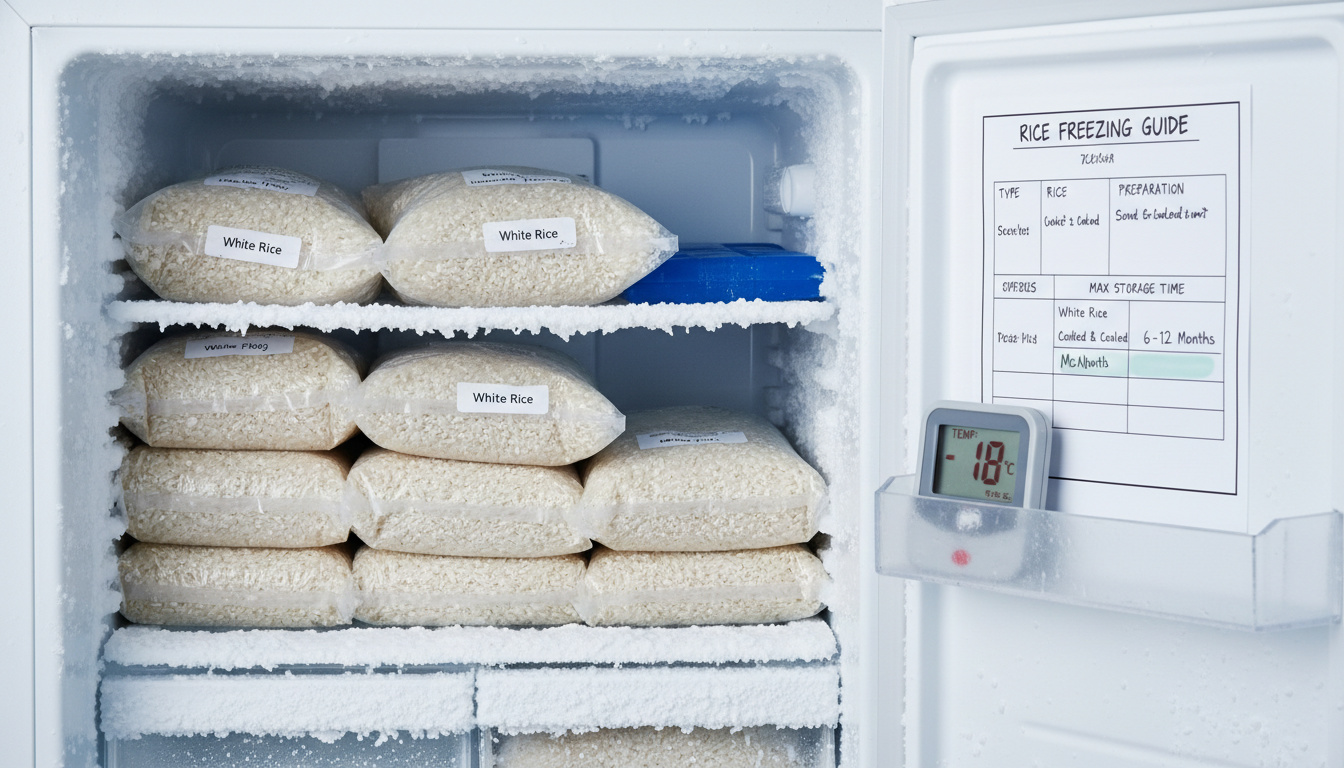

Freezing rice offers a practical solution for extending shelf life and reducing food waste, yet safety concerns persist among home cooks. While both cooked and uncooked varieties can withstand frozen storage, improper handling before freezing creates significant health risks that reheating cannot remedy.
The primary challenge involves Bacillus cereus, a resilient spore-forming bacterium that survives standard cooking temperatures up to 100°C. These spores germinate in warm, moist environments between 10°C and 50°C, producing heat-stable toxins that cause emetic or diarrheal food poisoning. Understanding the interplay between bacterial risk and freezing mechanics proves essential for anyone storing rice long-term.
Scientific evidence confirms that freezing effectively halts bacterial proliferation, though it does not eliminate dormant spores or destroy pre-formed toxins. Success depends entirely on rapid cooling protocols, appropriate storage durations, and strict adherence to temperature controls during thawing and reheating.
Can You Freeze Rice Safely?
- Freezing arrests bacterial growth below 4°C but does not eliminate dormant Bacillus cereus spores or neutralize heat-stable toxins.
- Cooked rice left at room temperature enters the danger zone (10-50°C) where spores germinate rapidly, doubling every 20 minutes at 30°C.
- Portioning rice into shallow containers before freezing allows single-serving removal without exposing entire batches to temperature fluctuations.
- Uncooked rice requires airtight, moisture-free environments to prevent freezer burn and maintain spore dormancy for 48 weeks or longer.
- Reheating frozen rice to 165°F (74°C) ensures destruction of vegetative bacteria, though this temperature does not affect pre-existing toxins.
- Brown rice exhibits higher oil content than white varieties, potentially accelerating texture degradation and rancidity during extended freezing.
- Refreezing thawed rice remains safe exclusively when the original thawing occurred continuously under refrigeration below 5°C.
| Rice Type | Maximum Freezer Duration | Preparation Requirements | Safety Parameters | Microbiological Considerations |
|---|---|---|---|---|
| Cooked White Rice | Up to 6 months | Spread thinly, cool <2 hrs, airtight containers | Store at 0°F (-18°C) or below | Spores survive; prevent pre-freeze germination |
| Cooked Brown Rice | Up to 6 months | Same as white; oil content may affect texture | Monitor for rancidity | Identical spore risks as white rice |
| Uncooked White Rice | Indefinite (spores viable 48+ weeks) | Dry, airtight packaging, cool environment | Exclude moisture completely | Spores remain dormant but viable |
| Uncooked Brown Rice | Indefinite (quality diminishes faster) | Vacuum sealing recommended | Protect from oxygen exposure | Higher lipid oxidation risk |
| Refrozen Cooked Rice | Remaining duration from original freeze | Only if thawed below 5°C | Never refreeze room-temp thawed rice | Risk increases if temperature abused |
| Refrigerated Cooked Rice (Pre-freeze) | 3-4 days maximum before freezing | Shallow containers, <40°F (4°C) | Freeze promptly if not consumed | Growth continues even at 4-8°C |
How to Freeze Rice Properly
How to Make Puff Pastry – Perfect Flaky Layers at Home requires precise temperature control, and similarly, freezing rice demands strict adherence to cooling protocols to prevent bacterial proliferation. The window between cooking and freezing determines safety more than the freezing itself.
Cooling Cooked Rice Rapidly
Divide freshly cooked rice into shallow containers no more than two inches deep to facilitate rapid heat dissipation. Refrigerate within two hours at temperatures below 40°F (4°C) to prevent spore germination. Research from the National Center for Biotechnology Information demonstrates that B. cereus reaches dangerous levels of 10^7-10^9 CFU/g within 24 hours when held at 26-32°C.
Once cooled completely in the refrigerator, transfer the rice to airtight freezer bags or containers, removing as much air as possible to prevent freezer burn. Label containers with the freeze date to monitor the six-month maximum storage window.
Leaving cooked rice at room temperature between 10°C and 50°C allows Bacillus cereus spores to germinate and multiply rapidly. At 30°C, bacterial populations double every 20 minutes. The resulting heat-stable toxins persist even when rice is subsequently frozen and reheated, potentially causing vomiting within 1-5 hours or diarrheal symptoms within 6-15 hours after consumption.
Storing Uncooked Rice
Uncooked rice requires dry storage in cool conditions before freezing. Place grains in airtight containers or heavy-duty freezer bags to prevent moisture absorption. While freezing does not kill dormant spores, it prevents insect infestation and slows lipid degradation in brown rice varieties. Spores remain viable for at least 48 weeks under dehydrated conditions according to microbiological research, though freezing maintains dormancy effectively.
How Long Can You Freeze Rice?
Properly frozen cooked rice maintains optimal safety and quality for up to six months at 0°F (-18°C) or below, according to Food Safety News. Beyond this duration, texture degradation accelerates, though safety remains intact if continuous freezing temperatures are maintained.
Cooked Rice Timeline
Refrigerated cooked rice lasts only 3-4 days before requiring freezing or disposal. Once frozen, the six-month countdown begins. B and Q Kitchens – 2025 Prices and Quality Guide emphasizes the importance of reliable storage containers, a principle equally applicable to maintaining rice quality in domestic freezers.
Brown rice exhibits a shorter optimal texture window than white rice due to higher oil content in the bran layer. While safety remains equivalent, organoleptic qualities deteriorate more rapidly, potentially developing rancid notes after 4-6 months.
Freezing temperatures effectively halt bacterial multiplication but do not kill Bacillus cereus spores. These dormant structures survive indefinite frozen storage, remaining viable for 48 weeks or longer. Food safety depends entirely on preventing spore germination through rapid cooling before freezing and maintaining frozen states until reheating.
Uncooked Rice Longevity
Uncooked rice stored frozen in dry, airtight conditions remains safe indefinitely from a microbiological perspective. However, the UK Food Standards Agency notes that quality attributes including flavor, aroma, and cooking characteristics degrade gradually after 12 months for white varieties and 6 months for brown.
Best Ways to Thaw and Use Frozen Rice
Thawing methodology significantly impacts both safety and final texture. Improper thawing reintroduces the temperature danger zone where surviving spores may germinate and produce toxins.
Safe Thawing Protocols
Transfer frozen rice to the refrigerator and thaw overnight at temperatures below 5°C. Alternatively, add frozen rice directly to boiling liquids during cooking, ensuring the center reaches 165°F (74°C) rapidly. Never thaw rice on kitchen counters or in warm water baths, as these methods allow the outer layers to remain in the danger zone for extended periods.
The McGill University Office for Science and Society emphasizes that toxins produced before freezing or during improper thawing persist through reheating, making prevention the only effective safety measure.
Frozen rice often exhibits dryness due to moisture crystallization. Restore palatability by sprinkling 1-2 tablespoons of water over the rice before microwaving, or employ steam reheating methods. Brown rice particularly benefits from added moisture to counteract chewiness developed during freezing. Reheat only the portion intended for immediate consumption to avoid repeated temperature cycling.
Reheating Temperature Standards
Reheat all frozen rice to an internal temperature of 165°F (74°C), verified with a food thermometer. University of Washington Medicine confirms that while this temperature destroys vegetative bacterial cells, it cannot eliminate heat-stable toxins already present. Consume reheated rice immediately; do not return it to refrigeration or hold at serving temperatures for extended periods.
What Is the Safe Storage Timeline for Rice?
- Cook rice to minimum 74°C internal temperature. Divide into shallow containers and refrigerate below 40°F (4°C) within two hours to prevent B. cereus germination.
- Transfer cooled rice to airtight freezer bags or containers, removing air. Label with date and freeze promptly at 0°F (-18°C) or below.
- Maintain continuous freezing temperatures. Cooked rice remains safe for up to six months; uncooked rice indefinitely, though quality peaks within 12 months.
- Transfer from freezer to refrigerator. Thaw below 5°C overnight, or use direct-from-freezer cooking methods that rapidly exceed 74°C.
- Bring to 165°F (74°C) throughout. Add moisture to restore texture. Consume immediately without reheating leftovers.
What Do Food Safety Experts Know for Certain?
| Established Scientific Facts | Remaining Uncertainties and Variables |
|---|---|
| Rice freezes safely at 0°F (-18°C) or below, halting bacterial multiplication effectively. | Precise timeline for texture degradation varies significantly by rice cultivar, age, and initial moisture content. |
| Bacillus cereus spores survive boiling (100°C for 20 minutes) and freezing temperatures. | Individual susceptibility to emetic toxin (vomiting) versus diarrheal toxin varies by person and toxin concentration. |
| Rapid cooling within two hours prevents spore germination and toxin production. | Exact growth rates at abuse refrigeration temperatures (4-8°C) show variability in different rice dishes. |
| Reheating to 165°F (74°C) kills vegetative bacteria but not pre-formed heat-stable toxins. | Long-term viability of spores beyond 48 weeks under home freezing conditions lacks extensive longitudinal data. |
| Cooked rice maintains safety for six months frozen; uncooked rice remains safe indefinitely when dry. | Interaction between freezing and subsequent spore germination resistance requires further study. |
Why Does Rice Pose Unique Freezing Challenges?
Bacillus cereus presents a unique preservation challenge because the bacterium forms endospores that withstand cooking temperatures that kill most foodborne pathogens. Once rice cools to temperatures between 10°C and 50°C, these spores germinate into active cells that multiply exponentially in the starchy, neutral-pH environment. While freezing rice can halt bacterial multiplication, it’s important to understand the nuances of food safety, and for more detailed information, you can get rid of flu in 24 hours.
The organism produces two distinct toxin types: the emetic toxin (cereulide) causes vomiting within 1-5 hours, while diarrheal toxins produce symptoms within 6-15 hours. Both toxins remain heat-stable, resisting reheating to 165°F. USDA research identifies rice, pasta, and starchy vegetables as primary vehicles for B. cereus illness, emphasizing that freezing interrupts but does not resolve the spore safety equation.
Because the danger lies in pre-freezing handling, rice requires stricter cooling protocols than many other leftovers. The high water activity of cooked rice combined with neutral pH creates ideal conditions for rapid bacterial proliferation when temperature controls fail.
What Do Official Sources Say About Rice Safety?
“Bacillus cereus is a spore-forming bacterium that grows in a wide temperature range (4°C to 55°C) and is commonly associated with rice, potatoes, pasta, and meat products. The spores survive normal cooking and may germinate and grow rapidly when foods are held at improper temperatures.”
— USDA National Institute of Food and Agriculture, Preventing Foodborne Illness
The heat-stable toxin produced by Bacillus cereus presents a particular challenge because reheating the food does not destroy the toxin. Once present, the toxin remains dangerous regardless of subsequent heating.
— McGill University Office for Science and Society
Leftover rice should be refrigerated within two hours of cooking and consumed within three to four days, or frozen for up to six months. When reheating, ensure the internal temperature reaches 165°F.
— Food Safety News, Publishers Platform
What Should You Remember About Freezing Rice?
Freezing rice safely requires rapid cooling within two hours of cooking to prevent Bacillus cereus spore germination, followed by storage at 0°F (-18°C) for up to six months. While freezing halts bacterial growth, it does not eliminate spores or neutralize heat-stable toxins, making proper pre-freeze handling the critical safety determinant. Always thaw in refrigeration below 5°C and reheat to 165°F (74°C), consuming immediately to minimize risk.
Frequently Asked Questions
Can freezing cooked rice kill bacteria?
No. Freezing halts bacterial growth but does not kill Bacillus cereus spores or destroy pre-formed toxins. Reheating to 165°F kills vegetative cells but cannot neutralize heat-stable toxins produced before freezing.
Can I freeze rice immediately after cooking?
No. Rice must cool to below 40°F (4°C) within two hours before freezing. Placing warm rice directly in the freezer raises the surrounding temperature and allows spore germination in the center during the cooling process.
Is frozen brown rice different from white rice?
Both freeze safely for up to six months, though brown rice contains higher oil levels that may accelerate texture changes and potential rancidity. White rice typically maintains better textural quality throughout the frozen storage period.
Can I refreeze thawed rice?
Only if thawed continuously below 5°C in the refrigerator. Never refreeze rice left at room temperature, as toxin production may have occurred during the thawing process, creating a food safety hazard.
Why does my frozen rice taste dry?
Freezing crystallizes internal moisture, altering texture upon thawing. Restore quality by adding 1-2 tablespoons of water before reheating or using steam methods, particularly for brown rice which becomes notably chewy when frozen.
Does freezing uncooked rice kill weevils?
Freezing temperatures may kill adult insects and larvae, though Bacillus cereus spores remain viable. Store uncooked rice in airtight containers to prevent infestation; freezing provides preservation benefits beyond pest control.
Can I freeze rice dishes containing meat or vegetables?
Mixed rice dishes follow the same cooling and freezing protocols, but the six-month freezer life applies to the shortest-lived ingredient. Protein additions require strict adherence to the 165°F reheating standard to address multiple bacterial risks.

Sophie Larkin is Culture & Events Editor at UrbanMixr.uk, covering UK culture, events, festivals, arts and pop culture.