
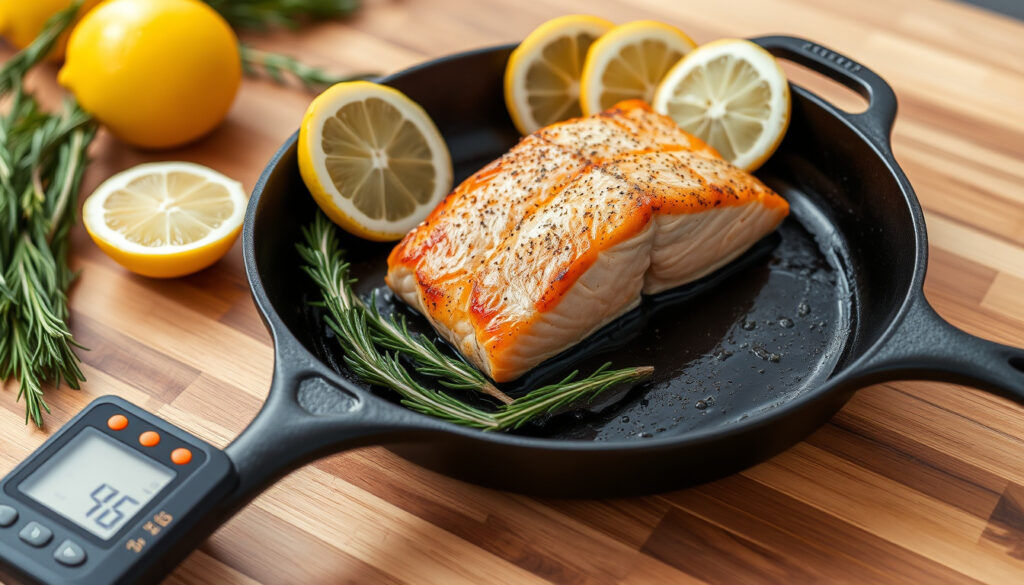
Few things are as satisfying as perfectly cooked salmon — flaky, moist, with that delicate balance of richness and lightness. Yet for many home cooks, nailing the right temperature and method can feel like guesswork.
Ideal internal temperature: 145°F (63°C) per USDA ·
10-minute rule: Cook salmon 10 minutes per inch of thickness ·
Omega-3 content: Approx. 2.2g per 4oz serving ·
Most popular cooking method: Oven baking
Quick snapshot
- Internal temperature of 145°F kills harmful bacteria (Simply Home Cooked citing USDA guidelines)
- Pan searing produces crispy skin when the skin is patted dry (RecipeTeacher)
- Albumin is safe to eat and common in cooked salmon (The Hungry Bites)
- Optimal cooking time varies significantly by thickness and cooking method (Feel Good Foodie)
- Whether foil cooking significantly alters texture compared to open baking is not settled (DVO)
- Exact air fryer times depend heavily on model wattage and fillet thickness (Simply Home Cooked)
- General cooking timeline: Preheat (5 min) → Cook (10–15 min based on thickness) → Rest (3–5 min) (The Hungry Bites)
- Use an instant-read thermometer at the thickest part to confirm 145°F (RecipeTeacher)
- Check internal temperature at 145°F, then rest 3–5 minutes before serving (Feel Good Foodie)
- Pat skin dry before any high-heat method to maximize crispiness (RecipeTeacher)
- Consider a thin coat of oil or butter to prevent sticking and add flavor (Simply Home Cooked)
Here is a quick-reference table of the core cooking facts every home cook should know.
| Fact | Value | Source |
|---|---|---|
| Ideal internal temperature | 145°F (63°C) | Simply Home Cooked (citing USDA) |
| Resting time after cooking | 3–5 minutes | The Hungry Bites |
| Omega-3 per serving | Approx. 2.2g per 4oz serving | Feel Good Foodie |
| Cooking time per inch of thickness | 10 minutes (general rule) | DVO |
The implication: precision on temperature and resting time matters more than which method you pick.
How to Cook Salmon Perfectly?
The most reliable path to perfectly cooked salmon starts with a thermometer and a clear understanding of how heat interacts with the fish. Below we address the two most common method questions head-on.
What is the best way to cook your salmon?
No single method works for every situation. Oven baking at 350°F (175°C) for 12–15 minutes is the most forgiving, according to The Hungry Bites, because the even heat reduces the risk of burning. Pan searing on high heat gives you a crispy skin in about 4–6 minutes per side, as noted by RecipeTeacher. Air fryers deliver speed — 7–10 minutes at 400°F — but require fillets of comparable thickness for even cooking (Feel Good Foodie).
Four methods, one pattern: each demands that you stop cooking the moment the thickest part hits 145°F. Overcooking is the enemy; carry-over heat will continue raising the internal temperature during the rest period.
Should I cook salmon in foil or not?
Cooking salmon in foil (often called “en papillote” or foil packets) steams the fish, yielding a tender, moist result. The Hungry Bites recommends wrapping with herbs and lemon and baking at 400°F for 15–20 minutes. However, the trade-off is that you lose the crispy skin and the Maillard browning you’d get from direct heat. DVO notes that foil cooking alters texture significantly — some prefer it, others find the salmon too soft. The choice hinges on whether you prioritize texture or convenience.
The pattern: foil locks in moisture at the cost of crust, while open methods trade a bit of moisture for browning and crunch.
Is it better to cook salmon in the oven or pan?
The oven-versus-pan debate hinges on two factors: texture goals and tolerance for attention. Oven baking is more forgiving; pan searing delivers a superior crust but requires constant watching.
How do you pan fry salmon fillet?
Start with a dry fillet — pat the skin with paper towels. RecipeTeacher emphasizes that moisture prevents crisping. Heat a heavy pan (cast iron works best) over medium-high heat with a thin layer of oil. Place the fillet skin-side down and cook for 4–6 minutes without moving it, until the skin is golden and releases easily. Flip and cook another 3–4 minutes. The internal temperature should read 145°F at the thickest part. Simply Home Cooked recommends brushing with a little butter before flipping for extra flavor.
What temperature should you bake salmon?
Most oven recipes call for 350°F to 450°F. Baking at 350°F yields a gentle, even cook with less risk of drying out, taking 12–15 minutes for a 6-ounce fillet (The Hungry Bites). Higher temperatures — like 450°F — cut cooking time to 12 minutes but require closer monitoring to avoid overcooking the exterior. DVO’s guide suggests baking at 450°F skin-side down until the fish flakes easily.
Pan searing gives a crispy crust but demands attention; oven baking is set-and-forget but won’t develop the same caramelization. Choose based on whether you want to stand at the stove or walk away.
For the home cook, the choice often comes down to personal preference and available time. Both methods can produce excellent results if the internal temperature target is respected.
The catch: whichever route you take, resting the fillet for 3–5 minutes after cooking lets carryover heat finish the job without drying out the exterior.
What is the white stuff on salmon when you cook it?
You’ve seen it — that white, cottage-cheese-like substance that oozes out of salmon fillets. It’s albumin, a protein that coagulates and becomes visible when the fish’s internal temperature hits around 140°F to 150°F.
Can you eat salmon with albumin?
Yes, albumin is completely safe to eat. It’s just protein. The Hungry Bites confirms that it’s harmless and common. However, its appearance can be off-putting, and some diners find the texture unpleasant. To minimize albumin, cook salmon at a lower temperature (350°F rather than 450°F) and avoid overcooking, as higher heat forces more albumin to the surface. Soaking the fillet in a brine (salt water) for 10 minutes before cooking can also help.
The implication: albumin is cosmetic, not a safety issue — but lower, gentler heat keeps it from showing up on your plate.
What is the biggest mistake when cooking salmon?
Overcooking is the single most common error, according to multiple recipe sources. It turns a moist, flaky fillet into dry, tough protein.
Cooking at too high heat dries out salmon
When the heat is too high, the exterior cooks much faster than the interior, leading to a dry, cracked crust and undercooked center by the time the middle reaches 145°F. DVO warns that this is the root of most dry salmon. The fix: moderate heat (350°F–400°F in the oven; medium-high on the stove) and a thermometer to stop cooking exactly at 145°F.
Not patting skin dry prevents crispiness
Moisture is the enemy of a crispy skin. If you pan-sear with a wet fillet, the skin will steam instead of searing. RecipeTeacher explicitly advises patting the skin dry before cooking. A dry surface also helps the skin brown evenly and release from the pan without sticking.
Even if you nail the temperature, using too much oil can make the salmon greasy. A thin, even coating is enough — about a tablespoon per fillet.
The pattern: two mistakes — heat too high and skin too wet — account for most failed salmon dishes. Both are easy fixes.
What is the 10 minute rule for fish?
The “10-minute rule” is a widely quoted guideline: cook fish 10 minutes per inch of thickness, measured at the thickest part. This applies across methods, though the exact time may vary depending on cooking temperature and equipment.
How long should you cook salmon in the oven?
At 350°F, a 1-inch-thick fillet takes about 12–15 minutes in a standard oven. At 450°F, that drops to around 10–12 minutes. The Hungry Bites suggests checking after 12 minutes at 400°F (fan oven).
How do you cook salmon in an air fryer?
Air fryers cook faster thanks to convection. Preheat the air fryer to 400°F (most models). Place the fillet skin-side down and cook for 7–10 minutes, depending on thickness. RecipeTeacher recommends preheating to 390°F for 5 minutes before adding salmon, then cooking 10 minutes skin-side down. Feel Good Foodie suggests 7–9 minutes at 400°F for fillets of even thickness. Always verify with a thermometer — internal temp should be 145°F. For crispy edges, brush with a little oil.
Looking to expand your air fryer repertoire? Check out our guide to Bacon in Air Fryer: Perfect Crispy Recipe and Timing and Pork Chops in Air Fryer: Juicy Recipe & Timing Guide for more tips on cooking proteins in the air fryer.
The pattern is consistent across all methods: thickness is the primary variable. Use the 10-minute rule as a starting point, then rely on your thermometer.
Comparison of cooking methods
Four common techniques, one goal: a perfectly cooked fillet at 145°F. Here’s how they stack up:
| Method | Ideal temperature | Cooking time (1-inch fillet) | Best for |
|---|---|---|---|
| Oven baked | 350°F–450°F | 12–15 min | Even, hands-off cooking |
| Pan seared | Medium-high heat | 4–6 min per side | Crispy skin, quick cook |
| Air fryer | 400°F | 7–10 min | Speed and crispiness |
| Foil packet | 400°F | 15–20 min | Moist, steamed texture |
The implication: if speed and texture are your priorities, air fryers win on time; pans win on crust; ovens win on consistency. Foil packets are best when you want minimal cleanup and a tender result.
Step-by-step: Perfect oven-baked salmon
Start with a 6-ounce fillet, skin on. Preheat oven to 350°F. Pat the skin dry with paper towels. Lightly oil a baking dish or line with parchment. Place fillet skin-side down. Season with salt, pepper, and any herbs (dill or thyme work well). Bake 12–15 minutes until the thickest part registers 145°F. Remove from oven and rest 3–5 minutes before serving — the internal temperature will rise a few degrees during rest (The Hungry Bites).
- Start with a 6-ounce fillet, skin on, and preheat oven to 350°F.
- Pat the skin dry with paper towels, then lightly oil a baking dish or line with parchment.
- Place fillet skin-side down and season with salt, pepper, and herbs (dill or thyme work well).
- Bake 12–15 minutes until the thickest part registers 145°F.
- Remove from oven and rest 3–5 minutes before serving — the internal temperature will rise a few degrees during rest.
The pattern: no matter which method you choose, the last 5 minutes off heat matter as much as the cooking time itself.
Upsides and downsides of cooking salmon
Upsides
- Salmon is rich in omega-3 fatty acids (approx. 2.2g per 4oz serving)
- Cooks quickly — most methods finish in under 20 minutes
- Versatile: works with endless seasoning and sauce combinations
- High heat searing creates a delicious crispy crust
Downsides
- Easy to overcook, resulting in dry, tough texture
- Albumin (white residue) can be visually unappealing
- Skin can stick if not dried or if pan isn’t hot enough
- Thickness variations require adjustment — not a one-size-fits-all time
The catch: salmon’s biggest advantages — speed and richness — also make it the easiest protein to ruin. Respect the inverse relationship between heat and moisture.
Clarity check: what we know and what remains uncertain
Confirmed facts
- Internal temperature of 145°F ensures safety
- Cooking time correlates with thickness (approximately 10 minutes per inch)
- Resting 3–5 minutes improves texture and carryover cooking
What’s unclear
- Optimal time varies by exact cooking temperature and appliance model
- Whether foil-wrapped cooking fundamentally alters texture versus open baking
- Best air fryer temperature and time across different brands (390°F vs 400°F vs 450°F)
- Effect of brining on albumin reduction is not rigorously tested
The pattern: the more variables you control (thermometer, consistent thickness, dry skin), the fewer uncertainties remain.
Expert perspectives
“Cook salmon to an internal temperature of 145°F in the thickest part.”
— USDA Food Safety and Inspection Service (via Simply Home Cooked)
“Preheat air fryer to 390°F for 5 minutes before cooking salmon for crispy edges.”
— RecipeTeacher
The first quote underscores the safety baseline; the second highlights how small tweaks — like a preheat step — can elevate the final texture.
The implication: trusted sources agree on the science (145°F), but the art lives in the prep details that each source emphasizes differently.
For those who want to explore every method in detail, a comprehensive salmon cooking guide covers oven, pan, and air fryer techniques with precise timings.
Frequently asked questions
How do I get crispy skin on salmon?
Pat the skin dry with paper towels, use a hot pan with a thin layer of oil, and cook skin-side down without moving for 4–6 minutes.
Can I cook frozen salmon without thawing?
Yes. Increase cooking time by about 50% (e.g., bake at 350°F for 18–22 minutes). Check internal temperature at 145°F.
How do I season salmon?
Salt and pepper are essential. Add garlic powder, paprika, dill, or lemon zest. For an Asian twist, try soy sauce, honey, and ginger.
What is the best oil for pan frying salmon?
Use oils with a high smoke point: avocado oil, vegetable oil, or canola oil. Olive oil works at medium heat but can burn at high temperatures.
Should I remove the skin before cooking?
For most methods, leave the skin on. It helps hold the fillet together, adds flavor, and provides a crispy texture. Remove after cooking if desired.
How do I know when salmon is done without a thermometer?
The flesh should flake easily with a fork and appear opaque throughout. However, a thermometer is far more reliable. When in doubt, go for the thermometer.
Related reading
If you enjoyed this salmon guide, you might find these helpful:
- Bacon in Air Fryer: Perfect Crispy Recipe and Timing
- Pork Chops in Air Fryer: Juicy Recipe & Timing Guide
For home cooks, the choice is clear: invest in an instant-read thermometer, respect the 145°F target, and practice the method that fits your schedule. Overcooked salmon will always be the bigger risk than any single technique — and it’s a risk that’s entirely avoidable.

Charlotte Hayes is Music & Nightlife Correspondent at UrbanMixr.uk, covering live music, nightlife, clubs, venues and festivals.