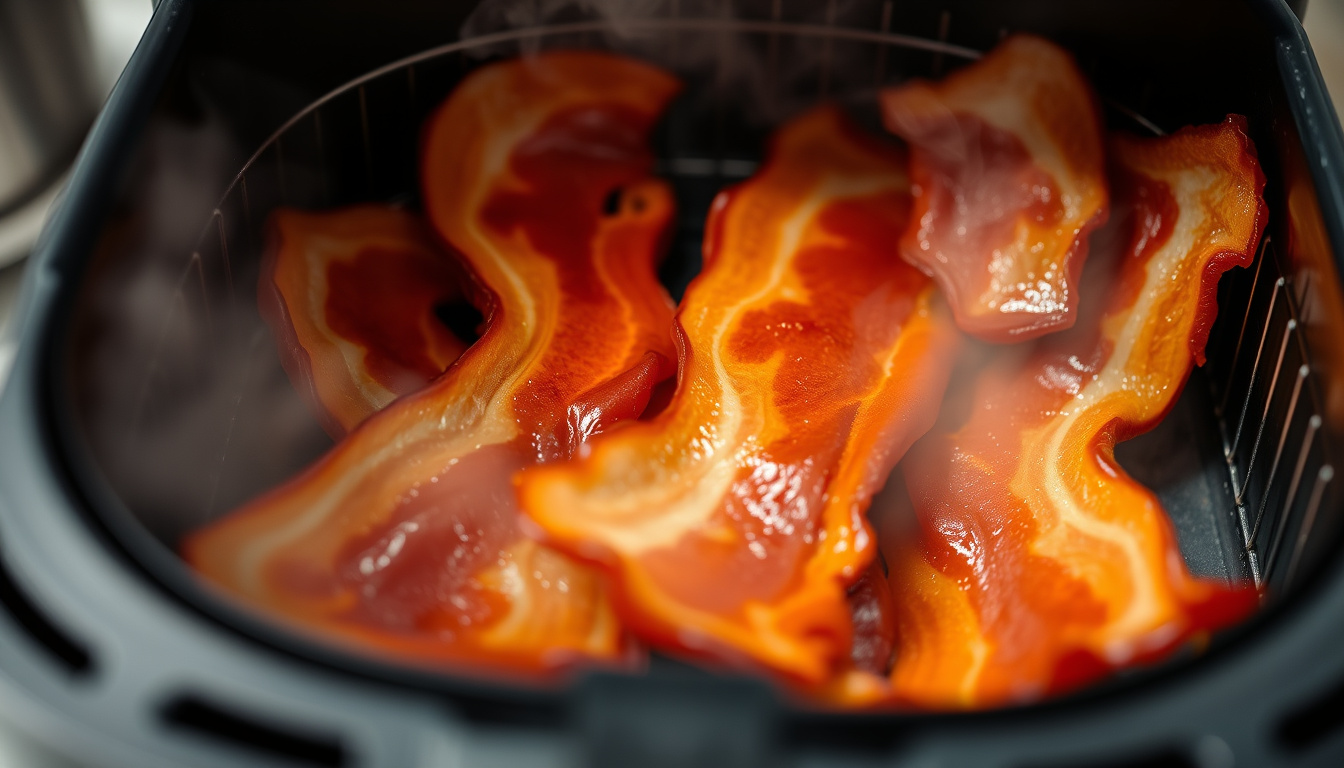
If you’ve ever scrubbed baked-on bacon grease from a pan, you already know why people keep asking about air fryer bacon. The promise is simple: crispy rashers without the splatter, without the oven preheating, without the 15-minute soak afterward. Whether that promise delivers depends entirely on a handful of variables most recipes gloss over — thickness, temperature, and whether your basket can actually breathe. This guide cuts through the conflicting advice and gives you tested timings for every cut.
Typical Cooking Time: 6-12 minutes · Common Temperature: 200°C / 400°F · Prep Time: 3 minutes preheat · Bacon Types: Regular or thick-cut · Result: Crispy, no mess
Quick snapshot
- Bacon thickness drives cooking time more than any other variable (Cooking with Coit)
- Single-layer placement ensures even airflow and consistent crisping (Natasha’s Kitchen)
- Bacon fat reaches smoke point at 400°F — staying at 350°F avoids excessive smoke (Natasha’s Kitchen)
- Whether a specific air fryer model consistently outperforms others for bacon
- How air-fried bacon specifically affects blood glucose compared to other cooking methods
- Recipe testing intensifies year-round, with heaviest traffic spikes around holiday breakfast periods
- Expect more appliances to ship with dedicated bacon presets as demand grows
The table below summarizes the key parameters for cooking bacon in an air fryer.
| Parameter | Value |
|---|---|
| Standard Temp | 200°C / 400°F |
| Streaky Bacon Time | 6-10 minutes |
| Thick-Cut Time | 10-12 minutes |
| Preheat | 3 minutes |
How long does it take for bacon to cook in the air fryer?
The honest answer is: it depends on the cut. Thickness varies more than most people realize, and that single variable can swing your cook time by nearly double.
Regular cut timing
For standard supermarket bacon — the kind most people have in their fridge right now — air frying at 350°F produces crispy results in 7-9 minutes according to tested recipes from Natasha’s Kitchen. This sits comfortably below the smoke point of bacon fat, which begins around 400°F. The result is rashers that are genuinely crisp without the charred edges that come from cranking the heat higher.
Thick-cut bacon duration
Thick-cut bacon needs more patience. Expect 10-12 minutes at 350°F for that layered, chewy center with a shatter-crisp edge — again per Natasha’s Kitchen. The extra time isn’t just about thickness, though. Thicker cuts render their fat more slowly, and that slow render is what gives you that contrast between edge and center that texture-forward cooks actually want.
Temperature variations
Some cooks push the temperature higher for speed. Mom’s Dish documents a method using 390°F for 4 minutes, then flipping the bacon, then another 4 minutes — roughly 8 minutes total. The trade-off is that at temperatures closer to that 400°F smoke threshold, you’re walking a tighter line. The payoff is faster results for people who forgot they promised bacon for breakfast and are now racing the clock.
What is the best way to cook bacon in the air fryer?
The method is straightforward, but “straightforward” hides a few steps most people skip because they assume they’re optional. They aren’t.
Preheat steps
One area where air fryer bacon differs from many air fryer recipes: preheating is not always necessary. Natasha’s Kitchen specifically recommends placing bacon directly into the basket without preheating. The reasoning is practical — bacon renders its own fat fast enough that the initial temperature climb happens naturally. Skipping preheat also sidesteps a common complaint: that preheating an empty basket before adding bacon just preheats your kitchen.
Single layer placement
This is the step most responsible for disappointing results. Bacon must sit in a single layer with no overlapping pieces. Overlapping doesn’t just prevent crisping in the overlapped zones — it creates a greasy, steamed texture instead of a fried one. Natasha’s Kitchen emphasizes this explicitly, and it aligns with how convection cooking works: the hot air needs contact with every surface to drive moisture out and render fat properly.
No oil needed
Unlike chicken wings or roasted vegetables, bacon doesn’t need added oil. The fat content is the cooking medium. For very lean bacon where you worry about sticking, a light spray of cooking oil on the basket is enough — but standard bacon with visible marbling will handle itself.
What are common mistakes when air frying bacon?
Every cooking method has its failure modes. Air fryer bacon’s are specific enough that knowing them upfront can save you a ruined Saturday morning and a smoking kitchen.
Overcrowding the basket
This shows up in every list of mistakes because it’s the most common. Mom’s Dish notes that overcrowding is the primary reason bacon fails to crisp in an air fryer. When pieces touch, the hot air can’t circulate between them. You get steamed bacon — grey, limp, and disappointing. If your air fryer is small, cook in batches. Yes, it takes longer. But half a batch of properly crispy bacon beats a full batch of sad, floppy strips.
Wrong temperature
Setting the temperature too high is the other frequent error. The instinct to blast bacon at maximum heat backfires because bacon fat begins to smoke around 400°F. Working at 350°F — or even 325°F for very fatty cuts — gives you control. You can always add a minute if you want more crisp. You can’t undo burned bacon.
Skipping preheat (when needed)
Contradicting the earlier point slightly: some older or smaller air fryer models benefit from a brief 2-3 minute preheat to ensure consistent temperature from the first minute of cooking. Natasha’s Kitchen suggests placing bacon directly in for most models, but notes that results can vary by appliance. The practical move: if your first batch doesn’t come out as expected and your model has a preheat option, try it next time.
Overcrowding doesn’t just ruin texture — it can cause grease pooling at the bottom of newer models, which triggers automatic overheating shutoffs in some machines. Cook in a single layer, always.
Why you should never cook bacon in your air fryer?
The question is deliberately provocative, but the concerns behind it are real enough to address directly.
Grease and smoke issues
The internet is full of stories about air fryer bacon producing smoke that sets off smoke detectors and leaves a residue that’s harder to clean than a stovetop pan. Bacon fat at high temperature does exactly what you’d expect: it smokes. Even at 350°F, very fatty cuts will produce visible vapor. Reddit users have described air fryer bacon sessions as “greasy smoky disasters” depending on their specific appliance and the fat content of their bacon. For open-plan kitchens or poorly ventilated apartments, this isn’t hypothetical.
Cleanup challenges
Air fryer baskets — especially the non-stick coated ones — require careful cleaning after bacon. The rendered fat collects in the drip tray and can carbonize if left to cool. Many manufacturers specifically note that dishwasher cleaning can damage the coating, meaning hand-washing with hot water and a non-abrasive sponge is required. For people who bought an air fryer partly because it promised easy cleanup, bacon is the exception that tests that promise.
Model-specific risks
Some smaller air fryer models — particularly those under 2 quarts capacity — simply aren’t designed for bacon. The basket is too close to the heating element, and grease splatter from bacon can reach the heating chamber directly, creating both smoke and a fire risk. Always check your manufacturer’s guidance. If your manual says to avoid cooking high-fat foods without a liner, believe it.
Is bacon better cooked in the oven or air fryer?
Oven versus air fryer is the question most people have after their first few air fryer bacon experiments. The honest answer depends on what you value most.
The comparison table below highlights how these two methods stack up across the factors that matter most for bacon.
| Factor | Air Fryer | Oven |
|---|---|---|
| Temperature control | Precise, fast response | Consistent across batch |
| Cleanup effort | Greasy basket + drip tray | Line with foil, discard |
| Batch capacity | Limited by basket size | Sheet pan holds more |
| Texture results | Very crispy edges | More even, less intense crisping |
| Speed | Faster overall (no preheat usually) | 10-15 min preheat required |
| Grease splatter | Contained in unit | Contained on lined sheet |
| Skill required | Watch for timing | Set and forget |
Three variables stand out when comparing the two: capacity, convenience, and cleanup. If you’re cooking for two, the air fryer wins on speed and cleanup. If you’re feeding a family or meal-prepping for the week, the oven’s batch capacity means fewer cycles and less watching. Some testers who have run side-by-side comparisons on YouTube cooking channels have found the oven produces more uniformly cooked bacon across a batch, while the air fryer produces more dramatically crispy edges on individual pieces.
For a quick weekday breakfast for one or two, the air fryer is faster and produces superior crisp on individual pieces. For weekend meal prep or family cooking, the oven’s capacity advantage is hard to ignore — line it with foil, cook a full package, and walk away.
Upsides
- Crispy results with no grease splatter on kitchen surfaces
- Faster than oven for small batches — no preheat needed
- Contained grease mess inside the appliance
- Precise temperature control prevents burning
- Single-layer cooking produces consistent texture
Downsides
- Small basket limits batch size significantly
- Grease smoke can trigger smoke detectors in apartments
- Cleanup requires hand-washing basket and drip tray
- Some budget models have fire risk with high-fat foods
- Overlapping pieces produce steamed, not crispy, results
For home cooks prioritizing texture over convenience, the air fryer’s superior crisp edges make it worth the extra attention. For those prioritizing cleanup speed and batch cooking, the oven remains the practical workhorse.
The “never cook bacon in your air fryer” framing is hyperbolic, but the underlying concerns are valid. Smoke and cleanup are real trade-offs that oven cooking sidesteps entirely. Weigh your kitchen setup and tolerance for cleanup before committing to air fryer bacon as a routine method.
Related reading: Pork Chops in Air Fryer: Juicy Recipe & Timing Guide · Gammon in Air Fryer: Cooking Times, Tips & Recipes
Frequently asked questions
How long to cook bacon in air fryer at 400°F?
At 400°F, regular cut bacon cooks in approximately 6-8 minutes, and thick-cut bacon in 8-10 minutes. However, this is closer to the smoke point of bacon fat, so monitor for smoke and consider reducing to 350°F if you notice excessive flickering or odor. Natasha’s Kitchen recommends the lower temperature for better control.
Is air frying ok for diabetics?
Air frying itself doesn’t add fat or carbohydrates to bacon — it uses hot air to cook rather than oil. For diabetics, the more relevant factor is the bacon’s sodium and sugar content, which varies by brand and type (uncured, smoked, maple-flavored). Always check nutrition labels. Consult a healthcare provider for personalized dietary guidance.
Is air frying truly a healthier choice?
Air frying reduces the need for added cooking oil, which can reduce total fat content compared to pan-frying. However, the difference is modest for bacon specifically, since bacon renders its own fat regardless of cooking method. Any health advantage is in avoiding excess oil, not in fundamentally altering bacon’s nutritional profile.
Can I cook bacon in an air fryer in the UK?
Yes. UK air fryers operate at the same 200°C standard as most recipes specify. “Streaky bacon” is the UK term for standard American bacon (long, thin strips with visible fat), while “back bacon” refers to leaner cuts similar to Canadian bacon. Streaky bacon cooks in 6-10 minutes at 200°C; back bacon may require slightly less time due to lower fat content.
Why is everyone getting rid of air fryers?
Complaints center on limited capacity, smoke production with fatty foods, and cleanup difficulty. Some users also find that promised time savings don’t materialize for large batches, since air fryers require cooking in single layers. For bacon specifically, the smoke and cleanup issues are more pronounced than for vegetables or proteins with lower fat content.
What food is the number one enemy of diabetes?
This question is more medical than culinary. From a dietary perspective, foods with high glycemic index and high added sugar are generally of concern for blood glucose management. For specific guidance, consulting a registered dietitian or endocrinologist is the appropriate step.
How do I cook bacon in a Ninja air fryer?
Ninja air fryers generally follow the same timing guidelines: 7-9 minutes at 180°C (355°F) for regular cut, 10-12 minutes at the same temperature for thick-cut. Ninja models with a “bacon” preset mode exist on some units — if yours has one, the machine handles the timing. Otherwise, start checking at 6 minutes and adjust from there based on your preferred crispness level.
The air fryer works for bacon — but only if you respect its constraints. Single layers, moderate temperatures, and awareness of your appliance’s smoke thresholds are non-negotiable. For weekend cooks who want hands-off convenience, the oven remains the safer default. For weekday speedsters who don’t mind a bit of attention, the air fryer delivers crispness that most pans can’t match. The method you choose should depend on your kitchen setup and what you actually need from breakfast.
For those with smaller kitchens or shared living spaces, the smoke risk from air fryer bacon is the deciding factor. A single batch that sets off a smoke alarm at 7 a.m. costs more in disruption than any time saved. For those with dedicated kitchens and decent ventilation, the air fryer’s quick turnaround and contained mess make it worth keeping in rotation.
Home cooks who master the air fryer’s constraints will find it delivers weekday bacon that rivals any pan-fried result, as long as they’re willing to manage the smoke and cleanup trade-offs.

Charlotte Hayes is Music & Nightlife Correspondent at UrbanMixr.uk, covering live music, nightlife, clubs, venues and festivals.