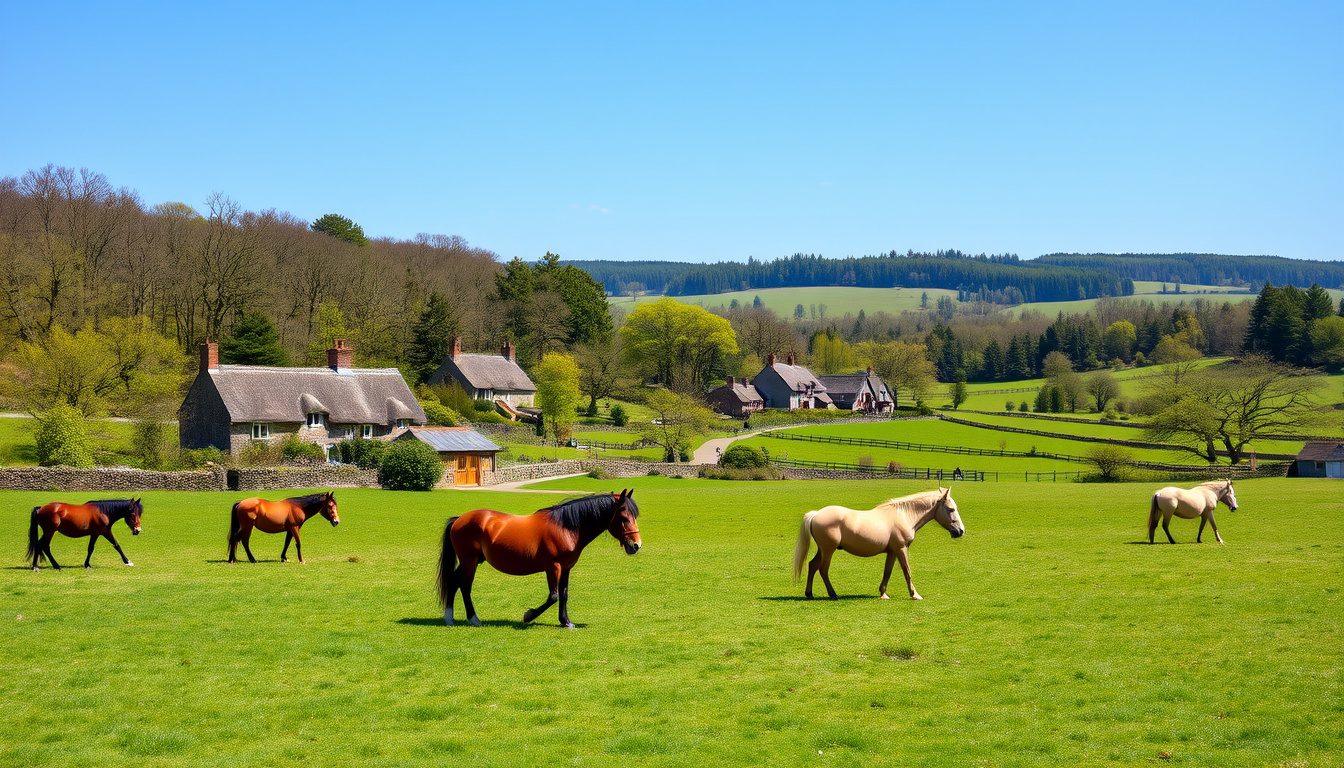

On paper, the New Forest looks like any British national park: 140,000 acres of protected landscape, scenic trails, quaint villages. In practice, this one runs differently—ponies wander through campsite grounds at dawn, cattle hold up traffic on single-lane roads, and the entrance is a suggestion rather than a gate. Most people come for the ponies: around 5,000 of them roam freely across the heathland, woodland, and pasture of southwest Hampshire. Knowing where to find them, how to behave around them, and where to stay makes the difference between a good visit and a great one.
Location: Southwest Hampshire, England · Iconic Feature: Free-roaming ponies · Landscape: Pasture, heathland, forest · Entry: Free
Quick snapshot
- 5,000 free-roaming ponies owned by local commoners (Visit the New Forest)
- No entry fee — drive or walk in freely (New Forest NPA)
- 10 Forestry England campsites; wild camping prohibited (Forestry England)
- Exact 2026 pony population disputed — reports cite 3,000+ to 5,000 (Campsites.co.uk)
- 2026 camping fee structure not publicly confirmed at time of writing
- Specific opening dates for bell tents vary by campsite
- Commoning rights established by William the Conqueror, 11th century (Visit the New Forest)
- Beaulieu Estate owned by Montagu family since 1538 (Hipcamp)
- Official New Forest Pocket Guide published in 2018 (New Forest NPA)
- Book campsites early — Forestry England sites fill quickly in summer
- Bell tents typically available from May onwards (Forestry England)
- Visitor Centre at Lyndhurst remains main planning hub for walks and ranger events (New Forest NPA)
Four key dimensions define any visit: the ponies, the villages, the rules, and the practical costs.
The key facts table below summarizes what visitors need to know before arrival.
| Fact | Detail |
|---|---|
| Location | Southwest Hampshire, Southern England |
| Total area | 140,000 acres |
| Iconic animals | Approximately 5,000 free-roaming ponies |
| Commoning origin | Rights established by William the Conqueror, 11th century |
| Official campsite manager | Forestry England (10 campsites) |
| Entry cost | Free — no tickets required |
| Largest village | Lyndhurst (New Forest Visitor Centre) |
| Historical estate | Beaulieu — Montagu family since 1538 |
What is New Forest National Park famous for?
The New Forest earns its reputation from two sources that visitors encounter within minutes of arriving: the ponies and the unhurried landscape they help maintain. No visit is complete without spotting its most iconic residents.
History and origins
The forest’s story goes back to 1066, when William the Conqueror designated the land as a royal hunting ground. He established commoning rights that allowed local people to graze their animals—including the ancestors of today’s ponies—on common land. According to Visit the New Forest, these grazing rights have been continuously exercised for over 900 years.
The commoning tradition shapes the forest’s character today. Commoners own and manage the ponies; government officials called agisters oversee their welfare. This system keeps the ponies roaming freely while ensuring they receive basic care. The Beaulieu Estate, home to the Montagu family since 1538, represents another long-standing connection to the landscape, according to Hipcamp.
Wildlife highlights
With roughly 5,000 ponies and smaller herds of donkeys and cattle roaming the forest, wildlife encounters are virtually guaranteed. The commoning system supports more than livestock: according to Visit the New Forest, the grazing pattern maintains rare wildflowers and species such as the Dartford warbler.
Ponies are commonly seen in Beaulieu (Culverley Green, Hatchets Pond), Brockenhurst (areas away from main roads), Burley (village circular walk), and Christchurch (Abbots Well Road area), according to Lovat Parks. They wander through villages, grasslands, woodlands, and lanes—sometimes directly through campsite grounds.
Unique landscapes
The New Forest blends three terrain types across its 140,000 acres: pasture land where cattle and ponies graze, open heathland with gorse and heather, and patches of ancient woodland. Unlike national parks with clear boundaries, the New Forest has no formal gates. New Forest National Park Authority manages the park under a framework that balances public access with ecological protection.
The implication: this open-access design rewards spontaneous exploration but places the burden of self-regulation on visitors.
How do I enter New Forest National Park?
The New Forest lacks the entrance gates and ticket booths common at other protected areas. Access is open and free, which is part of its appeal—but it helps to know the practical routes.
Access points
There are no formal entry points. The park covers southwest Hampshire and portions of southern Wiltshire, but the core area concentrates around a handful of main routes. New Forest NPA recommends approaching from the M27 motorway (junction 1 or 2), then following A337 towards Lyndhurst—the largest village and home to the New Forest Visitor Centre.
Secondary access roads lead into Brockenhurst, Beaulieu, and Burley from multiple directions. Parking areas exist throughout, but spaces fill quickly during summer weekends and school holidays.
Location map
The park sits roughly 100 miles southwest of London. By car, the journey takes about two hours from central London via the M3 and M27. From Southampton, the park is a 30-minute drive north. The nearest major train station is Brockenhurst, which sits on the main line from London Waterloo to Weymouth.
Public transport options
Public transit coverage is limited but improving. The Wilts & Dorset bus route 3 connects Southampton to Lyndhurst and Brockenhurst. The Brockenhurst train station offers the most practical rail access, with direct services from London Waterloo taking under two hours. Once in the park, bus services thin considerably—most visitors rely on cars, bicycles, or walking to explore beyond the main villages.
The New Forest’s open roads double as grazing areas. Drivers should expect ponies and cattle on lanes at any time, particularly near Beaulieu, Brockenhurst, and Burley. Horse riders have right of way on roads; motor vehicles must give way.
What is the prettiest town in the New Forest?
Beauty is subjective, but visitor data and guide recommendations consistently highlight the same villages. The “prettiest” depends on what you’re looking for—ponies in the street, historic estates, or easy access to beaches.
Top villages for stays
Lyndhurst is the largest village and practical hub: the New Forest Visitor Centre here offers maps, ranger-led walks, and trip planning. Accommodation ranges from pubs to guesthouses, and the village sits central enough for day trips to most attractions.
Beaulieu combines pony spotting with cultural interest. The village sits near Culverley Green and Hatchets Pond—both reliable spots for encounters. The National Motor Museum at Beaulieu Palace House adds a reason to linger, according to Lovat Parks.
Burley ranks among the most picturesque, famous for ponies wandering through the village itself. The Burley village circular walk offers good viewing without needing to drive to remote areas, according to Lovat Parks.
Visitor favorites
Based on visitor reviews and campground guides, Brockenhurst scores high for practicality—it has the main train station, multiple accommodation options, and pony sightings in and around the village center. According to Hipcamp, Brockenhurst and Burley frequently appear in positive visitor feedback for pony encounters.
Best for beach access
Milford-on-Sea, on the park’s southern edge, offers coastal scenery and beach access—distinct from the forest interior but within the broader New Forest area. According to Hipcamp, this village attracts visitors who want both forest and seaside in one trip.
Lyndhurst wins on practicality; Burley wins on charm and pony encounters; Brockenhurst wins on transport access. Visitors prioritizing pony sightings should stay in or near Burley or Brockenhurst. Those focused on walks and ranger events should base themselves in Lyndhurst.
Why can’t you touch New Forest ponies?
This rule causes more confusion than any other for first-time visitors. The short answer: these ponies are not wild animals, not pets, and touching them creates problems for everyone.
Pony behavior rules
According to Visit the New Forest, the core rule is simple: admire the ponies from a distance. They are managed livestock, not wildlife, and they are not accustomed to human contact in the way that petting zoo animals are.
Visitors who approach too closely risk being kicked or bitten. More significantly, feeding ponies causes digestive problems and teaches them to associate humans with food—leading to aggressive begging behavior in villages and campsites. Forestry England explicitly warns against feeding any free-roaming animals.
Wildlife safety
The ponies are monitored by agisters—officials who check their welfare and move them when necessary. According to Lovat Parks, this management system means ponies can sometimes appear in unexpected places: village streets, car parks, campsite loops.
Safety guidelines recommend keeping vehicle speed low on forest roads, giving ponies right of way, and never parking in a way that blocks their path. Motorists must slow down and yield when encountering horse riders, who have rights on forest roads. At campsites, ponies, donkeys, and cattle often wander through sites, and campers should enjoy the spectacle without intervention.
Forestry guidelines
Forestry England, which manages much of the camping estate, reinforces the “look don’t touch” approach across all its materials. The rule applies equally at campsites: ponies, donkeys, and cattle often wander through sites, and campers should enjoy the spectacle without intervention.
Ponies that appear calm near humans are not tame—they are simply accustomed to traffic and foot traffic. Their size and herd behavior can surprise visitors who expect docility. Keep at least 10 meters distance, never hand-feed, and move slowly if a pony approaches you.
Is the New Forest free to visit?
One of the New Forest’s strongest appeals is its lack of entry barriers. Unlike many protected landscapes with permit systems or entrance fees, the New Forest operates on open access principles.
Entry fees and costs
According to New Forest NPA, there is no entry fee and no requirement to purchase tickets or permits to access the park. You can drive in, walk in, or cycle in freely. The cost structure applies only to specific services: campsite fees, parking in some areas, and activities like the National Motor Museum at Beaulieu.
Budget activities
Free activities dominate the visitor experience: walking any of the marked trails, spotting ponies in villages, cycling forest roads, and visiting the New Forest Visitor Centre in Lyndhurst. The park’s landscapes require no fee to enjoy. Visit the New Forest highlights that most of what draws visitors—the ponies, the heaths, the ancient woodlands—is visible without spending a penny.
Driving and parking
Vehicle access is unrestricted on public roads. Parking fees apply in some Forestry England car parks, particularly near popular walks and picnic areas. Daily rates are modest (typically £2-5), and annual parking passes are available for regular visitors. According to Forestry England, campsite parking is included with accommodation fees.
Free entry does not mean free infrastructure. The forest relies partly on campsite fees, parking charges, and activity revenue to fund path maintenance and visitor services. Budget-conscious visitors should plan for parking costs and resist the temptation to park on grass or verges—off-road parking damages sensitive heathland.
What this means: the park’s funding model depends on visitor-paid services, so those expecting pristine facilities everywhere may need to adjust expectations.
How to plan your New Forest stay
Whether you camp, stay in a village, or day-trip from nearby towns, planning ahead prevents common frustrations.
Step 1: Decide when to go
The New Forest draws peak crowds during UK school holidays—particularly the summer weeks and the October half-term when the forest shows autumn color. Summer brings longer days and bell tent availability (typically from May onwards, according to Forestry England). Off-season visits (March-April, September-October) offer quieter trails and fewer crowds, though some campsites operate on reduced schedules.
Step 2: Book accommodation early
Forestry England manages 10 campsites in the New Forest, and they fill fast during school holiday periods. According to Forestry England, wild camping is not permitted anywhere in the forest—independent campsites like Tom’s Field offer alternatives, but they also book out quickly. Big World Small Pockets describes Tom’s Field as a family-run site with hot showers, toilets, and bell tents near pony grazing areas.
Village accommodation in Lyndhurst, Burley, and Brockenhurst ranges from pubs to holiday cottages. The New Forest Visitor Centre in Lyndhurst is the best resource for real-time availability and last-minute options.
Step 3: Plan your pony-spotting route
Based on visitor guides and camping reviews, the most reliable villages for pony encounters are Burley and Brockenhurst—where ponies frequently appear in village streets and near car parks. Lovat Parks specifically recommends the Burley village circular walk for guaranteed sightings without venturing into remote areas.
Pack binoculars, bring water, and set realistic expectations: ponies are present year-round, but their exact locations vary daily based on grazing patterns and weather.
Step 4: Know the rules before you arrive
Download the New Forest code of conduct from New Forest NPA before your trip. The core reminders: keep vehicle speed low, give ponies right of way, never feed any free-roaming animal, and report injured ponies to Forestry England or the local agister.
No visit to the New Forest is complete without spotting its most iconic residents — the free-roaming New Forest ponies.
— Visit the New Forest (Official Tourism Site)
While they may look tame, New Forest ponies are not pets — they are free-roaming animals, and must be admired from a distance.
— Visit the New Forest (Official Tourism Site)
The New Forest is one of our favourite places for a camping holiday. It’s a natural playground that’s easy to get to, full of wildlife.
— Hipcamp (Camping Guide)
Upsides
- Free entry — no tickets, no permits
- Guaranteed pony encounters in multiple villages
- Multiple campsite options across budget levels
- Accessible from London by train (2 hours to Brockenhurst)
- Diverse terrain: forest, heath, beach within one park
Downsides
- Summer crowds push accommodation prices and campsite availability
- Wild camping prohibited — limited to official sites
- Pony population figures disputed; exact counts unclear
- Some campsites close off-season; not year-round options everywhere
- Limited public transport inside the park
Related reading: Jet2 holidays for New Forest trips
nps.gov, campsites.co.uk, bigworldsmallpockets.com, tripadvisor.com, newforestnpa.gov.uk, tripadvisor.com, hipcamp.com
Frequently asked questions
Why is it called the New Forest?
William the Conqueror designated the land as a royal hunting ground in the 11th century, clearing existing settlements to create new forestland for hunting deer. “New” refers to its status as a newly created royal forest, not its age.
Where is New Forest National Park on a map?
The park sits in southwest Hampshire, roughly 100 miles southwest of London. The main access routes approach from the M27 motorway (junction 1 or 2), with Lyndhurst serving as the central village. Brockenhurst provides the most practical train access via London Waterloo.
Are there tickets needed for New Forest National Park?
No. Entry is free. There are no gates, no ticket booths, and no permit requirements. Costs apply only to specific services such as Forestry England campsite fees, some parking areas, and paid attractions like the National Motor Museum at Beaulieu.
What hotels are in New Forest National Park?
Hotel options concentrate in the main villages: Lyndhurst offers the most variety including guesthouses and pubs; Brockenhurst and Burley provide smaller, more intimate options. The park lacks large resort hotels—most accommodation consists of village guesthouses, holiday cottages, and campsites.
Can you camp in New Forest National Park?
Yes, but only at designated campsites. Forestry England operates 10 campsites throughout the forest, and independent sites like Tom’s Field offer alternatives. Wild camping is prohibited. Bell tents are typically available from May onwards.
Are New Forest National Park horses wild?
No. The ponies are owned by local commoners who hold historic grazing rights dating back to the 11th century. They are managed livestock with official overseers called agisters. They roam freely but are not wild in the conventional sense—they are accustomed to human presence and vehicle traffic.
Where are the best places to spot ponies?
Burley and Brockenhurst offer the most reliable sightings — ponies frequently appear in village streets, near car parks, and on common grazing land. Beaulieu (Culverley Green and Hatchets Pond) and Christchurch (Abbots Well Road area) also rank high. The Burley village circular walk is specifically recommended for guaranteed encounters without remote hiking.

Sophie Larkin is Culture & Events Editor at UrbanMixr.uk, covering UK culture, events, festivals, arts and pop culture.