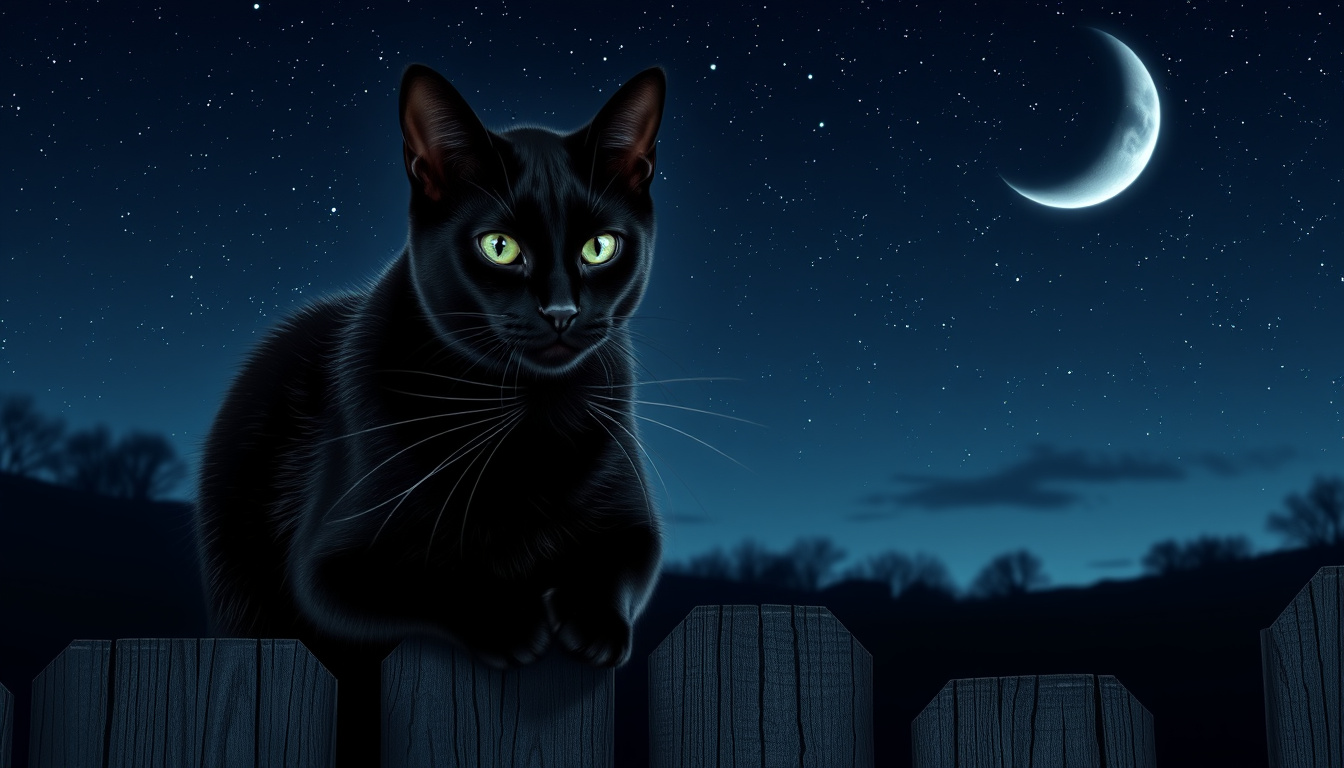
Few animals carry a reputation as split as the black cat. Depending on where in the world you grew up, a black cat crossing your path either makes you flinch or makes you smile. This article looks at the real story behind those contrasting beliefs, from the genetics that turn a coat black to the folklore that turned the cat into a symbol of both luck and fear. By the end, you’ll have a clearer picture of why the black cat remains one of the most misunderstood creatures in our homes.
Recognized black cat breeds: 20 ·
Wild cat species with melanism: 14 ·
Weekly visitors to r/blackcats: 10,000
Quick snapshot
- Bad luck in Western folklore (Wikipedia)
- Good luck in Japan and Ireland (Mount St. Joseph University)
- Modern reinterpretations (Chewy)
- 20 recognized breeds with black coats (Chewy (pet care resource))
- Bombay bred to mimic panthers (Petful (cat breed resource))
- Genetic melanism in domestic and wild cats (Wikipedia (melanism))
- Lower adoption rates due to superstition (Mount St. Joseph University)
- Many shelters waive fees for black cats (Chewy (pet care resource))
- Black cats are affectionate and loyal (Chewy (pet care resource))
- 14 species exhibit melanism (Petful (cat breed resource))
- Jaguars and leopards are most famous (Wikipedia (black panther))
- Melanism provides camouflage in dense forests (Wikipedia (melanism))
Four numbers worth knowing about black cats, one story: they are both a biological marvel and a cultural lightning rod.
| Fact | Value |
|---|---|
| Black cat fur color cause | Dominant melanism gene (Wikipedia (melanism)) |
| Common eye color | Golden or copper (Wikipedia (black cat)) |
| Oldest known black cat breed | Bombay (developed 1950s) (Petful (cat breed resource)) |
| Wild cat species with melanism | 14 (Wikipedia (melanism)) |
What do black cats symbolize?
Symbols of bad luck in Western folklore
- Black cats were associated with witchcraft in medieval Europe (Wikipedia (encyclopedia))
- Ownership of a black cat could be cited in charges of witchcraft during the Salem Witch Trials (Hyperallergic (arts and culture publication))
- In some traditions, a black cat crossing the road is considered an omen of misfortune (Wikipedia (encyclopedia))
The thread that runs through this is a fear of the dark and the unknown. When humans struggle to explain a phenomenon — a cat’s sudden appearance, its silent movement — the mind fills the gap with good or bad intention. The black cat got the bad end of that deal in much of Europe.
Symbols of good luck in other cultures
- In Japan, black cats are considered good luck
- In Scotland, a black cat on the doorstep signifies prosperity (Wikipedia (encyclopedia))
- In the United Kingdom, a black cat entering a house or ship is considered a good omen (Wikipedia (cultural history))
The pattern is striking. The same animal that triggers a flinch in one culture triggers a welcome in another. It tells us less about cats and more about the stories we inherit.
Black cats in modern media
Today, black cats are a staple of Halloween imagery — often shown alongside witches and broomsticks (Chewy (pet care resource)). This may be the most persistent form of their dark reputation, because it keeps the old symbolism alive in a new, commercial context. The catch: for every Halloween decoration that spooks, there is a real black cat in a shelter hoping a family sees past the costume.
The same black cat that terrified medieval Europeans is the same animal that Japanese shopkeepers welcome as a good luck charm. The coat color hasn’t changed — the culture around it has.
Are black cats good luck in Ireland?
Irish folklore and black cats
- In Irish folklore, a black cat crossing your path is considered good luck (Cats Hobby (cultural blog))
- Some Irish fishermen believed black cats brought good weather (Wikipedia (encyclopedia))
- In the United Kingdom and Ireland, black cats can be a symbol of prosperity (Cats Hobby (cultural blog))
What this means for anyone visiting Ireland: the black cat you meet on a country lane is not a warning. It’s a blessing from the old world. For Irish readers who grew up with the “black cat = good” tradition, the global superstition can feel upside-down.
Comparison with other Celtic traditions
- Black cats have positive associations in the Celtic nations and England (Wikipedia (encyclopedia))
- In Western Europe, black cats are generally held to be unlucky, while in the United Kingdom they can be considered good luck (Wikipedia (cultural history))
- A sailor’s wife should have a black cat for her husband’s safety on the sea (Wikipedia (cultural history))
The trade-off between Celtic and mainland European views is not about the cat — it is about maritime culture versus agricultural fear. On islands, where ships and fishing dominate, a black cat on board means safe passage. On the continent, where the cat roamed villages at night, it meant the devil’s companion.
Why do black cats have a dark reputation?
Medieval witch hunts and black cats
- Black cats were believed to be witches’ familiars (Wikipedia (encyclopedia))
- During the Middle Ages, Christians killed black cats because of perceived proximity to the underworld (Hyperallergic (arts and culture publication))
- Black cats were linked to witchcraft, shape-shifting, and the underworld in European superstition narratives (Chewy (pet care resource))
The implication: a black cat’s life in medieval Europe was precarious. If a neighbor fell ill, a black cat in the yard was evidence. This link between a cat’s color and a person’s fate lasted centuries.
The role of the Catholic Church
- Pope Gregory IX’s 13th-century decree linked black cats to Satan (Chewy (pet care resource))
- Ownership of a black cat could be cited in charges of witchcraft during the Salem Witch Trials (Hyperallergic (arts and culture publication))
Why this matters: the Church’s institutional weight turned a local folk fear into a continent-wide suspicion. A cat was no longer a cat — it was a theological symbol. That kind of branding is hard to reverse, even 800 years later.
Persistence of superstitions today
- Black cats are often the last to be adopted from shelters (Mount St. Joseph University (academic research))
- Modern media often portrays black cats as omens (Chewy (pet care resource))
- Black cats became a popular Halloween symbol (Chewy (pet care resource))
The pattern is clear: what began as a medieval fear now operates in shelters and cartoon strips. The superstition doesn’t need believers to persist — it only needs a culture that repeats the image.
The same superstition that once killed black cats now reduces their chances of adoption. Mount St. Joseph University reports that black cats are often overlooked in shelters because of lingering associations with bad luck.
What is special about black cats?
Genetic basis of black fur
- The black coat is caused by a dominant gene (melanism) (Wikipedia (melanism))
- High eumelanin levels produce the black color (Wikipedia (melanism))
- Melanism is also found in at least 14 wild cat species (Wikipedia (melanism))
A dominant allele tells the body to produce extra melanin, darkening the fur. This mutation appears in domestic cats and in wild relatives like jaguars and leopards, where it offers camouflage in dense forests (Wikipedia (melanism)).
Black cats in shelters and adoption challenges
- Black cats are often the last to be adopted from shelters (Mount St. Joseph University (academic research))
- Many shelters waive fees for black cats to encourage adoption (Chewy (pet care resource))
The catch: a beautiful black coat and a friendly personality often go unnoticed because of a story that started 800 years ago. For shelter workers, the challenge is not the cat — it is the cultural baggage the adopter carries through the door.
Unique personality traits
- Black cats are described as affectionate and loyal by many owners
- Whether black cats have distinct temperaments compared to other colors is not proven (Petful (cat breed resource))
The trade-off: science hasn’t settled whether coat color predicts personality. What is clear is that a cat’s upbringing and care matter far more than its shade.
What are the most common black cat breeds?
Bombay
- The Bombay breed was developed to resemble a miniature panther (Petful (cat breed resource))
A breed created in the 1950s by crossing a sable Burmese with a black American Shorthair, the Bombay has a sleek, glossy black coat and copper eyes. It’s one of the few breeds bred specifically for black color.
American Shorthair
- American Shorthairs come in solid black (Wikipedia (American Shorthair))
This is the classic working cat — sturdy, adaptable, and independent. A solid black American Shorthair is a common sight at shows and in homes.
Persian
- Persian cats can have black coats with copper eyes (Wikipedia (Persian cat))
The contrast between a black Persian’s long, dark coat and its copper eyes makes it one of the most striking color combinations in the cat fancy.
Maine Coon
- Maine Coons can have solid black coats (Wikipedia (Maine Coon))
One of the largest domestic breeds, the Maine Coon in black looks like a small panther with a fluffy tail. A popular choice for families who want a big, affectionate cat.
Cornish Rex
- The Cornish Rex can have solid black coats (Wikipedia (Cornish Rex))
With its short, wavy coat, a black Cornish Rex is sleek and unusual. The coat shows off the glossy black color better than almost any other breed.
For a potential cat owner in the UK or Ireland, a black cat is not a superstitious risk — it is a practical choice. You get a genetically fascinating animal with golden eyes, and you may save a life from a shelter that struggles to find adopters for black-coated cats.
Confirmed facts and what remains unclear
Confirmed facts
- Black cats have golden irises due to high melanin (Wikipedia (black cat))
- Melanism is found in at least 14 wild cat species (Wikipedia (melanism))
- Black cats are often the last to be adopted from shelters (Mount St. Joseph University (academic research))
- At least 22 cat breeds can produce solid black cats (Chewy (pet care resource))
- The Bombay is the only breed bred to be exclusively black (Petful (cat breed resource))
What’s unclear
- The exact origin of the black cat bad luck superstition (Wikipedia (encyclopedia))
- Whether black cats have distinct temperaments compared to other colors (Petful (cat breed resource))
“Melanism provides an evolutionary advantage in certain environments, including camouflage in dense forests.”
“A black cat is a cat with a predominantly black coat, not a separate breed.”
— Wikipedia (black cat)
“In the United Kingdom and Ireland, black cats can be a symbol of prosperity and good luck.”
“Black cats have been portrayed as symbols of evil omens and witchcraft in Western culture for centuries.”
— Hyperallergic (arts and culture publication)
The implication for anyone thinking about adopting a black cat: the cultural baggage is real, but it is also fading. Younger generations in the UK and Ireland are more likely to see a black cat as a pet than as a symbol. For shelters, that shift cannot come fast enough.
Related reading: **Swollen Ankles: Causes, Remedies, and When to Worry** · **Toothbrush Holder Guide: Hygiene, Alternatives & ADHD Tips**
globaldatabase.ecpat.org, en.wikipedia.org, enflomaplata.uep.edu.py, ru.wikipedia.org, blackcatrescue.com, artsandculture.google.com, stockholmbrief.se
For a deeper dive into the myths and breeds, check out this comprehensive black cats guide breeds superstitions that explores the cultural weight of these felines.
Frequently asked questions
Is a black cat good for a house?
Yes. A black cat is no different from any other cat in terms of suitability for indoor living. In the UK and Ireland, a black cat entering a house is traditionally considered a good omen (Wikipedia).
What do black cats protect you from?
In maritime folklore, a black cat on a ship protected sailors from storms. In modern times, some believe a black cat at home wards off evil spirits, though this is more aligned with superstition than evidence (Chewy).
What is the luckiest color of a cat?
It depends on the culture. In Japan and Ireland, black is considered the luckiest. In the United States, calico and tortoiseshell cats are sometimes viewed as lucky. In Western Europe, a black cat is often considered unlucky (Wikipedia).
What does the Catholic Church say about black cats?
During the 13th century, Pope Gregory IX issued a decree that linked black cats to Satan, which contributed to their persecution during the Middle Ages (Chewy). The modern Catholic Church does not hold an official position on black cats.
What does it mean if a black cat is at your house?
In the UK and Ireland, it is traditionally considered good luck. In Western Europe, it may be viewed with suspicion. In practical terms, it means a cat has found a warm place to rest.
What is a cat’s worst enemy?
In the wild, a cat’s predators include larger carnivores such as coyotes, foxes, and birds of prey. For domestic cats, the greatest threat is often vehicles.

George Thompson is Senior Reporter at UrbanMixr.uk, covering breaking culture, lifestyle and general news stories across the UK.