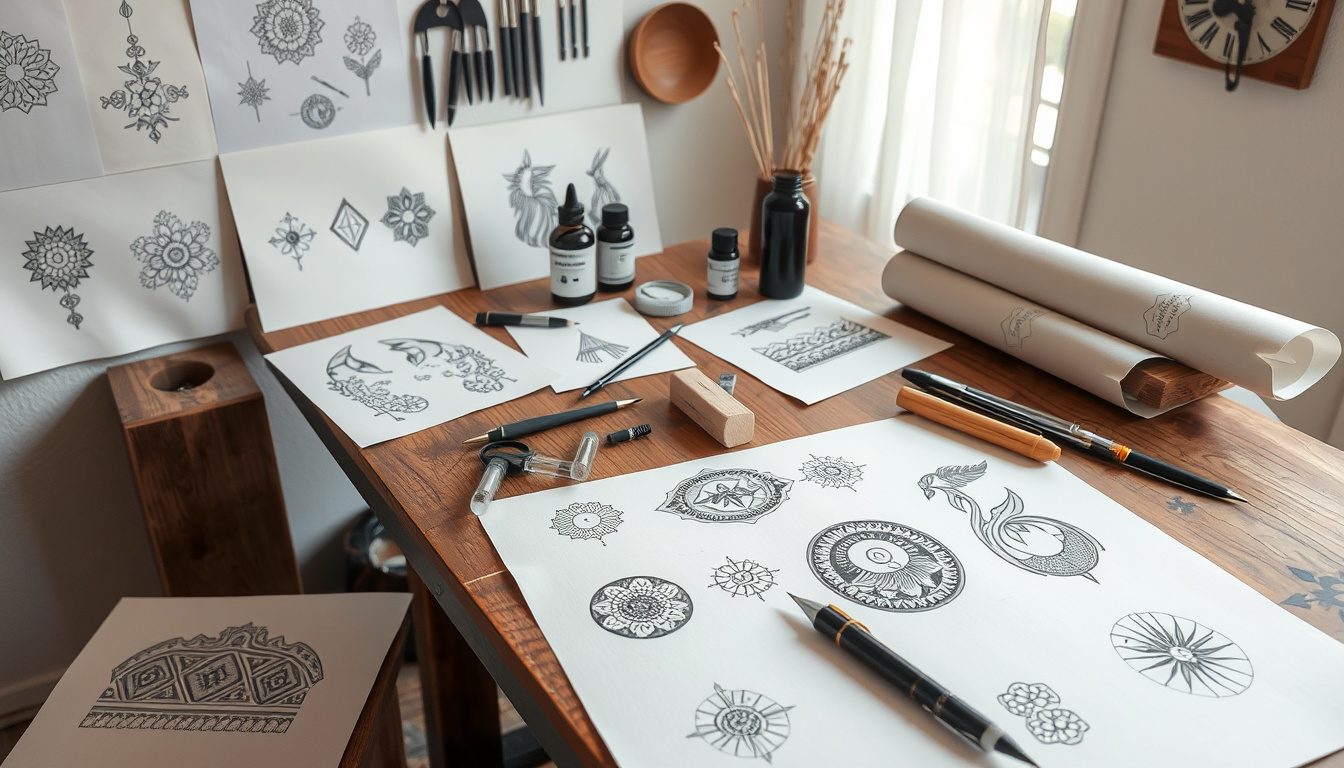
Most people don’t walk into a tattoo studio with a finished design; they walk in with a feeling — a memory, a name, a phase of life — and hope an artist can turn it into something they’ll still love decades later. That instinct is older than the word itself: “tattoo” traces back to the Tahitian tatau, meaning “to mark or strike” (Världskulturmuseet).
Ink oversight: FDA regulates tattoo inks as cosmetics (U.S. Food and Drug Administration) ·
Needle depth: ink sits in the upper layer of skin (Mayo Clinic) ·
Historic roles: rank, faith, and rites of passage (MUDEC) ·
Traditional style: bold outlines and a limited palette (Kunstplaza)
Quick snapshot
- Tattoo ink is deposited into the upper layer of skin through repeated needle punctures (Mayo Clinic)
- The FDA regulates tattoo inks as cosmetics and their pigments as color additives (U.S. Food and Drug Administration)
- Tattooing has marked rank, faith, and rites of passage across cultures (MUDEC)
- Whether ink particles that reach the lymph nodes carry long-term health effects
- What specific meanings ancient designs like Ötzi’s lines held for their wearers
- Whether some placements fade faster than others over decades
- For millennia — Iñupiat and Yup’ik women passed down tattooing traditions in Alaska (Anchorage Museum)
- 19th–20th centuries — missionaries suppressed these traditions (Anchorage Museum) (Anchorage Museum)
- Today — state and local authorities regulate tattooing, while the FDA oversees ink ingredients (U.S. Food and Drug Administration)
- Design work is shifting toward consultation-driven, body-aware planning
- FDA oversight will keep ink ingredients under scrutiny
- Expect more emphasis on healed results and long-term legibility
Eight facts, one pattern: the most reliable truths about tattoos are about process — how ink is placed, how bodies change, who regulates the tools — not about which design is trendiest.
| Fact | What the record shows |
|---|---|
| Earliest reported tattoo evidence | Ötzi the Iceman is reported to have carried more than 60 tattooed lines and dots, c. 3300 BCE (Art Types) |
| Ink placement | Needle punctures deposit ink into the upper layer of skin (Mayo Clinic) |
| Word origin | “Tattoo” traces to the Tahitian tatau, “to mark or strike” (Världskulturmuseet) |
| Cultural functions | Identity, belonging, spirituality, protection, healing, and life transitions (Världskulturmuseet) |
| Traditional style | Bold outlines, solid color fields, and a limited palette (Kunstplaza) |
| Traditional motifs | Anchors, roses, daggers, hearts, ships, swallows, and eagles (Kunstplaza) |
| Ink oversight | The FDA regulates tattoo inks as cosmetics and their pigments as color additives (U.S. Food and Drug Administration) |
| Practice regulation | The act of tattooing is regulated by state and local authorities (U.S. Food and Drug Administration) |
What are the best tattoo designs for girls and men?
Search trends in tattoo design are not as rigid as they look. Fine-line and botanical motifs dominate the “feminine” results, while bold, geometric, and symbolic pieces lead the “masculine” side. Overlap is common, and the smartest choice is the one that fits your body.
Tattoo designs for women: floral, delicate, and meaningful
- Fine-line botanicals: thin stems, single blooms, leaves drawn with one steady line
- Meaning-heavy symbols: a birth flower, a child’s name, a small constellation
- Delicate placements: wrist, collarbone, ankle, behind the ear
Delicate doesn’t mean fragile. Fine-line tattoos emphasize thin outlines and small detail, but their long-term legibility depends on placement, execution, skin characteristics, and aftercare, according to Art Types. A wispy flower placed on a sun-exposed wrist will fade faster than the same design on a collarbone that mostly stays covered.
Tattoo designs for men: bold, geometric, and symbolic
- Traditional and neo-traditional pieces with heavy outlines and solid color
- Geometric and blackwork designs that use the body’s lines as part of the art
- Popular placements: chest, full arm, ribs, and upper back
Traditional-style imagery was built on bold outlines and solid color fields, and those same motifs now appear in neo-traditional, blackwork, and fine-line variations. The style name matters less than the execution: a geometric chest piece needs an artist who can match the body’s symmetry, not just replicate a drawing.
Unisex designs that work for everyone
- Minimalist line art and one-line drawings
- Blackwork: dense solid shapes or fine ornamental patterns
- Watercolor, botanical, and lettering styles
Most design families — minimalist, traditional, realistic, tribal, watercolor — are worn by people of every gender. What changes is scale, placement, and how the motif follows the body.
A fine-line tattoo can outlive trend cycles if it’s planned for your skin; the same design on the wrong spot can blur within a few years.
What are the best tattoo designs for the back?
The back is the largest uninterrupted canvas most people will ever offer an artist, and it comes with a catch: it moves, stretches, and ages exactly like the skin everywhere else.
Large-scale back pieces: landscapes, wings, and mythology
- Full-back compositions that treat the spine as the vertical axis
- Long-standing motifs: wings, mountains, myth and folklore scenes
- Best suited to artists who specialize in large-scale shading
Tattoo designs generally need to be planned around body contours rather than treated as flat images placed on a static surface, notes Art Types. On the back, the art should flow with the spine and shoulder blades instead of sitting on top of them.
Spine tattoos: delicate and vertical designs
- Fine-line text, botanical vines, or a single column of symbols
- Designs that follow the natural line of the vertebrae
- A long, narrow format that suits vertical motifs
Sensitivity is not uniform across the back. Most people describe the spine as sharper than the fleshier shoulder blades, so plan for a shorter session if you choose a long spinal piece.
Shoulder blade designs: smaller, symmetrical motifs
- Paired wings, birds, or ornamental patterns that mirror each other
- Compact enough for a single session
- A spot that is easy to cover or show off
Because shoulder blades move with every arm motion, a symmetrical motif can drift out of alignment in the stencil. Ask your artist to check the design in motion before the needle starts.
What this means: the back rewards patience. A design that ignores the body’s structure will fight it for the rest of your life.
What are simple tattoo designs?
Simple doesn’t mean easier. Clean, minimal tattoos give the artist less room to hide mistakes and give the design fewer lines to stay crisp.
Minimalist line art and one-line tattoos
- A single continuous line — a face, a flower, a wave
- Thin black ink, no shading, deliberate negative space
- Common on wrist, forearm, or ankle
Minimalism sits near the top of most design-family lists, and it pairs naturally with black-and-grey ink. The style reads as effortless, but the execution demands precision.
Small symbols: hearts, stars, arrows
- Classic small motifs that work on finger, wrist, or collarbone
- Easy to cover, easy to add to later
- Often chosen as a first tattoo
Small symbols are a popular first-tattoo choice because they heal quickly, fit almost anywhere, and leave room for a larger piece later.
Text and lettering in clean fonts
- Single words, coordinates, dates, or short phrases
- Clean sans-serif or classic script
- Placement on forearm, ribs, or collarbone
Avoid overly ornate fonts. Fine details in lettering can blur as skin ages, so the cleanest typefaces usually stay readable the longest.
The trade-off: simple designs look effortless but demand precision. A shaky line on a minimalist piece is much harder to forgive than a busy one.
Where can I find new tattoo design photos?
The best reference photos show a design from multiple angles, in daylight, on real skin — not a filtered mock-up on a blank background.
Social media platforms: Instagram, Pinterest, TikTok
- Follow artists, not just hashtags — studios post healed work alongside fresh work
- Search by style, placement, and the word “healed” to see how tattoos age
- Save everything into one folder before you consult
A strong reference set should include both the style you love and the placement you are planning. The same design on a forearm and a ribcage will behave very differently.
Tattoo studio websites and portfolios
- Look for consistent quality over years, not one great piece
- Check for healed-work photos, not just fresh tattoos
- Read the studio’s aftercare and booking policies
A licensed studio should be happy to show credentials, explain local regulations, and walk you through the design process before you commit.
Online galleries and stock photo sites
- Useful for ideas, less useful for execution
- Reverse-image search a design before booking to see how common it is
- Remember that stock photos are often edited
Search results for tattoo inspiration skew heavily toward image galleries and template platforms, so treat galleries as a starting point, not a verdict.
The pattern: the best reference you can bring to a consultation is a healed tattoo by the actual artist, in the placement you want.
How to create a tattoo design with a name?
Name tattoos are personal by definition, and the margin for regret is wider than with a decorative motif. A little planning changes the outcome.
Choosing the right font and style
- Match the lettering to the overall mood of the design
- Choose open letterforms with room between strokes
- Ask the artist to draw a custom version instead of using a default font
Script and fine-line lettering are common choices, but readability over time should drive the decision. The artist’s lettering portfolio will tell you more than any font preview.
Integrating names with symbols or dates
- Add a birth flower, a star map, or a meaningful date under the name
- Combine elements in a single composition so it doesn’t look clipped together
- Keep the name readable at a glance
The most successful name designs treat the text as the anchor and everything else as context. Symbols placed too close to the lettering can hurt legibility.
Working with an artist to customise the design
- Bring reference photos but stay open to redraws
- Ask to see the artist’s lettering samples
- Review the stencil size, angle, and placement before the session
A professional will happily redraw a name until the spacing and flow are right. This is the step where a design stops being a picture and becomes your tattoo.
The catch: permanence multiplies personal significance. A badly placed or poorly lettered name tattoo is harder to live with than almost any other design.
How to design a tattoo, step by step
The design process doesn’t start at the studio door. It starts with references, placement, and a realistic conversation about permanence.
- Collect references — styles, placements, and healed examples — into one folder.
- Match the design to the body area; tattoos should follow contours, not fight them.
- Check the studio’s license and portfolio before booking.
- Book a consultation and let the artist redraw the design to fit you.
- Review the stencil in a mirror, and ask to see it while you move.
- Plan aftercare before you get tattooed, not after.
- Budget for a touch-up if the artist recommends one.
Each of these steps gets easier with a clear reference set. The consultation is where a design becomes yours, because a good artist redraws the motif around your skin rather than stenciling it straight from a photo.
The cheapest quote in town can become the most expensive tattoo you’ll ever remove. Licensing, healed-work portfolios, and a consultation that doesn’t feel rushed are worth the difference.
What this means: the design you walk in with is a starting point. The design you walk out with — redrawn, resized, and re-placed — is the one that lasts.
What we know and what’s still unclear
Separating evidence from assumption keeps a tattoo conversation honest. Here’s where the record stands.
Confirmed facts
- Repeated needle punctures deposit ink into the upper layer of skin (Mayo Clinic)
- The FDA regulates tattoo inks as cosmetics and their pigments as color additives (U.S. Food and Drug Administration)
- “Tattoo” traces to the Tahitian tatau, and tattooing has expressed identity and belonging for centuries (Världskulturmuseet)
What’s unclear
- Whether tattoo ink particles that reach the lymph nodes cause long-term health effects
- What specific meanings ancient designs such as Ötzi’s lines carried for their wearers
- Whether some placements accelerate fading faster than others over decades
- How a particular fine-line design will hold up on a particular person’s skin
- Whether all pigments currently on the market have been fully reviewed for safety
The pattern: the stronger the evidence, the more it points to process — licensed artists, informed placement, honest aftercare — rather than to any single “best” design.
What the experts say
Four voices matter in any tattoo decision: the regulator, the medical system, the museum, and the culture-keeper.
“A tattoo is a permanent mark, design, or drawing created by inserting colored ink into the skin with needles or other skin-piercing equipment.”
U.S. Food and Drug Administration
“Tattoo ink is deposited into the upper layer of skin through repeated needle punctures.”
Mayo Clinic
“Tattoo traditions have been used across cultures to express identity, belonging, spirituality, protection, healing, and life transitions.”
Världskulturmuseet
“Traditional Inuit tattoos can signify cultural belonging and should not automatically be treated as interchangeable decorative motifs for outsiders.”
Anchorage Museum
The strongest voices in tattoo design don’t sell a single style. They describe how ink behaves, what traditions mean, and who to trust — the rest is taste.
Why this matters
Tattoo design is a decision about permanence dressed up as a decision about taste. The styles, symbols, and placements that look right in a photo only earn their keep when they’re planned around your skin, your artist’s skill, and your willingness to heal them properly. For anyone booking a first session, the choice is clear: find a licensed artist whose portfolio shows healed work, and ask them to redraw the design for your body — or accept a tattoo that may blur, drift, or disappoint before the decade is out.
Related reading
- Dr Martens: Models, Styling, Foot Health & Alternatives
- Shein Clothes: Ethics, Safety, Quality & Alternatives
The implication: both guides test style decisions against materials, safety, and long-term use — the same standard that separates a tattoo that lasts from one that doesn’t.
Frequently Asked Questions
How much does a tattoo cost?
Pricing varies with the artist’s experience, the studio’s location, and the complexity of the design. Small pieces are usually quoted by the piece, and larger custom work is often quoted by the session. Always get a written estimate during the consultation.
Does getting a tattoo hurt?
Pain is subjective and placement-dependent. The spine, ribs, and kneecaps tend to be more sensitive because the skin sits closer to bone, while fleshier areas such as the shoulder blades are usually easier. Your artist can walk you through what to expect for your specific placement.
Can I bring my own design to a tattoo artist?
Yes. Artists are used to working from reference photos and sketches, and most will redraw the design to fit your body. What you shouldn’t do is print a single photo and expect it to be stenciled exactly as-is.
What tattoo styles are most durable?
Styles with bold outlines and fewer fine details tend to hold up best because ink spreads slightly under the skin over time. Traditional-style tattoos — bold lines, solid color, a limited palette — are famous for aging well, as Kunstplaza notes.
How do I prepare for a tattoo appointment?
Show up clean, rested, and well-fed. Avoid alcohol the night before, wear clothes that give the artist access to the area, and bring your reference folder. Ask your artist for specific prep instructions when you book.
Are there any health risks with tattoos?
Yes. Tattoo ink can trigger allergic reactions in some people, and contaminated ink or unsterile equipment raises the risk of infection. The FDA classifies inks as cosmetics and their pigments as color additives, but it does not approve tattoos themselves before they are applied.
How do I find a trustworthy tattoo artist?
Check that the studio is licensed for your state or local jurisdiction, review several years of portfolio work, and look specifically for photos of healed tattoos. A great artist will be happy to discuss licensing, aftercare, and their design process before you book.
What should I avoid after getting a tattoo?
Avoid soaking the tattoo in pools, bathtubs, or direct sun while it heals. Don’t pick at peeling skin, keep the area clean and moisturized, and follow the artist’s aftercare sheet — the healing window shapes how the final design settles.

George Thompson is Senior Reporter at UrbanMixr.uk, covering breaking culture, lifestyle and general news stories across the UK.