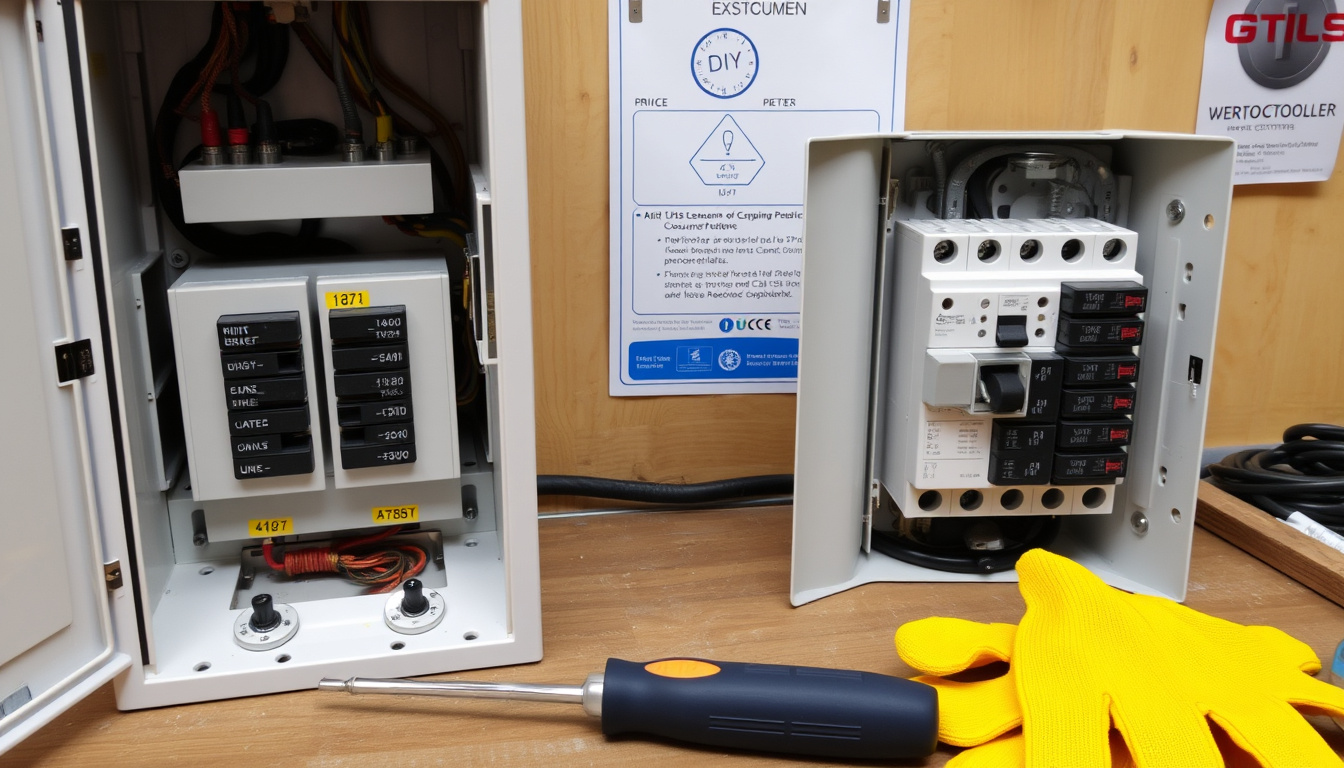
Few home improvements feel as invisible yet as vital as upgrading your consumer unit. If your home still relies on a fuse box from the 1980s, the choice between a DIY upgrade and hiring a certified electrician comes down to more than just money — the average professional replacement in the UK costs between £500 and £1,200, according to MyJobQuote (UK trade pricing guide). We cut through the jargon on 18th Edition regulations, RCD types, and the real risks of going it alone.
Average replacement cost (UK): £500–£1,200 (MyJobQuote) ·
Typical number of circuits: 10 ways (MyJobQuote) ·
Legislative standard: BS EN 61439-3 (Hager UK (electrical equipment manufacturer)) ·
RCD types available: Type A, Type AC, Type B, Type F (Hager UK) ·
DIY red flag price: £350 or less (Exeter PM (electrical project management))
Quick snapshot
- Distributes electricity from mains to individual circuits (IET Electrical (UK wiring regulations body))
- Houses circuit breakers, RCDs, and a main switch (IET Electrical)
- Also called fuse box or distribution board (IET Electrical)
- Average £500–£1,200 (MyJobQuote; Checkatrade (UK trade directory gives ~£485))
- Includes labour, materials, testing, and certification (Bright Spark Electrician (UK electrical contractor))
- Higher for metal-clad units, more circuits, or heat pump setups (Bright Spark Electrician)
- Legally possible but must notify building control under Part P (IET Electrical)
- High risk of shock, fire, and invalidated insurance if not certified (ElectriSafe Bournemouth (NICEIC-registered electrician))
- Registered electrician recommended for compliance (IET Electrical)
- Type A for standard circuits (sinusoidal AC and pulsating DC) (Hager UK (electrical equipment manufacturer))
- Type B required for heat pumps, EV chargers, inverters (Hager UK)
- Type B handles smooth DC leakage up to 1000 Hz (Hager UK)
Six key numbers lay out the playing field for any consumer unit decision.
| Fact | Value | Source |
|---|---|---|
| Average replacement cost | £500–£1,200 | MyJobQuote |
| Typical number of circuits | 6–12 ways | MyJobQuote (10-way typical) |
| Compliance standard | BS EN 61439-3 | Hager UK |
| RCD types available | Type A, Type AC, Type B, Type F | Hager UK |
| RCD type for EV chargers / heat pumps | Type B required when DC fault current >6 mA | Hager UK |
| DIY legal requirement | Must notify building control under Part P | IET Electrical |
The pattern: Cost and compliance are inseparable. The cheapest quote may skip certification, leaving you exposed.
How much does it cost to fit a new consumer unit?
- Average UK cost: £500–£1,200 including labour and materials (MyJobQuote; Checkatrade quotes ~£485 for a 10-way RCBO unit)
- Cost varies by number of circuits, RCD type, and location (Bright Spark Electrician)
- Higher cost for metal-clad units and larger homes (Bright Spark Electrician)
What factors affect consumer unit replacement cost?
- Number of circuits: more ways = higher price (Bright Spark Electrician)
- RCD type: Type B units cost more than Type A (Hager UK)
- Location: prices vary by region in the UK (unclear exact variation)
Why this matters: A £350 quote is almost certainly too good to be true. Exeter PM (electrical project management) warns that such low prices often skip certification or use substandard parts, leaving you with no paper trail and potential insurance issues.
How long does it take an electrician to replace a consumer unit?
A standard 10-way replacement typically takes 4–8 hours for a registered electrician, including testing and certification (Bright Spark Electrician).
- Isolate the existing supply and verify dead.
- Remove the old consumer unit and disconnect all circuits.
- Mount the new unit and connect incoming mains.
- Wire each circuit into the correct RCD or RCBO.
- Test all circuits for insulation resistance, polarity, and earth loop impedance.
- Certify the installation with an Electrical Installation Certificate.
Can I replace a consumer unit myself?
- DIY replacement is not illegal but must comply with Building Regulations Part P (IET Electrical)
- Work must be notified to local authority or done by a registered competent person (IET Electrical)
- Risk of electric shock, fire, and invalidated insurance if not certified (ElectriSafe Bournemouth)
Is it legal to replace a consumer unit in the UK?
Legally, anyone can carry out electrical work in their own home. However, under Part P of the Building Regulations, work that involves replacing a consumer unit is “notifiable” — you must either use a registered competent person (e.g., NICEIC-approved electrician) or notify the local authority building control department and pay a fee (IET Electrical).
What are the safety risks of DIY consumer unit replacement?
Working inside a live consumer unit carries fatal shock risk. Even if you isolate the supply, incorrect wiring can cause persistent RCD tripping, overheating, and fire. ElectriSafe Bournemouth reports that improperly installed units often fail to meet 18th Edition requirements, voiding home insurance and leaving the property non-compliant.
What is the difference between Type A and Type B consumer unit?
- Type A RCD detects sinusoidal AC and pulsating DC residual currents (Hager UK)
- Type B RCD detects AC, pulsating DC, and smooth DC up to 1000 Hz (Hager UK)
- Type B is required for heat pumps, EV chargers, and inverters (Hager UK)
The choice between RCD types directly affects cost and compliance.
| Feature | Type A RCD | Type B RCD |
|---|---|---|
| Detects sinusoidal AC | Yes | Yes |
| Detects pulsating DC | Yes | Yes |
| Detects smooth DC up to 1000 Hz | No | Yes |
| Required for standard lighting and socket circuits | Yes | Not mandatory |
| Required for heat pumps and EV chargers (UK 18th Ed. Amend. 2) | No — not sufficient | Yes |
| Typical cost premium vs Type A | Baseline | +30–60% |
The implication: For modern homes with electronic loads, Type B is a regulation, not an option.
When to use Type A RCD vs Type B RCD?
Use Type A for standard domestic circuits — lighting, sockets, ovens. Use Type B whenever the circuit contains electronic equipment that can generate smooth DC leakage: heat pumps, EV chargers, photovoltaic inverters, UPS systems (Hager UK). The 18th Edition Amendment 2 (2022) explicitly requires Type B for these applications.
Type A vs Type B RCDs for heat pumps – which should you use?
For heat pumps, Type B is mandatory in the UK under BS 7671:2018 Amendment 2 (Hager UK). A Type A RCD may not detect smooth DC fault currents, leaving the circuit unprotected.
Homeowners installing a heat pump or EV charger: budget for a Type B RCD. It costs more than Type A but is legally required and prevents nuisance tripping. Get it wrong, and your warranty may be void.
What are the signs of a faulty consumer unit?
- Flickering lights, tripping RCDs without load, burn marks or discolouration on the unit (ElectriSafe Bournemouth)
- Units over 25 years old likely need replacement (Mida Cable (electrical cable specialist))
- Upgrade needed if adding new circuits like EV charger (ElectriSafe Bournemouth)
9 red flags signalling an overdue consumer unit upgrade
- Rewirable fuses instead of circuit breakers
- No RCD protection (or only one RCD for whole board)
- Plastic enclosure (non-compliant since 2015 Amendment 3) (Surewire Electrical (UK electrical contractor))
- Burnt or brittle insulation on incoming cables
- RCD tripping randomly at least once a week
- Visible rust or moisture inside the unit
- Loose or warm connections
- Unit located in a damp environment
- Any DIY repairs or tape visible on wiring
How to test if your consumer unit is working properly?
A registered electrician will perform a full inspection using a multifunction tester to measure earth fault loop impedance, insulation resistance, and RCD trip time (IET Electrical). Homeowners can press the ‘Test’ button on each RCD quarterly, but this only checks the trip mechanism, not the underlying wiring.
The catch: A unit that looks fine from the outside can hide dangerous wiring faults. If you notice any of the red flags above, don’t rely on the test button — call a certified electrician.
Can you put in a new consumer unit with old wiring?
- Possible, but old wiring must be tested for insulation resistance and condition (IET Electrical)
- If wiring fails tests, rewiring may be required (Bright Spark Electrician)
- Professional electrician will inspect all circuits before connection (Bright Spark Electrician)
What to check before connecting old wiring to a new consumer unit?
The electrician will test each circuit for insulation resistance (minimum 1 MΩ per BS 7671), polarity, and earth continuity (IET Electrical). If the wiring is rubber-insulated (pre-1960s) or PVC-insulated showing signs of cracking, the circuit may need rewiring before being connected to the new unit.
Does old wiring need to be rewired when replacing consumer unit?
Not necessarily. Many homes with 1970s–1990s wiring pass all tests and can be safely connected to a new consumer unit. But if the insulation resistance is below 1 MΩ, the section of wiring must be repaired or replaced, according to Bright Spark Electrician (UK electrical contractor).
The pattern: Replacing the consumer unit often forces you to fix hidden wiring faults. Budget for potential rewiring costs of £500–£2,000 on top of the unit replacement.
Homeowners with 1980s wiring: you can keep the old cables if they test OK. But each circuit that fails costs extra. The smart move: get a full inspection before committing to a new consumer unit.
The implication for your budget: Always plan for at least one circuit needing attention.
Timeline: How consumer unit regulations evolved
- 2008 – 17th Edition introduced mandatory RCDs for socket circuits (WOSOM Electrical (electrical trade site))
- 2015 – Amendment 3 required non-combustible enclosures (metal consumer units) (Surewire Electrical)
- 2022 – Amendment 2 of the 18th Edition updated RCD requirements, mandating Type B for heat pumps and EV chargers (Hager UK)
- 2025 – Full enforcement of 18th Edition Amendment 2 for new installations
What this means: If your consumer unit predates 2015, it likely has a plastic enclosure and no compatibility with modern heat pump or EV charger requirements. The cost of upgrading only increases as regulations tighten.
What’s confirmed and what’s still unclear
Confirmed facts
- Consumer units must comply with BS EN 61439-3 (Hager UK)
- Type B RCD is required for heat pumps and EV chargers in the UK (Hager UK)
- Domestic consumer unit replacement costs £500–£1,200 (MyJobQuote; Checkatrade)
- DIY replacement is legal but must comply with Part P and be notified (IET Electrical)
What’s unclear
- Exact cost variations in different UK regions (no published regional breakdown)
- How many DIY replacements go unnotified to building control
- Whether older RCDs need retesting on AC setting only (YouTube (electrician training – low confidence))
- The exact percentage of UK homes still using pre-2008 fuse boxes
Expert perspectives on consumer unit safety
“Using a registered competent person for consumer unit work is the only way to guarantee the installation meets 18th Edition standards and stays compliant with your home insurance.”
— NICEIC (UK electrical contracting accreditation body)
“DIY consumer unit replacement carries serious risk of electric shock and fire. Even if you follow a wiring diagram, one mistake can leave your family unprotected.”
— Electrical Safety First (UK consumer safety charity)
“The 18th Edition Amendment 2 requirement for Type B RCDs on heat pumps and EV chargers reflects the increasing presence of electronic loads in UK homes. This is not a suggestion — it’s the standard.”
— BS 7671 (IET Wiring Regulations) committee member
For UK homeowners facing a consumer unit upgrade, the decision is clear: hire a registered electrician, budget £500–£1,200, and expect Type B RCDs if you own a heat pump or EV charger. Attempting a DIY replacement may save money upfront but risks invalidating insurance, failing compliance checks, and — in the worst case — causing a fire. The 18th Edition isn’t optional; it’s the price of safe, modern electricity in your home.
For a detailed overview of the latest wiring rules and best brands, see our dedicated guide on UK consumer unit regulations.
Frequently asked questions
Do I need to replace my consumer unit if it has old fuse wire?
Yes, if it still uses rewirable fuses, it cannot provide the RCD protection required by the 18th Edition. Replacement is strongly recommended (ElectriSafe Bournemouth).
What is the lifespan of a consumer unit?
Typically 25–30 years, but regulations change. A unit from 2000 may meet 16th Edition but not 18th Edition, so replacement may be needed earlier (WOSOM Electrical).
Can a consumer unit be installed outside?
Yes, provided it has an IP rating suitable for outdoor use (e.g., IP65) and is installed by a competent person (IET guidance).
What does ‘high integrity consumer unit’ mean?
It means the unit has at least two RCDs or RCBOs to provide selectivity (formerly called discrimination) — so a fault on one circuit doesn’t take out half the house (IET Electrical).
How many circuits can a domestic consumer unit have?
Standard domestic units typically accommodate 6–12 ways, but larger homes may need dual units or up to 20 ways (MyJobQuote).
Does a new consumer unit require an earth bond?
Yes, the incoming earth connection must be verified and bonded to metallic services (gas, water) according to BS 7671 (IET Electrical).
Related reading: Consumer Energy Solutions Jobs Lost · 2024 Tesla Model 3: Price, Range, and Specs

George Thompson is Senior Reporter at UrbanMixr.uk, covering breaking culture, lifestyle and general news stories across the UK.