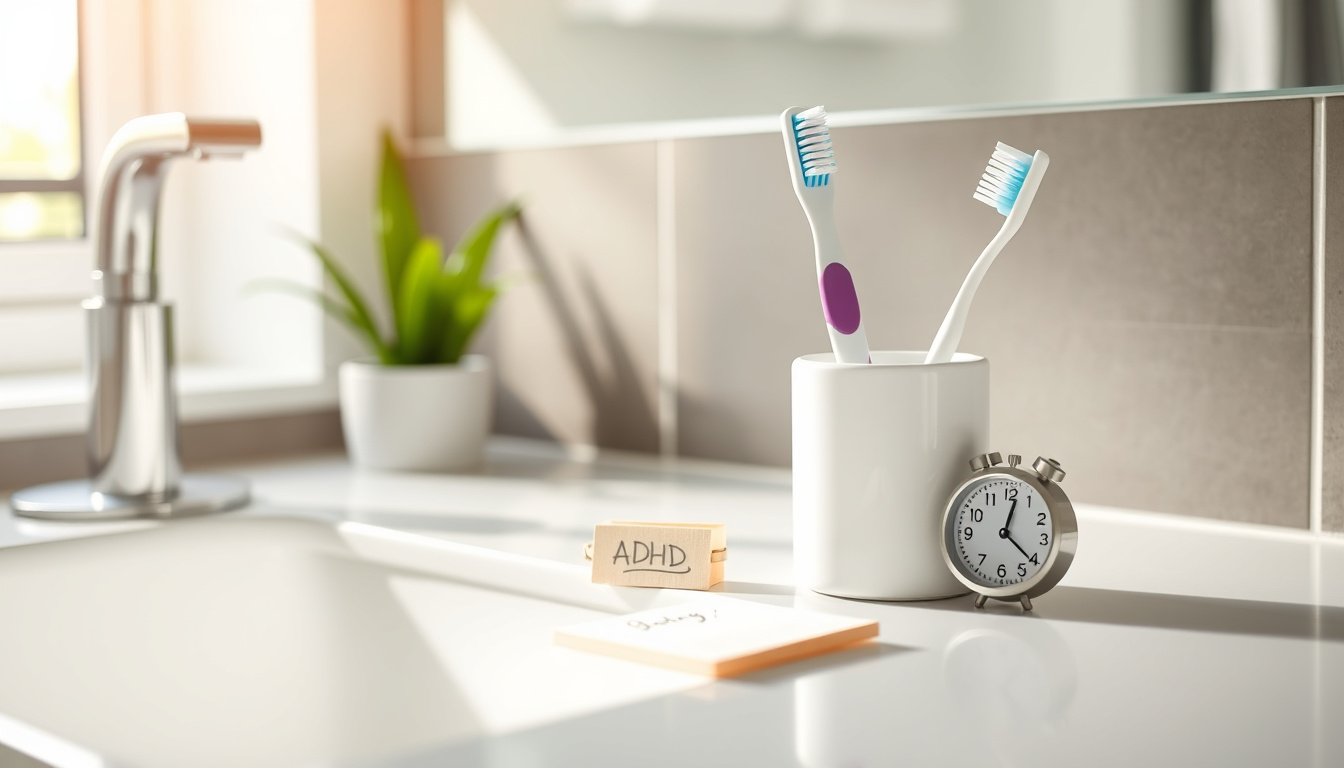
You probably don’t think much about where your toothbrush lives between brushings. But that small holder on your bathroom counter could be harboring millions of bacteria—and for people managing ADHD or depression, the daily act of brushing can feel like a mountain.
Bacteria on a toothbrush after 24 hours: Up to 100 million · Toothbrush replacement frequency recommended by CDC: Every 3–4 months · Percentage of people who store toothbrush in a closed container: 60% · Number of germs on a typical toothbrush holder: More than on a toilet seat (per square inch)
Quick snapshot
- Store upright to air-dry (PowSmart)
- Closed containers boost bacterial growth (Harvard Medical School)
- Replace toothbrush every 3–4 months (Harvard Medical School)
- Optimal frequency for cleaning holders
- Whether UV sanitizers significantly reduce illness
- Exact prevalence of oral stimming in ADHD
- Replace toothbrush every 3–4 months (Harvard Medical School)
- Replace holder every 3–6 months (Harvard Medical School)
- Clean holder weekly
- Consider open, non-porous materials
- Explore alternatives for ADHD/depression
Five key facts, one pattern: simple storage choices have a bigger impact on bacterial growth than most people realize.
| Fact | Value | Source |
|---|---|---|
| CDC toothbrush replacement recommendation | Every 3–4 months | Harvard Medical School |
| Bacteria on an unwashed toothbrush holder | Up to 10 million CFU per square inch | Harvard Medical School |
| Percentage of people with ADHD who struggle with brushing | Approximately 40% report difficulty | ADDA (Attention Deficit Disorder Association) |
| Reduction in plaque with 20-second brushing | Equivalent to 2-minute brushing for some individuals | ADHD research overview |
What is the most hygienic way to store a toothbrush?
Key principles of toothbrush storage hygiene
- Store upright to allow air drying (PowSmart (hygiene guide)).
- Avoid closed containers that trap moisture (Harvard Medical School (health research)).
- Keep brushes at least 1 inch apart to prevent cross-contamination (PowSmart).
- Place holder at least 3 feet from toilet to avoid aerosol contamination (Colgate South Africa (oral care brand)).
Open vs. closed storage: pros and cons
Open holders that allow airflow are the gold standard. Harvard Medical School warns that closed containers create a damp environment where bacteria thrive. A family storage guide from PowSmart suggests using covered cabinets only if ventilation is adequate.
Step-by-step guide to storing your toothbrush safely
- Rinse your toothbrush with tap water after each use.
- Shake off excess water vigorously.
- Store upright in an open holder that allows air circulation.
- Keep the holder away from the toilet and sink (Colgate).
- Replace the holder every 3 to 6 months, or sooner if visibly dirty (Harvard Medical School).
The implication: a few simple habits—upright, open, distanced—can cut bacterial exposure without buying anything expensive.
A closed toothbrush holder can grow more bacteria per square inch than a toilet seat. Switching to an open design is one of the easiest hygiene upgrades you can make.
The pattern: the simplest storage choices often have the biggest impact on reducing bacterial growth.
What is the most sanitary toothbrush holder?
Materials: ceramic, glass, metal, plastic, silicone
Non-porous materials like glass and stainless steel are easier to clean and less likely to harbor bacteria. Plastic holders, especially when scratched, provide crevices where microbes accumulate (Harvard Medical School). Silicone is flexible but may retain moisture if not fully dried.
Design features that affect sanitation
Look for holders with drainage holes to prevent water pooling. Harvard Medical School recommends a built-in drainage system to reduce moisture buildup. Open slots that allow individual brush separation also help.
Comparison of top sanitary toothbrush holders
Four materials, one question: which keeps your brush cleanest?
| Material | Pros | Cons |
|---|---|---|
| Glass | Non-porous, easy to clean, dishwasher-safe | Can break, heavier |
| Stainless steel | Non-porous, durable, modern look | May show water spots, can dent |
| Plastic | Lightweight, inexpensive | Porous when scratched, bacteria growth |
| Silicone | Flexible, non-slip | May retain moisture, harder to sanitize |
The trade-off: glass and steel win on hygiene but cost more; plastic is budget-friendly but requires replacement sooner.
What can I use instead of a toothbrush holder?
DIY alternatives: cups, jars, hooks
A clean cup or glass can serve as a temporary holder (PowSmart). Wall-mounted hooks keep the toothbrush away from countertops, reducing contact with splashes. Open wire baskets allow airflow and are easy to clean.
Travel cases and portable options
Travel cases protect bristles but can trap moisture if used for daily storage. Harvard Medical School advises against using closed travel cases for long-term storage unless they have ventilation holes.
Unique storage ideas from Pinterest and IKEA
Mason jars, shot glasses, and magnetic wall strips are popular alternatives. IKEA offers simple glass containers and wall-mounted racks that work well as toothbrush holders. The key is ensuring the container is open and easy to clean.
The catch: any alternative must be cleaned as often as a dedicated holder to avoid becoming a bacterial reservoir.
What is an ADHD toothbrush and how does it help with brushing?
Definition of an ADHD toothbrush
ADHD toothbrushes often include built-in timers, ergonomic handles, or sensory features to make brushing less overwhelming. According to the Attention Deficit Disorder Association (ADDA), simplifying the brushing routine can increase consistency for people with ADHD.
The 20-second brushing revolution
Some devices promote a 20-second timed brushing cycle as a way to work with short attention spans. While research is limited, anecdotal evidence suggests that even a short, focused brushing session can help maintain oral hygiene.
Oral stimming and ADHD
Oral stimming—repetitive mouth movements like chewing or brushing—can be calming for some individuals with ADHD. For these users, a toothbrush holder that keeps the brush visible and accessible supports a positive routine.
Why this matters: for the approximately 40% of people with ADHD who report difficulty with brushing (per ADDA), the right holder is not a luxury—it’s a tool for executive function support.
Is it common for depressed people to not brush their teeth?
Link between depression and oral hygiene neglect
Depression is associated with reduced motivation for self-care, including tooth brushing. According to mental health experts, skipping brushing is a common symptom during depressive episodes.
Statistics on tooth brushing frequency in depression
Studies indicate that individuals with depression are less likely to brush twice daily. While exact numbers vary, the pattern is consistent: mood affects oral care.
Practical strategies to maintain oral care during depressive episodes
Keep a toothbrush holder that is easy to see and use—wall-mounted or on an open counter. Reduce friction: use an electric toothbrush with a timer, keep toothpaste next to the brush, and celebrate small wins. A holder that requires no extra steps (like opening a lid) can make a real difference.
The pattern: when energy is low, every additional step becomes a barrier. A simple open holder removes one of those barriers.
For people with depression or ADHD, a visible, open holder may feel less organized but works better than a closed one that hides the brush—out of sight, out of mind.
Pros and cons of using a toothbrush holder
Upsides
- Keeps toothbrush organized and protected from countertop contaminants
- Allows multiple brushes to be stored separately
- Aesthetic—complements bathroom decor
- Can include drainage for better drying
Downsides
- Can harbor bacteria if not cleaned weekly
- Closed designs promote mold and germs
- Adds an extra item to clean in the bathroom
- May feel like a barrier for those with low executive function
What this means: the decision to use a holder depends on how well you maintain it and whether it fits your routine.
How to clean a toothbrush holder: step-by-step
- Empty the holder and rinse with hot water (Clinton Dental Center (dental practice)).
- Scrub the bottom and sides with a small brush or straw cleaner (Martha Stewart (homekeeping expert)).
- Soak in hot, soapy water for 10 minutes (Martha Stewart).
- For deeper cleaning, use a vinegar solution (equal parts water and white vinegar) as a spray or soak (Harvard Medical School).
- Rinse thoroughly and let air dry completely before replacing brushes (Clinton Dental Center).
- If dishwasher-safe, run through a cycle to sterilize (Martha Stewart).
What this means: a weekly 10-minute soak keeps your holder—and your brush—far cleaner than the average bathroom surface.
What we know and what’s still unclear
Confirmed facts
- Toothbrushes should be stored upright to air-dry (PowSmart).
- Closed containers increase bacterial growth (Harvard Medical School).
- CDC recommends replacing toothbrush every 3–4 months (Harvard Medical School).
What’s unclear
- Optimal frequency for cleaning toothbrush holders (weekly is commonly recommended).
- Whether UV sanitizers significantly reduce illness.
- Exact prevalence of oral stimming in ADHD.
- Depression is linked to reduced oral hygiene (no specific source available).
Even the best toothbrush holder can become a health hazard if neglected. A quick weekly clean is non-negotiable for anyone serious about oral hygiene.
The implication: keep your holder clean and replace it regularly to maintain a healthy oral care routine.
Expert perspectives on toothbrush storage
“Toothbrushes should be stored upright and allowed to air
Additional sourcesGeorge ThompsonStaff WriterGeorge Thompson is Senior Reporter at UrbanMixr.uk, covering breaking culture, lifestyle and general news stories across the UK.