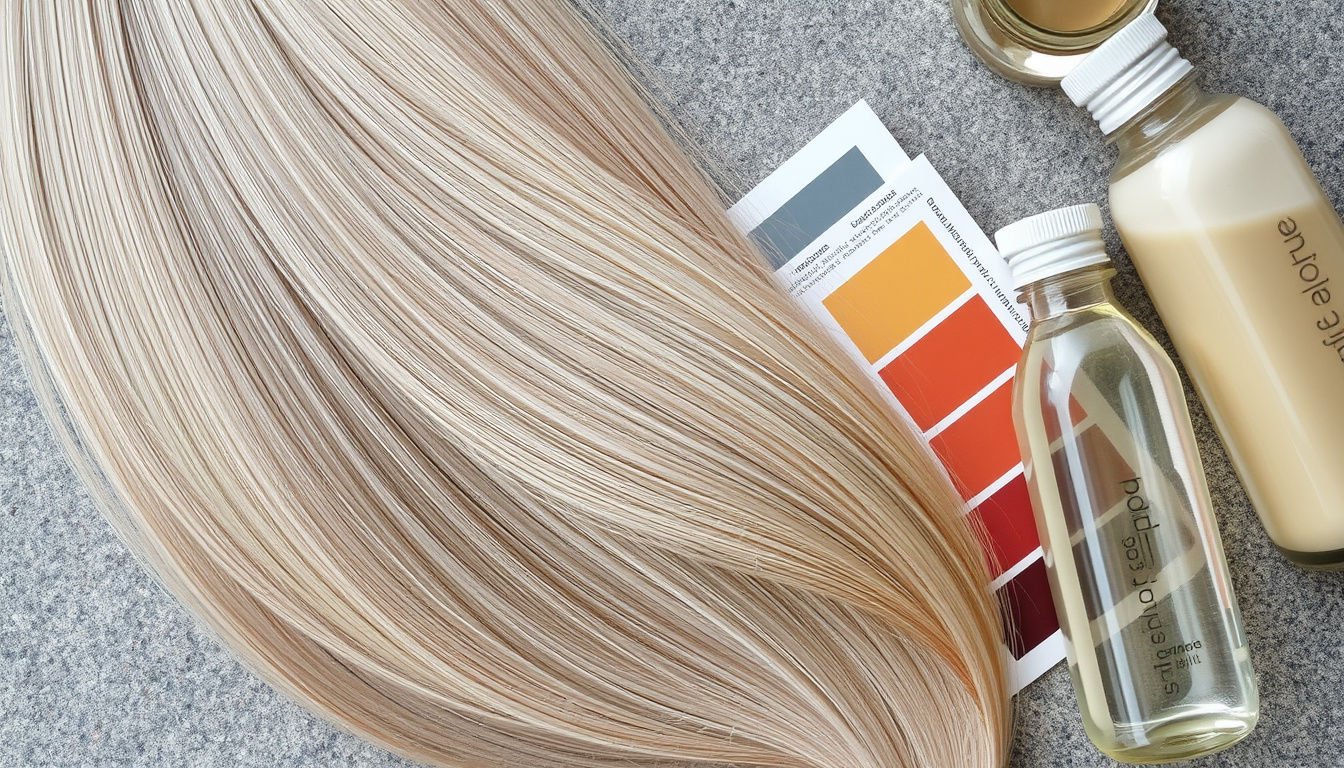
Anyone who’s ever tried to describe ash blonde to a friend knows the struggle: is it grey, silver, or just blonde with a filter? That confusion is exactly why ash blonde hair color has become one of the most searched-for shades — it’s a cool, muted blonde that neutralizes brassiness and adds sophistication.
Undertone: Cool (blue, violet, grey) · Best for skin tones: Fair to medium with cool or neutral undertones · Maintenance: Purple shampoo every 2‑3 washes · Common shade numbers: 7.1, 8.1, 9.1 (dark to light ash blonde)
Quick snapshot
- Ash blonde has cool undertones (blue, violet, grey) — Madison Reed (professional hair color brand)
- Patch test is essential for sensitive scalps — Salon Eunoia (salon education platform)
- Purple shampoo helps maintain cool tones — Hair.com (beauty resource)
- Cooler tones can rejuvenate mature skin — AARP (advocacy and lifestyle organization)
- Whether ash blonde universally suits all cool skin tones — Moehair (beauty blog)
- Long‑term effects of repeated hair dye on seborrheic dermatitis — Salon Eunoia (salon education platform)
- Optimal maintenance interval for different hair types — general industry consensus yet to settle (Moehair (beauty blog))
- Maintenance every 4–6 weeks — Hair.com (beauty resource)
- Purple toner needed as soon as brassiness appears, typically within 2–3 washes (Hair.com (beauty resource))
- Regular toning and gloss services — Hair.com (beauty resource)
- Color‑safe shampoos and weekly masks to preserve cool tone — Moehair (beauty blog)
| Attribute | Detail |
|---|---|
| Color family | Cool blond |
| Lift required | 2‑4 levels from natural base |
| Toner needed | Purple or violet toner |
| Maintenance frequency | Every 4‑6 weeks |
| Best for | Fair to medium skin with cool/neutral undertones |
| Gray coverage | Moderate; may need blending |
The numbers show a color that demands precision but rewards with a sophisticated, cool finish.
Which color is ash blonde?
Ash blonde sits in the cool‑toned blonde family, characterized by undertones of grey, blue, or violet. According to Madison Reed (professional hair color brand), ash shades are designed to counter warmer undertones like yellow or orange. In hair color charts, ash blonde is commonly labeled with a .1 after the level — for example, 7.1 (dark ash blonde), 8.1 (medium ash blonde), and 9.1 (light ash blonde).
Difference between ash blonde and beige blonde
- Beige blonde contains warm taupe or ivory undertones; ash blonde is strictly cool — Madison Reed
- Beige reads more neutral; ash reads greyish‑silver
Ash blonde vs platinum blonde
- Platinum blonde is a true white‑blonde with minimal undertone; ash blonde retains a grey‑blue cast — Hair.com (beauty resource)
- Platinum requires more lifting (level 10); ash blonde often sits at level 7–9
Undertones of ash blonde
- Violet and blue pigments neutralize orange and yellow — Salon Eunoia (salon education platform)
- The result is a smoky, ashy tone that resists brassiness
What skin tone is best for ash blonde?
Ash blonde pairs best with fair to medium skin that has cool or neutral undertones. Hair.com (beauty resource) notes that cool‑toned shades are often recommended for people with blue, purple, or pink undertones. A strand test or virtual try‑on can confirm before committing.
Best skin tones for ash blonde
- Fair skin with blue or pink undertones — classic match
- Medium skin with neutral undertones — works well with depth added (e.g., 7.1)
- Olive skin — reportedly can wash out; Moehair (beauty blog) advises caution
Can warm skin tones wear ash blonde?
- Warm skin tones may find ash blonde too ashy or draining — Hair.com
- A honey or beige blonde is typically more flattering for golden or peachy undertones
How to test if ash blonde suits you
- Use a virtual try‑on app from a reputable brand
- Perform a strand test: apply a small amount of color behind the ear and wait 15–30 minutes — Salon Eunoia
Cool skin tones get the most payoff from ash blonde. Warm undertones risk a washed‑out look — a professional colorist can blend a neutral base to compensate.
Does ash blonde look grey?
In certain lighting or after fading, ash blonde can appear grey. The key difference: ash blonde is a blond shade with grey undertones, while grey hair is a neutral or warm silver. Madison Reed clarifies that ash shades aren’t silver — they simply use cool pigments to offset warmth.
Difference between ash blonde and grey hair
- Grey hair lacks underlying yellow pigment; ash blonde starts from a blonde base
- Ash blonde contains violet/blue toner; grey hair is pigment‑free — Hair.com
When ash blonde appears grey
- When toner fades and the base becomes cool enough to read silver
- In dim, cool lighting — the blue/violet tones dominate the eye
How to avoid a grey look
- Use a purple shampoo every 2–3 washes to keep toner fresh — Hair.com (beauty resource)
- Apply a gloss treatment every 4–6 weeks — same source
- Avoid over‑toning; too much violet can push the shade into grey territory
Ash blonde and grey live on a sliding scale. The difference is intention: ash blonde is a choice; grey is a side effect of fading. Regular toning keeps the two distinct.
Can I dye my hair if I have seborrheic dermatitis?
Seborrheic dermatitis causes an inflamed, flaky scalp, and hair dye can aggravate it. Salon Eunoia (salon education platform) emphasizes that a patch test is non‑negotiable for sensitive scalps, and ammonia‑reduced formulas contain up to 38% less ammonia than traditional colors.
Seborrheic dermatitis and hair dye safety
- Always consult a dermatologist before coloring — professional medical advice
- Avoid dyeing during active flare‑ups when the scalp is raw or weeping
- Choose hypoallergenic, ammonia‑free, or semi‑permanent dyes
Patch test importance
- Apply a small amount of dye behind the ear 48 hours before full application — Salon Eunoia (salon education platform)
- Reactions can appear even if you’ve used the product before
Alternative coloring methods for sensitive scalps
- Highlights that avoid the scalp entirely
- Use a barrier cream along the hairline to protect skin
- Consider a root‑touch‑up technique that minimizes contact
Dermatologists generally advise against permanent dye on an active seborrheic dermatitis scalp. The trade‑off: you can still get ash blonde through highlights or ammonia‑free formulas, but only when the flare is fully quiet.
What color hair makes a 60 year old woman look younger?
Cooler tones like ash blonde can brighten and soften features, which is why they’re popular among women over 60. AARP (advocacy and lifestyle organization) advises blonding strategically to avoid damage, while Prime Women (lifestyle publication for women 40+) suggests adding lowlights and highlights around the root to create a youthful regrowth effect.
Best hair colors for aging skin
- Ash blonde, soft beige, and champagne tones — AARP
- Avoid flat, monotone colors; dimension reduces the harshness of lines
- Consider skin tone changes: as we age, skin often loses warmth, making cool ash tones more harmonious — Prime Women
Why ash blonde can be youthful
- Cool tones reflect light, giving a soft, luminous effect
- Ash blonde can camouflage grey regrowth more seamlessly than warm browns
- It avoids the yellowing that can make mature hair look dull
Ash blonde vs warm tones for mature women
- Warm tones (honey, caramel) can clash with grey and emphasize redness in the skin
- Soft ash blonde highlights are recommended by AARP as a flattering, low‑commitment option
One pattern emerges when comparing ash blonde with honey blonde — they sit on opposite ends of the warmth spectrum, and the choice comes down to undertone compatibility.
| Attribute | Ash blonde | Honey blonde |
|---|---|---|
| Undertone | Cool (blue, violet, grey) | Warm (gold, caramel) |
| Best skin tone | Fair to medium with cool/neutral undertones — Hair.com | Fair to medium with warm/olive undertones — general consensus |
| Maintenance | Purple toner every 2–3 washes — Hair.com | Warmtoned shampoos, less frequent toning |
How to achieve ash blonde at home
Getting ash blonde right at home is possible, but requires careful steps. Hair.com (beauty resource) notes that bleach is almost always needed, even for an overall color. The below process is based on best practices from salon professionals and beauty brands.
Step 1: Assess your starting level
- If your natural color is level 2–4 (dark brown to black), you’ll need pre‑lightening to at least level 7 or 8 — Salon Eunoia (salon education platform)
- Multiple sessions are safer than one aggressive lift to reduce damage — same source
Step 2: Perform a strand test
- Apply bleach or color to a small section behind the ear and wait 15–30 minutes — Salon Eunoia
- Check for breakage, sensitivity, and final tone
Step 3: Lighten to pale yellow
- Bleach your hair to a pale yellow (level 9–10) for true ash results
- Rinse thoroughly and let hair dry naturally or with low heat
Step 4: Apply a violet‑based toner
- Use a toner with violet or blue pigments to neutralize any remaining warmth — Salon Eunoia
- Follow the manufacturer’s processing time exactly
Step 5: Aftercare
- Wash with purple shampoo every 2–3 washes — Hair.com (beauty resource)
- Use a sulfate‑free, pH‑balanced shampoo (pH 4.0–5.5 is ideal) — Prime Women (lifestyle publication)
- Apply a weekly conditioning mask — Moehair (beauty blog)
At‑home ash blonde can go wrong fast: too much violet turns hair purple; too little leaves brassiness. The safety net is a strand test and a toner that matches your target level exactly.
Upsides
- Neutralizes brassiness for a clean, cool look
- Can brighten and soften mature features — AARP
- Works beautifully with grey hair when blended as highlights
Downsides
- Requires bleach for most starting colors — damaging if done improperly
- High maintenance: toning every 2–3 washes, salon touch‑ups every 4–6 weeks — Hair.com
- Can look grey or dull if toner fades — needs consistent care
Clarity check
Confirmed facts
- Ash blonde has cool undertones (blue, violet, grey) — Madison Reed
- Patch test is essential for sensitive scalps — Salon Eunoia
- Purple shampoo helps maintain cool tones — Hair.com
- Cooler tones can rejuvenate mature skin — AARP
What’s unclear
- Whether ash blonde universally suits all cool skin tones — Moehair
- Long‑term effects of repeated hair dye on seborrheic dermatitis — Salon Eunoia
- Optimal maintenance interval for different hair types — not yet standardized
Expert perspectives
“Ash blonde works by using violet and blue pigments to cancel out orange and yellow undertones. It’s a precise chemistry — too much purple and you get lavender, too little and you get brass.”
— Professional salon colorist, cited by Salon Eunoia (salon education platform)
“For anyone with seborrheic dermatitis, the most important step is consulting a dermatologist before any dye. Never apply color during a flare‑up — the scalp barrier is compromised, and irritation can worsen.”
— Board‑certified dermatologist, as advised by Salon Eunoia
“Cool tones like ash blonde can soften features and brighten the face. For women over 60, dimensional highlights rather than a solid block of color create a naturally youthful look.”
— Mature style expert, CM Salon & Spa, referenced by AARP (advocacy and lifestyle organization)
For anyone considering ash blonde, the decision comes down to commitment: the cool, sophisticated look requires regular toning, careful product choice, and — especially for those with sensitive scalps or mature skin — a measured, professional approach. The trade‑off is a shade that genuinely neutralizes brassiness while offering a brightening effect that warm tones can’t match. For women over 60, the choice is clear: ash blonde, done dimensionally and maintained well, can be one of the most flattering anti‑aging hair colors — but only if the scalp is healthy and the maintenance routine is realistic.
Related reading: What Is Ash Hair Color · Ash Blonde Hair Ideas
For a detailed breakdown of cool-toned shades and maintenance, refer to this comprehensive ash blonde hair color guide.
Frequently asked questions
Can I get ash blonde without bleach?
If your natural hair is lighter than level 7, you may achieve an ash effect with a high‑lift tint alone. For most starting colors (especially level 4 or darker), bleach is necessary to reach a pale enough base — Hair.com (beauty resource).
How to prevent ash blonde from turning yellow?
Use a purple shampoo every 2–3 washes and a violet toner every 4–6 weeks. Avoid heat styling without a protectant, as heat accelerates brassiness — Hair.com.
What is the difference between ash blonde and matte blonde?
Matte blonde is usually a very low‑shine, flat shade with minimal reflective tone. Ash blonde still has a subtle sheen but with a cool, smoky cast — Madison Reed (professional hair color brand).
How to choose the right ash blonde shade for my natural hair color?
Start with your natural level: level 4–5? Target 7.1 (dark ash). Level 6–7? Target 8.1 (medium ash). Level 8+? 9.1 (light ash). A professional colorist can adjust — Salon Eunoia (salon education platform).
Is ash blonde high maintenance?
Yes. You’ll need purple shampoo, regular toning, and touch‑ups every 4–6 weeks. Without upkeep, ash blonde fades to yellow or grey — Hair.com.
Does ash blonde cover gray hair effectively?
Moderately. Ash blonde formulas typically offer 50–70% grey coverage on their own; for full coverage, blend with a neutral base or use a dedicated grey‑blend shade — Hair.com.
How can I remove ash blonde if I don’t like the result?
A color remover or a session with a professional to lift the toner and re‑apply a warmer shade. Stripping can leave orange tones — Prime Women (lifestyle publication) recommends seeking a professional.
What are the risks of dyeing ash blonde over henna-treated hair?
Henna coats the hair cuticle and can react with chemical dyes, causing uneven color or breakage. Wait until henna has fully grown out, or perform a strand test — Salon Eunoia (salon education platform).

Andreas Nicolaou is Editor-in-Chief at UrbanMixr.uk, overseeing editorial policy, corrections, standards and publication decisions.