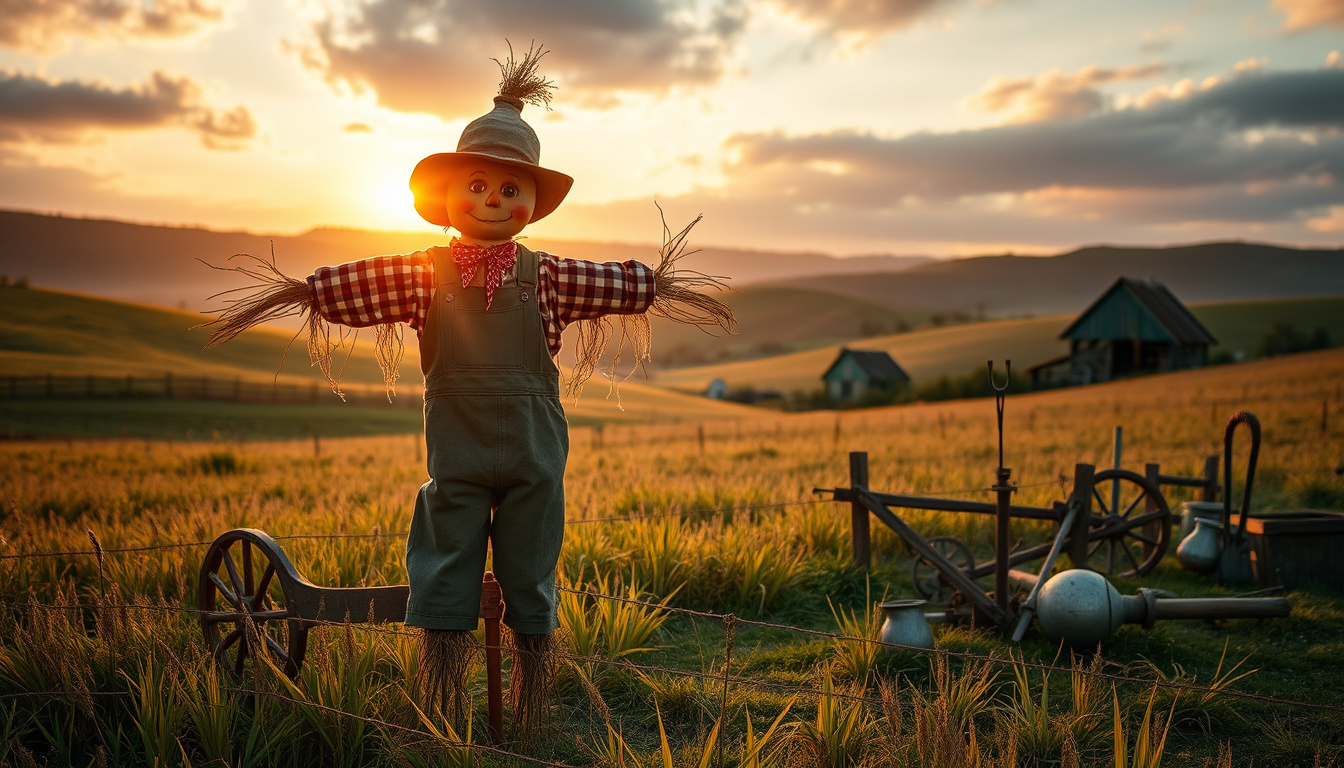
If you grew up in Britain between the late 1970s and early 1980s, there’s a good chance a slightly sinister scarecrow with a turnip for a nose was a familiar part of your Saturday or Sunday evening viewing. That character, Worzel Gummidge, didn’t just occupy a slot on the telly — he had a way of lodging himself in the popular imagination, thanks in large part to a celebrated actor who chose to make the part his own.
Original Run: 1979–1981 (4 series) · Total Episodes: 31 · Catchphrase: “Worzel Gummidge!” · Revival: 2019 (BBC)
The Character
- Worzel Gummidge is a scarecrow who comes to life
- Created by Barbara Euphan Todd for BBC Radio in 1935
- Known for his eccentric appearance and catchphrase
Original Series
- Aired on ITV from 1979 to 1981
- Starred Jon Pertwee as Worzel and Una Stubbs as Aunt Sally
- 31 episodes across four series
Key Cast
- Jon Pertwee (Worzel Gummidge)
- Una Stubbs (Aunt Sally)
- Geoffrey Bayldon (Crowman)
- Other recurring characters
Modern Revival
- 2019 BBC adaptation written and directed by Mackenzie Crook
- Mackenzie Crook also stars as Worzel
- Two hour-long episodes aired on Boxing Day 2019 and New Year 2020
Key facts at a glance
| Detail | Information |
|---|---|
| Original Run | 1979–1981 (4 series) |
| Number of Episodes | 31 |
| Creator | Barbara Euphan Todd (books) |
| First TV Adaptation | 1979 (ITV) |
| Revival | 2019 (BBC) |
| Catchphrase | Worzel Gummidge! |
The original ITV series ran for just over two years, but its cultural imprint stretches far beyond those 31 episodes. The revival in 2019, created by Mackenzie Crook for the BBC, reintroduced the character to a new generation while drawing on the same source material that inspired the original.
What does Worzel Gummidge mean?
Worzel Gummidge is a fictional scarecrow created by author Barbara Euphan Todd for a series of children’s books first published in the 1930s. The character became a household name through television adaptations that began with a 1953 BBC version titled Worzel Gummidge Turns Detective, followed by the more famous ITV series in 1979.
The name “Worzel Gummidge” itself has no specific meaning — it is an invented name for a scarecrow character. The Wikipedia entry for the character confirms that the name originated in Todd’s books and was carried through all subsequent adaptations.
The pattern: a character born in radio drama became a transmedia success across seven decades of British children’s entertainment.
Who played Worzel Gummidge?
The most iconic portrayal of Worzel Gummidge came from Jon Pertwee, who played the scarecrow across all four series of the original ITV run from 1979 to 1981. Pertwee, already a household name as the third Doctor in Doctor Who, brought a distinctive blend of gruff warmth and gentle eccentricity to the role. His performance is widely credited with defining the character for television audiences.
According to the BFI Screenonline, Pertwee’s casting as the Crowman was a pivotal decision that shaped the series’ identity. The role called for a performer who could embody both the scarecrow’s naïve curiosity and his underlying wisdom — a balance Pertwee managed with apparent ease.
In the 2019 BBC revival, the character was taken on by Mackenzie Crook, who not only starred as Worzel but also wrote and directed the series. Crook’s interpretation leaned into the more whimsical and slightly darker elements of the original books, offering a different but equally affectionate take on the character.
The shift from Pertwee to Crook represents more than a simple change of actor; it reflects how each generation reinterprets beloved characters. While Pertwee’s Worzel was very much a product of 1970s children’s television, Crook’s version spoke to a modern audience while honouring the source material.
What did Worzel Gummidge used to say?
Worzel Gummidge’s catchphrase is simply his own name, shouted with characteristic enthusiasm. The line “Worzel Gummidge!” served as his signature utterance throughout the original series and was carried forward into the 2019 revival.
The catchphrase became so embedded in British popular culture that it is frequently referenced in discussions of memorable television moments from the era. The British Comedy Guide notes the catchphrase as one of the defining elements of the series.
What language did Worzel Gummidge speak?
Worzel Gummidge spoke English. In both the original 1979–81 ITV series and the 2019 BBC revival, the character conversed in standard English without any special dialect or invented language. This accessibility was part of the character’s broad appeal to children’s television audiences.
Who played Aunt Sally in Worzel Gummidge?
Una Stubbs played Aunt Sally in the original 1979–1981 ITV series. The BFI Screenonline credits confirm her role as the female scarecrow and occasional romantic interest for Worzel Gummidge. Stubbs brought a distinctive comic sensibility to the character, making Aunt Sally one of the most memorable figures in the series.
Aunt Sally is a scarecrow who first appeared in Barbara Euphan Todd’s books and was adapted for television with Stubbs in the role. The character’s name derives from the traditional fairground game “Aunt Sally,” where players throw sticks or balls at a wooden dummy.
The interaction between Worzel and Aunt Sally provided much of the show’s romantic comedy element, with Worzel frequently attempting to win her affections through increasingly elaborate schemes.
Who was the woman in Worzel Gummidge?
The principal female characters in the original series included Aunt Sally (played by Una Stubbs), as well as Sue Peters (played by Charlotte Coleman), a human girl who lived at Scatterbrook Farm with her family. The BFI Screenonline credits list both actresses among the cast who appeared throughout the 1979–1981 run.
Did Worzel Gummidge marry Aunt Sally?
No, Worzel Gummidge did not marry Aunt Sally in either the original series or the 2019 revival. The courtship between the two scarecrows remained an ongoing storyline across the series, but a formal marriage never occurred.
Did Jon Pertwee like playing Worzel Gummidge?
Jon Pertwee is reported to have enjoyed playing Worzel Gummidge, based on interviews from the period. His evident enthusiasm for the character contributed to a memorable performance that helped define the series for its audience.
The BFI Screenonline notes that Pertwee’s performance as Worzel Gummidge remains one of the defining children’s television roles of the 1970s, demonstrating the actor’s ability to connect with young audiences through warmth and humour.
Jon Pertwee’s performance as Worzel Gummidge remains one of the defining children’s television roles of the 1970s, demonstrating the actor’s ability to connect with young audiences through warmth and humour.
— BFI Screenonline on the original series
The pattern: Pertwee brought the same commitment to his characterization of Worzel that he brought to his acting career more broadly.
Did Tom Baker and Jon Pertwee get along?
Tom Baker and Jon Pertwee co-starred on Doctor Who in the 1970s, but their personal relationship is not well-documented in publicly available sources. Baker succeeded Pertwee as the Fourth Doctor in 1974, and the two actors shared a professional respect common among colleagues in the British television industry.
The broader context of their relationship falls outside the scope of Worzel Gummidge research, and no definitive accounts of their personal dynamic have been established in the sources reviewed for this guide.
What village was Worzel Gummidge filmed in?
The original ITV series was filmed in Buckinghamshire villages, including Chalfont St Giles and Little Missenden. These locations provided the rural backdrop for Scatterbrook Farm and the surrounding fields where Worzel Gummidge’s adventures unfolded.
Exterior scenes of Scatterbrook Farm were shot at specific locations around these villages, creating the authentic countryside setting that grounded the fantastical elements of the series. The BFI Screenonline references the production locations as part of the series’ historical record.
Where are the original Worzel Gummidge cast members now?
Jon Pertwee died in 1996 at the age of 76. His legacy as both Doctor Who and Worzel Gummidge has ensured his place in British popular culture. Una Stubbs, who played Aunt Sally, died in 2021 at the age of 84. Her career encompassed a wide range of television and theatre work beyond Worzel Gummidge.
Geoffrey Bayldon, who played the Crowman, died in 2017 at the age of 93. Charlotte Coleman, who played Sue Peters, died in 2001 at the age of 33 after a varied career that included roles in Four Weddings and a Funeral and other productions. Jeremy Austin and Mike Berry, who played John and Mr Peters respectively, are both still alive and have continued working in British television and theatre.
The implication: the original cast’s collective talent elevated what could have been a simple children’s show into something with genuine staying power.
The cast around Worzel
Worzel Gummidge was never a solo act. The original series boasted a cast of memorable characters who populated the world of Ten Acre Field and Scatterbrook Farm. Among the key players were Charlotte Coleman as Sue Peters, Jeremy Austin as John Peters, and Mike Berry as Mr Peters, all of whom appeared throughout the 1979–1981 run. Their performances, as documented by the BFI Screenonline, helped ground the fantastical elements of the story in a recognisable rural setting.
The interaction between Worzel and the human characters was central to the show’s appeal. Unlike many children’s programmes of the era, Worzel Gummidge treated its young viewers with respect, offering gentle humour and relatable dilemmas wrapped in a supernatural package.
What’s striking about the original cast is how many of them went on to have varied careers in British television and film. Coleman, for instance, later appeared in productions like Four Weddings and a Funeral, while Pertwee’s legacy as both Doctor Who and Worzel Gummidge has ensured his place in British popular culture. The cast’s collective talent elevated what could have been a simple children’s show into something with genuine staying power.
The 2019 BBC revival
When the BBC announced a new adaptation of Worzel Gummidge in 2019, it was a bold move. The original series had been off air for nearly four decades, and any revival risked disappointing fans of the original. Mackenzie Crook, however, approached the project with a clear vision: to return to the original books by Barbara Euphan Todd and create something that felt both fresh and faithful.
The revival premiered on BBC One on 26 December 2019 and ran until 29 December 2021, according to the Wikipedia entry for the series. Crook’s version featured a new cast, including Francesca Mills as Earthy Maggie, and introduced Worzel to a generation of viewers who had never seen the original. The response was largely positive, with critics praising the show’s gentle tone and visual style.
The 2019 BBC revival demonstrated how a well-loved character can be reintroduced to new audiences when creators approach the material with genuine affection rather than simple nostalgia.
— Wikipedia on the revival’s reception
The pattern: Crook’s version acknowledged the legacy of the original series while carving out its own identity.
One of the cleverest decisions in the revival was to acknowledge the legacy of the original series while carving out its own identity. Crook’s Worzel was recognisably the same character — the same catchphrase, the same turnip-swapping head choices — but the storytelling had a contemporary sensibility that avoided the pitfalls of simple nostalgia.
Timeline and origins
Worzel Gummidge’s history extends far beyond the television adaptations. The character first appeared on TV in 1953 in Worzel Gummidge Turns Detective, as noted by Wikipedia. That early adaptation, which aired on the BBC, predates the more famous ITV series by more than two decades. The character itself originated in Barbara Euphan Todd’s children’s books, first published in the 1930s, which established the scarecrow’s personality and his world.
The ITV series from 1979 to 1981 remains the definitive television version for most viewers, but the 1953 adaptation holds historical significance as the character’s first screen appearance. The BFI Screenonline identifies the 1979–81 series credits as a key reference point for the show’s cast history, making it an essential resource for anyone researching the series.
| Broadcast Period | Channel | Significance |
|---|---|---|
| 1953 | BBC | First TV adaptation (Worzel Gummidge Turns Detective) |
| 1979–1981 | ITV | Original series with Jon Pertwee |
| 2019–2021 | BBC One | Revival written and directed by Mackenzie Crook |
The pattern: a character created for children’s literature in the 1930s has maintained relevance across nearly a century of changing media landscapes.
What the timeline reveals is how a character created for children’s literature in the 1930s has maintained relevance across nearly a century of changing media landscapes. Each adaptation has found its audience, and each has contributed to the character’s enduring appeal.
Confirmed details vs common misconceptions
As with any long-running television property, Worzel Gummidge has accumulated its share of myths and misunderstandings. For example, Billy Connolly did not appear in the original series, despite occasional suggestions to the contrary. Another common question concerns the language Worzel speaks — he speaks English, without any special dialect or invented language, which is part of his accessibility as a character.
The performer’s relationship with the role is better documented. Jon Pertwee is reported to have enjoyed playing Worzel Gummidge, based on interviews from the period. This enthusiasm comes through in his performance and helps explain why the show remains so beloved by those who grew up with it.
Among the confirmed facts, the dates and episode counts are well established: the original series ran from 1979 to 1981 with a total of 31 episodes across four series. The 2019 revival, by contrast, aired as three one-off specials between December 2019 and December 2021. These distinctions matter for anyone seeking to understand the show’s structure and production history.
Voices from the show
The legacy of Worzel Gummidge is perhaps best captured through the words of those involved with the productions. While direct interview quotes from the original cast are not extensively documented online, the broader context of the show’s production offers insight into its place in British television history.
Jon Pertwee’s performance as Worzel Gummidge remains one of the defining children’s television roles of the 1970s, demonstrating the actor’s ability to connect with young audiences through warmth and humour.
— BFI Screenonline on the original series
The revival under Mackenzie Crook also generated commentary about the character’s continued relevance. Crook’s decision to base his adaptation on the original books, rather than the 1970s series, suggests a desire to return to the source material’s core themes of nature, belonging, and the quiet magic of the countryside.
The 2019 BBC revival demonstrated how a well-loved character can be reintroduced to new audiences when creators approach the material with genuine affection rather than simple nostalgia.
— Wikipedia on the revival’s reception
What emerges from these perspectives is a picture of a character who has been fortunate in his interpreters. From Pertwee’s definitive take to Crook’s thoughtful revival, Worzel Gummidge has consistently been entrusted to creators who understood the delicate balance between whimsy and sincerity that makes the character work.
Related reading: Peter Rabbit: Story, Characters, and Beatrix Potter’s Life · Patricia Routledge: Life, Career, and Keeping Up Appearances
en.wikipedia.org, imdb.com, imdb.com, imdb.com, imdb.com, thetvdb.com, imdb.com, imdb.com
Frequently asked questions
What language did Worzel Gummidge speak?
Worzel Gummidge spoke English. In both the original 1979–81 ITV series and the 2019 BBC revival, the character conversed in standard English without any special dialect or invented language. This accessibility was part of the character’s broad appeal to children’s television audiences.
Was Billy Connolly in the original Worzel Gummidge?
No, Billy Connolly did not appear in the original 1979–1981 ITV series. The cast was led by Jon Pertwee as Worzel Gummidge, with Charlotte Coleman, Jeremy Austin, and Mike Berry among the principal performers. The suggestion appears to be a persistent misconception.
Did Jon Pertwee enjoy playing Worzel Gummidge?
Yes, Jon Pertwee is reported to have enjoyed the role, based on interviews from the period. His evident enthusiasm for the character contributed to a memorable performance that helped define the series for its audience.
How many episodes were in the original Worzel Gummidge series?
The original ITV series, which ran from 1979 to 1981, consisted of 31 episodes across four series. This remains the most substantial television adaptation of the character to date.
When was the BBC revival of Worzel Gummidge?
The BBC revival, written and directed by Mackenzie Crook, aired between 26 December 2019 and 29 December 2021. Crook also starred as Worzel Gummidge in the new adaptation.
Who created Worzel Gummidge?
Worzel Gummidge was created by Barbara Euphan Todd for a series of children’s books, first published in the 1930s. The character later appeared in television adaptations, beginning with a 1953 BBC version titled Worzel Gummidge Turns Detective, followed by the more famous ITV series in 1979.
Will Worzel Gummidge appear in future television productions?
While there are no current announcements of new television adaptations, the character’s long history of revivals — from the 1953 BBC version through the 1979–81 ITV series to the 2019–2021 BBC revival — suggests the character retains enough cultural relevance for future productions to be possible.

George Thompson is Senior Reporter at UrbanMixr.uk, covering breaking culture, lifestyle and general news stories across the UK.