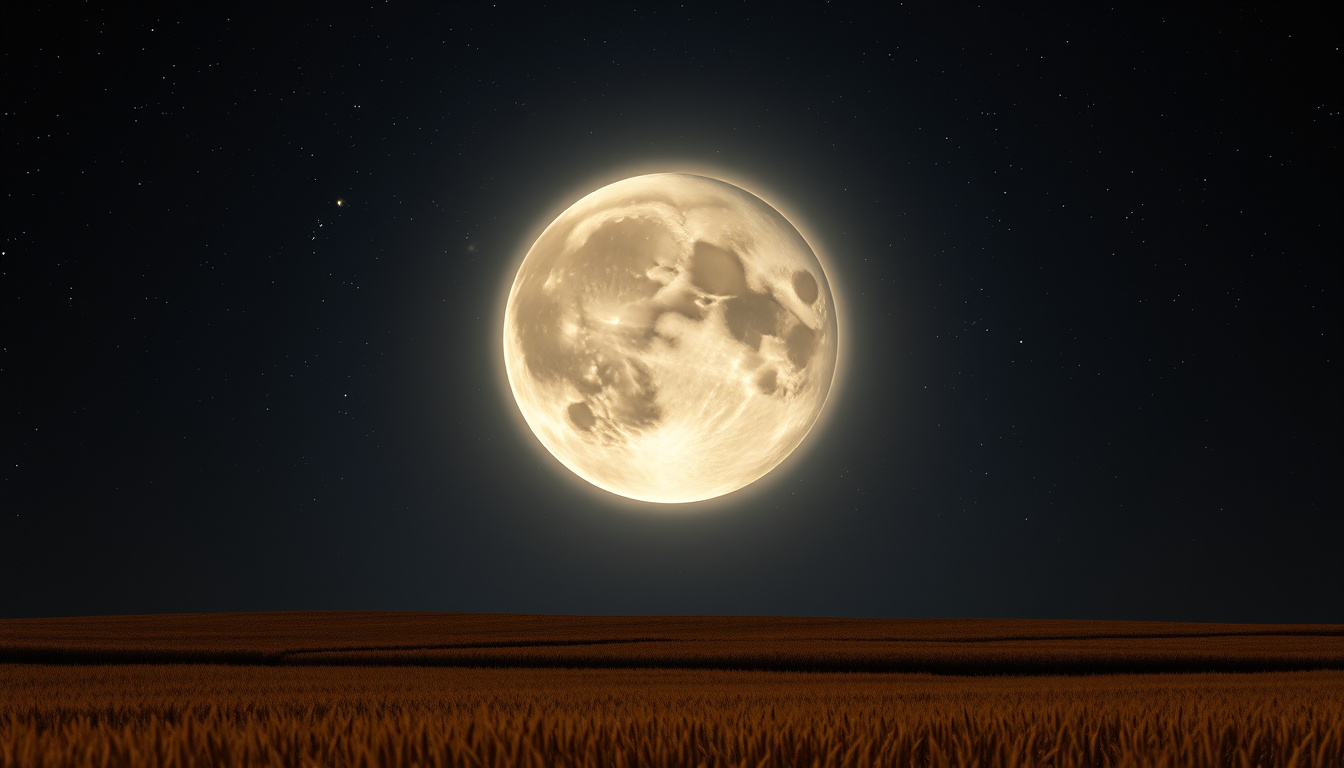

Skywatchers across the Eastern Hemisphere are preparing for a remarkable celestial event on September 7, 2025, when the full moon reaches its peak illumination at exactly 18:09 UTC. This month’s full moon coincides with a total lunar eclipse, offering observers a rare opportunity to witness Earth’s shadow completely covering the lunar surface for approximately 83 minutes. Unlike some recent full moons, this September event does not qualify as a supermoon, as the moon’s closest approach to Earth does not align with the full phase.
The September full moon carries the traditional name Corn Moon, marking the third full moon of the summer season in the Northern Hemisphere. While it shares some visual characteristics with the Harvest Moon—rising near sunset for several consecutive nights—this particular full moon occurs before the autumnal equinox, making the true Harvest Moon designation belong to October’s full moon instead.
When Is the Full Moon in September 2025?
The full moon reaches its exact peak phase on Sunday, September 7, 2025, at 18:09 UTC. Astronomers define this moment as opposition, when the moon sits precisely 180 degrees from the sun, placing it on the opposite side of Earth’s sky. For observers in North America, this translates to afternoon and evening viewing opportunities on September 7.
The moon appears nearly full on the evenings of September 6 and 8, though it reaches its absolute roundest state on September 7. Casual observers may find these neighboring nights equally satisfying for viewing.
September 2025 Full Moon Overview
| Attribute | Details |
|---|---|
| Date | September 7, 2025 |
| Peak Time (UTC) | 18:09 |
| Traditional Name | Corn Moon |
| Supermoon Status | No |
Moonrise times vary significantly depending on geographic location. In Los Angeles and San Francisco, the moon rises at approximately 11:09 a.m. PDT on September 7, which corresponds to 18:09 UTC. For viewers on the East Coast of the United States, the moon will be visible during evening hours as it moves through its full phase. Locations in Europe and Asia will have optimal viewing conditions during their local nighttime hours.
- The full moon occurs approximately one week before the September equinox on September 22, 2025
- This marks the third full moon since the June summer solstice
- The moon remains nearly full for several nights, simplifying observation planning
- The eclipse reaches maximum visibility at 18:11 UTC, just two minutes after the peak full moon phase
- Eastern Hemisphere observers have the best chance of witnessing the complete eclipse sequence
- Western areas of the Americas may catch partial phases before moonset
Key Facts About the September 2025 Full Moon
| Fact | Details |
|---|---|
| Illumination at Peak | Approximately 100% |
| Eclipse Type | Total Lunar Eclipse |
| Totality Duration | Approximately 83 minutes |
| Supermoon | No perigee alignment confirmed |
| Next Full Moon | October 6-7, 2025 |
| Visibility Region | Eastern Hemisphere preferred |
What Is the September 2025 Full Moon Called?
The September full moon traditionally carries the name Corn Moon among various indigenous and folkloric naming traditions. This designation reflects the agricultural cycle of the Northern Hemisphere, where September historically marked the peak of corn harvesting across many cultures. The name appears in almanac traditions and continues to be used by skywatchers who follow seasonal lunar nomenclature.
Some astronomical sources and traditions refer to the September full moon using zodiac-based naming conventions, identifying it as the Full Moon in Pisces or Aquarius, depending on the precise position of the moon against the star background. These astrological labels serve as one of several naming frameworks used throughout the year.
The Harvest Moon Distinction
A common point of confusion surrounds the Harvest Moon label. The true Harvest Moon for 2025 occurs in early October, specifically on October 6-7, when the full moon aligns nearest to the autumnal equinox on September 22. This timing is not arbitrary—it reflects the traditional agricultural calendar when farmers relied on moonlight to extend their working hours during harvest.
September 2025’s full moon is not the Harvest Moon. The Harvest Moon designation belongs to October 6-7, 2025, which falls closest to the autumnal equinox. While the September moon shares some visual characteristics with harvest moons, the astronomical definition reserves that title for the equinox-nearest full moon.
Despite this distinction, the September full moon does exhibit Harvest Moon-like traits. The moon rises near sunset for several consecutive nights, with the delay between nightly moonrises being approximately 50 minutes. This phenomenon occurs because of the shallow angle the ecliptic makes with the horizon during autumn months, creating the characteristic low trajectory of the harvest moon across the sky.
Is the September 2025 Full Moon a Supermoon?
No, the September 2025 full moon does not qualify as a supermoon. Supermoon classification requires the full moon to occur when the moon is at or near perigee—its closest approach to Earth in its elliptical orbit. Available astronomical data does not confirm perigee alignment with the September 7 full moon phase.
Supermoons typically appear approximately 7% larger and 16% brighter than an average full moon. The September 2025 event will appear as a standard full moon in terms of apparent size and brightness, though it remains a visually striking object when full and particularly captivating during the total eclipse phase.
Understanding Supermoon Classification
The supermoon term, while widely used in popular astronomy, does not have a universally standardized definition among professional astronomers. Various sources apply different thresholds for perigee distance, with some considering any full moon within approximately 360,000 kilometers of Earth as qualifying. Under more conservative definitions, only full moons within 360,000 kilometers accompanied by actual perigee timing receive the designation.
The September 2025 full moon’s distance from Earth, while not precisely quantified in the available data, does not appear to meet supermoon thresholds. Observers should not expect the enhanced visual impact associated with supermoons, though the eclipse compensation provides its own compelling visual experience.
How and Where to View the September 2025 Full Moon
The total lunar eclipse accompanying the September full moon offers the most compelling viewing opportunity of this event. Unlike solar eclipses, lunar eclipses are completely safe to observe with the naked eye, and no special equipment is required. However, binoculars or a small telescope can enhance the experience by revealing subtle color variations across the lunar surface during totality. Those planning observation sessions should consult TimeAndDate.com for comprehensive eclipse tracking and visibility maps.
Total Lunar Eclipse Timeline
The eclipse sequence on September 7 follows a structured progression as Earth moves between the sun and moon. Understanding these phases helps observers know what to expect throughout the evening.
| Eclipse Phase | Time (UTC) |
|---|---|
| Penumbral begins | 15:28 |
| Partial begins | 16:26 |
| Totality begins | 17:30 |
| Maximum eclipse | 18:11 |
| Totality ends | 18:53 |
| Partial ends | 19:56 |
| Penumbral ends | 20:55 |
Best Viewing Locations
Visibility for the total eclipse favors the Eastern Hemisphere, where the moon will be above the horizon during the peak phases. Specific viewing conditions vary by location.
- Europe: London observers can see the moon rise while already in Earth’s umbra at approximately 19:30 local time, with totality ending at 19:52. Dublin offers a dramatic view of the moon rising already reddened by the eclipse.
- Africa and Asia: These regions generally offer excellent viewing throughout the complete eclipse sequence, with the moon positioned high in the sky during maximum eclipse.
- Australia: Melbourne can observe partial phases and totality before moonset, providing meaningful viewing windows despite the shorter visibility window.
- India: The moon will be high in the sky during maximum eclipse, offering optimal atmospheric conditions for observation.
- Americas: Western regions may catch partial phases before moonset, though the full totality sequence is not visible from most North American locations.
Viewing Tips and Conditions
The lunar eclipse will cause the moon to take on a distinctive reddish coloration during totality, a phenomenon often called the Blood Moon effect. This coloring results from Earth’s atmosphere filtering sunlight, scattering blue wavelengths while allowing red light to pass through and illuminate the lunar surface.
Optimal viewing conditions require clear skies and an unobstructed eastern horizon, particularly for locations where the moon is rising during the eclipse. Urban areas with light pollution may still provide adequate views for the eclipse itself, as the darkened moon during totality is easier to observe than a bright full moon. The European Space Agency provides guidance on light pollution effects and optimal observation sites across the continent.
No specific weather forecasts are available for September 2025 as this remains a future event relative to current data. Observers should monitor local weather services closer to the date and plan alternative viewing arrangements if clouds are expected. Atmospheric clarity significantly impacts the quality of eclipse observation.
Binoculars with 7x to 10x magnification provide an excellent balance between portability and detail, allowing observers to see crater formations and subtle color gradations across the eclipsed surface. A small telescope can reveal additional detail, though the unaided eye experience of the Blood Moon effect remains compelling regardless of optical aid.
Photography Considerations
Photographing the eclipse requires different techniques than standard moon photography. During totality, longer exposures become necessary as the moon darkens significantly. A sturdy tripod is essential for any serious lunar eclipse photography. Smartphone cameras can capture the partially eclipsed and total phases with varying success, though dedicated cameras with manual settings provide greater creative control.
What Makes the September 2025 Full Moon Significant?
The September 2025 full moon holds significance across multiple domains, combining astronomical rarity with cultural resonance. Its position as the third full moon of summer, combined with the total eclipse, creates a noteworthy celestial event that connects astronomical observation with traditional calendar systems.
Astronomical Significance
From an astronomical perspective, the event represents the third full moon in the sequence from June’s summer solstice to September’s autumnal equinox. The total lunar eclipse provides an extended viewing opportunity, with the total phase lasting approximately 83 minutes—longer than many eclipses, allowing for extended observation and photography. For those interested in upcoming sporting events, the Australian Open 2026 schedule can be found at Australian Open 2026 schedule.
The eclipse geometry reaches its peak at 18:11 UTC, with the moon positioned at its zenith over the Indian Ocean. This positioning places most of the Eastern Hemisphere in optimal viewing range, with the moon high enough above the horizon to minimize atmospheric interference that can distort views near the horizon.
Cultural and Historical Context
The Corn Moon name connects the astronomical event to agricultural heritage, specifically referencing the late summer harvest of corn and other grain crops. In many indigenous and folk traditions, the September full moon signals the final stages of the harvest season before autumn preparations begin.
The zodiac position of the moon in Pisces or Aquarius during this phase holds significance in Western astrological traditions, which associate these signs with themes of release, celebration, and collective consciousness. Whether one assigns credence to astrological frameworks or views them as cultural traditions, these associations reflect the diverse ways humans have historically connected celestial events to earthly experience.
Understanding the Harvest Moon Connection
The relationship between the September full moon and the Harvest Moon designation requires careful distinction. While these terms are sometimes used interchangeably in popular media, astronomical definitions maintain a clear separation based on the lunar calendar’s alignment with the equinox.
The true Harvest Moon for 2025 occurs October 6-7, falling within days of the September 22 equinox. This timing is significant because the full moon nearest the equinox receives the Harvest Moon designation, regardless of whether it occurs in September or October. The October 2025 full moon reaches its peak at 04:48 UTC on October 7, making it the equinox-nearest full moon and thus the official Harvest Moon.
The September full moon, while not carrying the official Harvest Moon title, does exhibit similar Harvest Moon characteristics. The moon rises near sunset for multiple consecutive nights, with relatively short delays between nightly moonrises. This effect historically aided farmers working extended hours during harvest, hence the traditional name.
What’s Next After the September 2025 Full Moon?
Following the September 7 full moon, skywatchers can anticipate the next significant lunar event in October. The Harvest Moon on October 6-7, 2025, will provide the official harvest-related viewing opportunity, coinciding with the autumnal equinox. This October full moon will also be a supermoon, as its timing aligns more closely with lunar perigee.
For those interested in broader celestial events, the remainder of 2025 offers additional viewing opportunities. Checking reliable astronomical sources such as NASA for updates on future eclipses, meteor showers, and planetary alignments helps maintain engagement with skywatching activities throughout the year.
The sequence of full moons following September includes the Hunter’s Moon in November, traditionally associated with the hunting season that followed harvest, and the Cold Moon in December, marking the onset of winter conditions. Each of these full moons carries its own traditional names and cultural associations rooted in seasonal observations.
What Information Is Confirmed Versus Uncertain?
The full moon peak at 18:09 UTC on September 7, 2025, is confirmed across multiple astronomical sources. The total lunar eclipse timing and phases are verified, with penumbral phases beginning at 15:28 UTC and ending at 20:55 UTC. The eclipse totality duration of approximately 83 minutes is established. The Corn Moon name is confirmed as the traditional September full moon designation. The non-supermoon status is confirmed based on lack of perigee alignment.
The September 2025 full moon does not qualify as a supermoon, with no perigee confirmation from available sources.
Precise rise and set times for specific locations require local calculation or verification closer to the date. Weather conditions at viewing locations cannot be predicted in advance. Specific distance measurements from Earth to the moon on September 7 are not provided in available sources.
The visibility window for specific cities may require verification through local astronomical resources or planetarium applications closer to the date. While general regional guidance is available, individuals planning specific observation sessions should confirm local conditions through Royal Museums Greenwich or similar reliable sources.
Sources and Further Reading
Astronomical timing data for the September 2025 full moon and lunar eclipse comes from multiple sources that align on the core details. EarthSky and Moongiant provide consistent information regarding the peak timing and eclipse phases, with minor variations in presentation but agreement on the fundamental data.
Comprehensive eclipse tracking and lunar phase information is available through astronomical publications and observatory resources. For those planning observation activities, consulting official astronomical calendars closer to the date ensures access to the most current timing data and any adjustments that might occur.
The distinction between the Corn Moon and Harvest Moon designations, along with the traditional naming rationale, draws from folkloric and almanac traditions that have documented lunar calendars for agricultural and cultural purposes.
Summary
The full moon on September 7, 2025, at 18:09 UTC offers a compelling celestial event highlighted by a total lunar eclipse visible primarily across the Eastern Hemisphere. The Corn Moon, as this September full moon is traditionally called, is not a supermoon and is distinct from the Harvest Moon, which arrives in October. The total eclipse phase lasts approximately 83 minutes, providing an extended opportunity for observation. Viewing requires no special equipment, though binoculars enhance crater detail visibility. Those interested in related astronomical events may find the World Athletics Championships 2025 Schedule relevant, as both events occur in late August and September 2025, offering multiple reasons to check celestial calendars alongside sporting events. For those tracking time-related phenomena, the UK Time Change 2025 provides relevant context for understanding UTC conversions and local time considerations when observing astronomical events.
Frequently Asked Questions
How long does the full moon last in September 2025?
The full moon reaches its peak illumination at 18:09 UTC on September 7. The moon appears nearly full for several nights, with the exact full phase lasting only minutes at peak but remaining visually full for approximately 24 hours centered on that peak.
What weather affects viewing the full moon in September 2025?
Clear skies provide optimal viewing conditions. Atmospheric clarity impacts the quality of eclipse observation, particularly near the horizon. Cloud cover obscures the moon entirely. No specific September 2025 forecasts exist yet, as this remains a future event.
Is the September 2025 full moon a supermoon?
No. Available astronomical data does not confirm perigee alignment with the September 7 full moon phase, so it does not qualify as a supermoon. The October 2025 full moon is expected to be a supermoon.
Why is the September full moon called the Harvest Moon?
It is not. The September full moon is called the Corn Moon. The Harvest Moon designation belongs to the October 6-7 full moon, which falls nearest the autumnal equinox. The September moon shares some visual characteristics with harvest moons but does not receive that title.
Where is the total lunar eclipse visible on September 7, 2025?
The total lunar eclipse is best visible across the Eastern Hemisphere, including Europe, Africa, Asia, and Australia. Western Americas may see partial phases before moonset. Eastern Hemisphere locations have the moon above the horizon during the full totality phase.

Sophie Larkin is Culture & Events Editor at UrbanMixr.uk, covering UK culture, events, festivals, arts and pop culture.