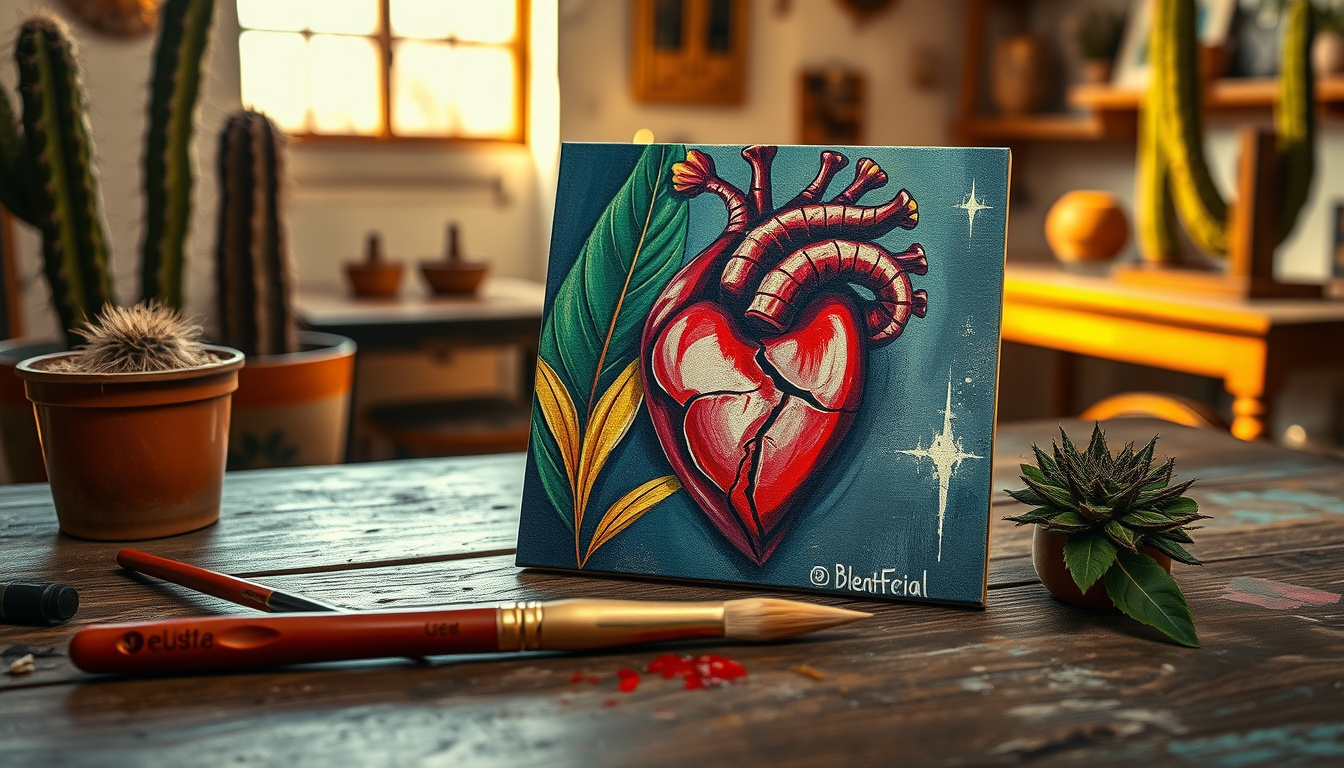
Few faces in modern art are as instantly recognizable as Frida Kahlo’s, yet the life behind the unbroken unibrow was far more painful than any painting suggests. Behind those iconic self-portraits lies a biography of physical agony, political defiance, and a marriage as volatile as the colors on her canvas.
Frida Kahlo at a Glance
- Born July 6, 1907, Coyoacán, Mexico – Museo Frida Kahlo
- Polio at age 6 – Encyclopedia.com
- Bus accident at 18 – National Museum of Women in the Arts
- Self-portraits – Britannica
- Mexican folk art influence – Britannica
- Surrealist exhibitions – Britannica
- Married Diego Rivera – Encyclopedia.com
- Bisexual relationships – Encyclopedia.com
- Three miscarriages – National Museum of Women in the Arts
- Feminist icon – Smithsonian Magazine
- LGBTQ representation – Encyclopedia.com
- Political activism – Britannica
Born: July 6, 1907, Coyoacán, Mexico | Died: July 13, 1954, Coyoacán, Mexico | Known for: Self-portraits, surrealism, Mexican folk art | Notable works: The Two Fridas, Self-Portrait with Thorn Necklace and Hummingbird | Major accident: 1925 bus crash that led to lifelong health issues
Key Facts: Frida Kahlo
| Label | Value |
|---|---|
| Full name | Magdalena Carmen Frida Kahlo y Calderón |
| Born | July 6, 1907, Coyoacán, Mexico |
| Died | July 13, 1954, Coyoacán, Mexico |
| Nationality | Mexican |
| Art style | Naïve folk art, surrealism |
| Spouse | Diego Rivera (1929-1939, 1940-1954) |
| Children | None (three miscarriages) |
The facts confirm a life defined by physical and emotional extremes, a stark backdrop against which her art was born.
Who was Frida Kahlo and why is she so famous?
Frida Kahlo is widely recognized for her self-portraits and works inspired by Mexican nature and artifacts, but her fame transcends the canvas to embody a spirit of resilience. Rather than being labeled a Surrealist, she rejected the term, famously stating she painted her own reality, not dreams. Her global popularity stems from her unique visual language that merges personal suffering with a deep national consciousness, making her an icon for many, from art lovers to political activists.
Her fame was also cemented by her personal life, which she lived on her own terms. According to her biography, she was an artist known for her intense, often autobiographical paintings that depicted the female experience with unprecedented frankness. Britannica (which details her later-career works like The Two Fridas) highlights how her late-career works solidified her status as a master of the genre. She transformed her suffering—physical and emotional—into art that resonates universally, which is why her reputation has only grown since her death.
Why was Frida Kahlo LGBTQ?
Frida Kahlo is considered an LGBTQ+ icon because she lived openly as a bisexual woman in a time and place where it was far from accepted, particularly within her own social circles. Her relationships with both men and women, including infamous affairs with figures like Josephine Baker and Paulette Goddard, were well-documented, even if their details remained private for years. This openness, coupled with a defiant embrace of her own identity, made her a figure of pride for the community decades before “queer” was a common descriptor in popular culture.
Her personal portrayal of gender was also a form of resistance. In a series of famous photographs, Kahlo appears in masculine-coded suits, wearing her hair cropped short, challenging the gender norms of conservative Mexican society just as she embraced traditional Tehuana dresses. This duality—the feminine and masculine, the traditional and the revolutionary—was not just a personal choice but a form of political and artistic expression. As one source notes, her relationship with her own identity was a bold statement. WikiArt (an artist-focused database) confirms her style was as much a part of her art as the paintings themselves, a point that underscores her importance to the LGBTQ community. She didn’t just exist within her sexuality; she celebrated it through her fashion and her interactions, making her a lasting symbol of queer identity.
What did Frida Kahlo do that was controversial?
Kahlo’s controversy partly stemmed from her radical political beliefs. She was an avowed Communist and an activist in the Mexican Communist Party, using her home and her art as a space for political discourse alongside her revolutionary friends. This political engagement, which translated into visually powerful murals and prints, painted her in a specific light during the Cold War era, making her a figure of both admiration and vilification. Her art, like The Two Fridas (1939), was deeply personal yet universally political, contrasting the Europeanized and the indigenous aspects of Mexican identity.
Another layer of controversy was her anti-Eurocentric stance in art. While other Latin American artists sought validation in Paris, Kahlo immersed herself in Mexican folk culture, proudly dressing in indigenous attire and adorning her home with “retablos” (votive paintings). She was unapologetic about her dual identity—a product of European and Mexican heritage—yet fiercely critical of colonial influences. Furthermore, her violent and passionate marriage to Diego Rivera, including their public affairs and even a brief divorce, was a scandal in its own time, one she corrected publicly by remarrying him. This dramatic life, full of reckonings with authority and societal expectations, ensured she was never a mere footnote in art history but a headline in the culture wars of her day.
Why did Frida Kahlo never shave her unibrows?
Frida Kahlo’s unibrow was a deliberate act of rebellion, a conscious refusal to alter her appearance to fit the narrow beauty standards of the West. In a society that prized European features, she exaggerated her own natural ones, sometimes even painting them bold and thickened in her self-portraits. This subversion was a core part of her political and cultural statement—a declaration that indigenous features were beautiful, and that a woman’s worth was not determined by her conformity to outside preferences. It was a way she could reclaim her own body from the constant medical gaze and her own mother’s traditional expectations.
She once said, “I am not a Surrealist… I never painted dreams. I painted my own reality,” and by contorting that reality to include a prominent unibrow, she insisted that reality was valid. This aesthetic choice was integral to her legacy, making her a symbol of radical self-acceptance. Rather than being a sign of neglect, her unibrow was a crucial part of a sophisticated visual identity that challenged and deconstructed European colonial standards of beauty. It was a marketing of her own “otherness” as a source of power, not shame, a point that is central to essays analyzing her iconic look. The Cleve Carney Museum of Art (a museum dedicated to offering accessible art experiences) describes how this visual defiance shaped her public reputation, turning her insecurities into a global brand of authenticity and artistic courage.
What was tragic about Frida Kahlo?
The central tragedy of Frida Kahlo’s life is the profound, unrelenting physical pain that she endured, primarily stemming from a devastating bus accident when she was 18 years old. After the accident, she suffered from multiple fractures in her spine, collarbone, ribs, and pelvis, leading to a lifetime of health crises and over 30 surgical operations. This chronic pain, described by the National Museum of Women in the Arts (who emphasize the impact of her injuries), forced her to live in a body that was broken, leading to physical decline and dependence on a series of custom-made corsets and prosthetics. She spent much of her life in constant pain related to those injuries and health complications, a fact which directly fed her incredible artistic output.
How many babies did Frida Kahlo lose?
Beyond the physical, there was great emotional tragedy, including her inability to carry a child to term. Her three miscarriages, coupled with the infidelity of her husband, Diego Rivera, with her own sister, created a deep well of grief and numbness that she channeled into her paintings. She often expressed her pain and despair by creating self-portraits that were unflinching portrayals of her vulnerability and shattered state. While her final diary entries joyfully awaited her exit, expressing a desire to never return, her death itself was tragic and steeped in controversy. Biography.com (the definitive biography site) notes that while officially ruled a pulmonary embolism, many suspect assisted suicide, further cementing the tragedy of an extraordinary woman who, even as she left, seemed to be in control of her own narrative.
What did Frida Kahlo’s husband do to her?
Diego Rivera’s infidelity was a persistent source of anguish for Kahlo. The most devastating betrayal was his affair with her younger sister, Cristina Kahlo, which led to their divorce in 1939. Rivera’s pattern of extramarital relationships—despite their mutual agreement about open marriage—often felt one-sided and humiliating to Kahlo. Even after they remarried in 1940, the emotional scars remained, and Rivera’s absences and ongoing womanizing continued to wound her. Encyclopedia.com records that these personal betrayals directly influenced the raw, bleeding imagery in many of her paintings.
What happened to Frida Kahlo’s relationship with Diego Rivera?
The relationship between Frida Kahlo and Diego Rivera is as famous as their individual works—a volatile, passionate, and intellectually entwined partnership that weathered affairs and a divorce. They married in 1929, a union that shocked many due to their differences in age and temperament, but they shared a deep devotion to art and Mexican culture. Rivera was a constant presence in her life, acting as a critic, champion, and biggest influence, but his infidelity was a source of immense pain. In 1939, they divorced, a period that led Kahlo to create some of her most potent and anguished paintings, but they remarried in 1940 because they could not live without each other, seeing each other as “fated” to be together despite the chaos.
Their dynamic was symbiotic, both artistically and personally. A museum researcher notes that their relationship granted them both a sense of purpose and companionship that transcended the traditional marital roles. The Cleve Carney Museum of Art (a venue that showcases Frida’s art and life) emphasizes that their love story was so intertwined with their creative trajectory that its public dissolution was shocking. Their home, La Casa Azul (The Blue House), was both a witness and a canvas for their dramatic narrative, transitioning from a symbol of their blended life to a shrine to their individual and shared history. The relationship was a codependent, intense, and, by all accounts, deeply necessary part of both of their creative processes.
How did Frida Kahlo die?
The official cause of Frida Kahlo’s death, on July 13, 1954, was a pulmonary embolism, a condition often associated with the respiratory infections and complications that plagued her in her final years. However, the circumstances surrounding her death remain a source of ongoing debate and suspicion. The public narrative was that she succumbed to a sudden illness, but various sources hint at a more foreboding truth. A key piece of the puzzle is that her diary entry read, “I joyfully await the exit – and I hope never to return,” suggesting a deep yearning to leave her painful existence. This has led many to speculate that her death was a suicide, with some reports confirming that she was cremated within hours of her passing.
Her final moments, as recounted by various biographers, are shadowed by ambiguity. Some sources report that her last words were about Diego Rivera, a final recognition of her lifelong obsession. The debate is fueled by the fact that she was heavily medicated for pain, and the exact circumstances of her dose, in relation to her stated desire to “never return,” suggest a possible intentional act. Biography.com (the leading biographical resource) notes that while the official record remains as a pulmonary embolism, the true nature of her death—whether a tragic accident of a broken body or a final act of defiant will—remains a central question in Kahlo’s mythology. Her death, like her life, became a provocative piece of art, open to interpretation and reinforcing her legendary status.
Confirmed Facts vs. Rumors
Separating the established biography from the apocryphal tales is crucial to understanding the real Frida Kahlo. Here is a clear breakdown of the evidence-based facts and the persistent rumors that have become part of the legend.
- She contracted polio as a child, leaving one leg weakened and thinner than the other – Encyclopedia.com
- Her 1925 bus accident resulted in severe injuries, including fractures to her spine and pelvis – National Museum of Women in the Arts
- She had a celebrated solo exhibition in Paris in 1939, though she had to wait until 1953 for her first solo show in Mexico – IAM.com
- She was an active Communist, advocating for left-wing causes, and briefly gave sanctuary to Leon Trotsky – Britannica
- Her relationship with Diego Rivera was a topic of public fascination, leading her to shave her hair and dress as a man in protest after his affair with her sister – Biography.com
- Kahlo’s first major U.S. retrospective took place in 1978 at the Museum of Contemporary Art Chicago – Cleve Carney Museum of Art
- Some believe her death was a suicide, but the official record, while challenged, has never been officially changed – Biography.com
- Rumors often overstate her romantic involvement with certain figures, conflating deep friendship with romantic affairs – Encyclopedia.com
- It is rumored that she never ate or socialized normally out of fear of her appearance, though these claims are contradicted by her many portrait sittings and social circle.
- Some biographers question the exact number of her sexual partners – Encyclopedia.com
- Details of her last words are disputed; different sources report different final phrases – Biography.com
- She legally changed her birth year to 1910 to align with the Mexican Revolution, but some historians argue the evidence is not definitive – Britannica
While this list clarifies the core truths, the persistent allure of the unknown keeps Kahlo’s story alive, proving that the myth is just as compelling as the reality.
What did Frida Kahlo say before she died?
Kahlo’s final diary entry, dated a few days before her death, reads: “I joyfully await the exit – and I hope never to return.” Some sources also report that her last spoken words were about Diego Rivera, though the exact phrasing varies. Biography.com notes that this ambiguity fuels the ongoing debate about whether her death was intentional.
I hope the exit is joyful — and I hope never to return.
Quotes From Frida Kahlo
I am not a Surrealist. I never painted dreams. I painted my own reality.
This quote, likely said in response to Andre Breton’s classification, is a well-documented sentiment that rejects any label other than her own.
I want to give you everything there is to give… you don’t know how much I want to make your life happy, my love.
A line from her letters to Diego Rivera, showing the intensity of her romantic devotion despite their public problems.
I hope the exit is joyful — and I hope never to return.
The final entry in her diary, a heartbreaking mix of weariness and resolve that contributes to the debate over her final days.
In these days I have learned many things. I have learned that the only thing I am certain of is that I am a woman who loves murals… and I am a woman who loves you.
A testament to her own self-awareness, and a poignant reminder that her legacy is intrinsically tied to her relationship with both art and life.
Frequently Asked Questions
Why is Frida Kahlo a unique artist in history?
Kahlo is unique because she created a deeply personal visual language that combined indigenous and Mexican folk art with her own physical and emotional pain. Unlike her male contemporaries, her work was not confined to public murals but focused intensely on the private, domestic sphere, which was revolutionary at the time. Her paintings are intimate, raw, and unflinchingly honest, making her a pioneer of emotional realism.
How did Frida Kahlo’s health affect her art?
Her health was the engine of her art. The constant pain, the corsets, and the immobility forced her to spend long hours in bed, turning inward and making her own face and body the central subjects of her work. Her paintings often depict her physical limitations with stark detail, such as in “The Wounded Deer” or “Without Hope,” where her body is a vessel for her suffering, making her art a form of therapy and autobiography.
What is the significance of the ‘Two Fridas’ painting?
The Two Fridas (1939) is a masterpiece of psychological symbolism, created during her divorce from Diego Rivera. It depicts a European Frida in a white dress, loved by Diego, and an indigenous Frida in a Tehuana dress, whom Diego rejected. It represents her dual heritage and the two sides of her identity, with severed arteries portraying the emotional pain of separation. It is a metaphor for her inner conflict and the complexities of identity.
Why are Frida Kahlo’s self-portraits so important?
Kahlo’s self-portraits are important because they were not representations of a beautiful ideal, but rather an honest exploration of identity, pain, and rebellion. She used her own face as a mirror to explore issues of colonialism, gender, and disability, challenges rarely tackled in such a direct way in high art. They function as a visual diary, offering a raw, unmediated look into the artist’s psyche long before identity politics was a mainstream concept.
Did Frida Kahlo ever have a solo exhibition in the US?
Yes, she had a highly successful solo exhibition at the Julien Levy Gallery in New York in 1938, which was a huge success. This was followed by another significant exhibition in Paris in 1939. Though she held a solo show in Mexico in 1953, the mainstream recognition from her international shows was critical in establishing her career and cementing her international reputation.
What does Frida Kahlo symbolize in modern culture?
In modern culture, Frida Kahlo has become a universal symbol of resilience, authenticity, and rebellion against the status quo. She represents the power of art to turn personal suffering into a collective voice, and her image is synonymous with non-conformity. She is a feminist icon and a hero to the LGBTQ and disability communities, representing an uncompromising stance on living life unapologetically.

George Thompson is Senior Reporter at UrbanMixr.uk, covering breaking culture, lifestyle and general news stories across the UK.