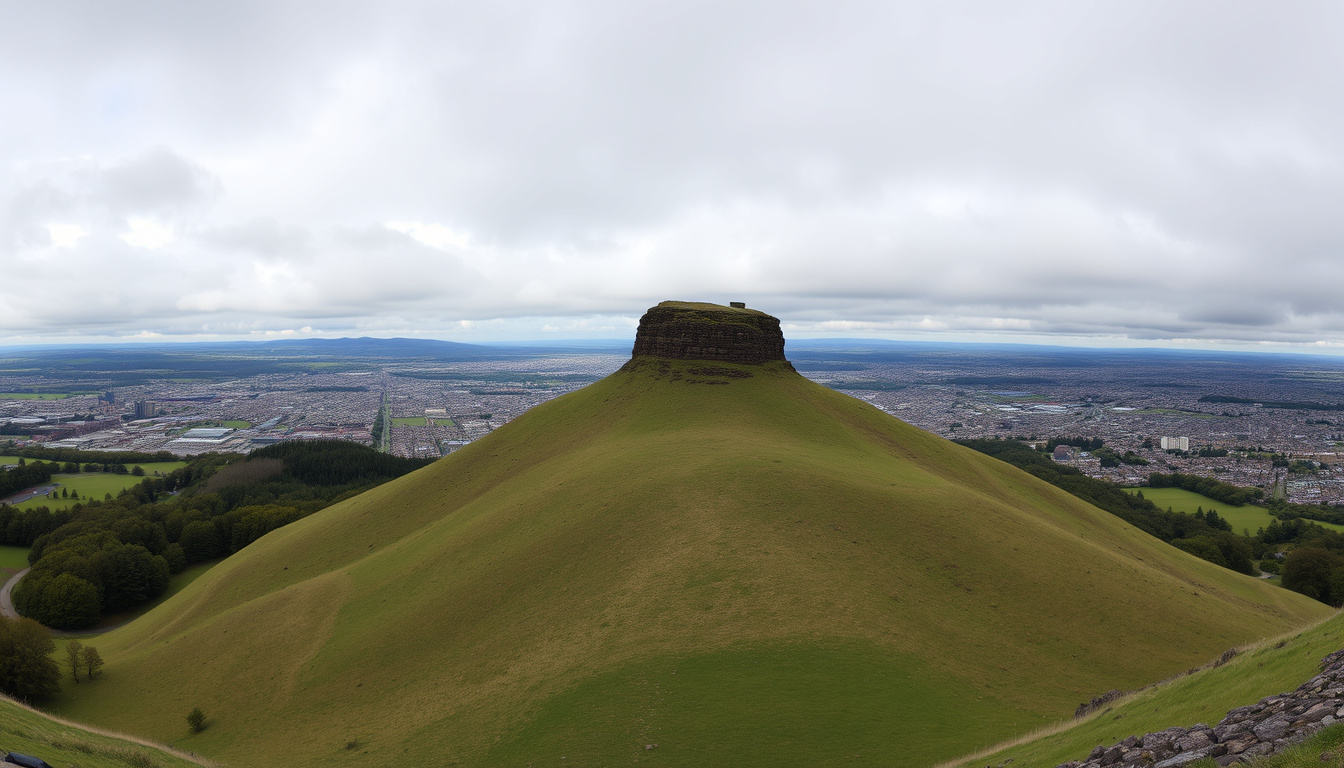
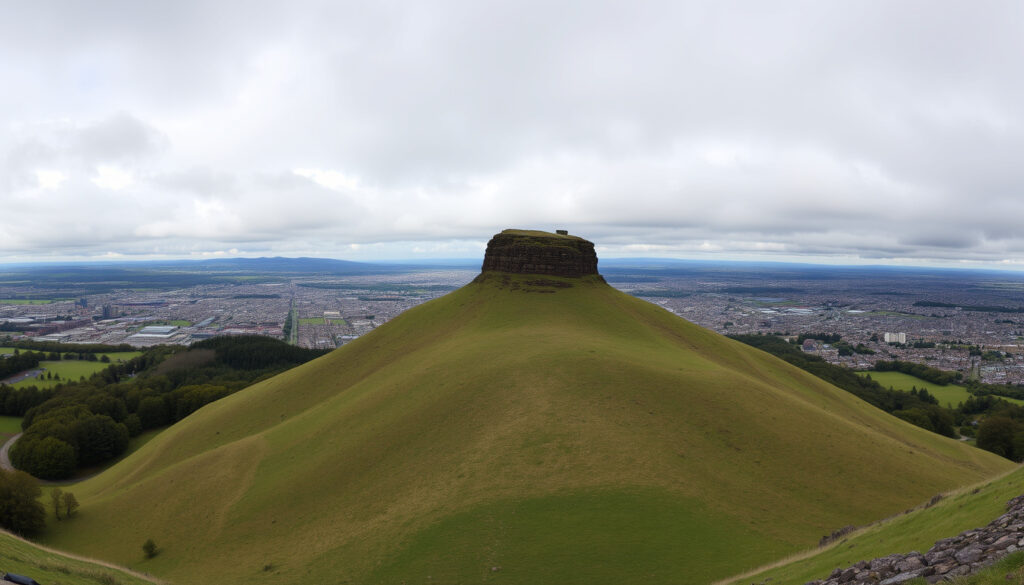
You have to love a city where a 350-million-year-old volcano sits right in the middle of a park, free for anyone to climb. Arthur’s Seat is that kind of Edinburgh landmark — a short, steep walk that rewards you with a full 360-degree view of the city and the Firth of Forth.
Height: 251 m (823 ft) ·
Average climb time: 30–45 minutes ·
Age: ~350 million years ·
Location: Holyrood Park, Edinburgh ·
Entrance fee: Free ·
Hill forts on site: 4 (dating ~2,000 years ago)
Quick snapshot
- Hill forts from around 2,000 years ago (Hiking in London (outdoor guide))
- Named after King Arthur (likely) (Expedia (travel guide))
- Part of Holyrood Park since 16th century (Wikipedia)
- Extinct volcano, last erupted 350 million years ago (Edinburgh Tourist (local guide))
- Composed of dolerite, basalt, and sedimentary rock (Wikipedia)
- 251 m (823 ft) high (EdinburghGuide.com (local guide))
- Allow 30–45 minutes for direct ascent (Expedia (travel guide))
- Sturdy trainers or walking shoes recommended (ExcursionMania (travel guide))
- Check weather – exposed summit (Viator (tour guide))
- Free entry, open year-round (ScotRail (national rail agency))
- Parking at Holyrood Park (charges apply) (EdinburghGuide.com (local guide))
- Toilets available at the park visitor center (Eurolandmarks (travel guide))
Here are the key facts summarised in a table.
| Fact | Value |
|---|---|
| Height | 251 m (823 ft) (Wikipedia) |
| Average climb time | 30–45 minutes (EdinburghGuide.com) |
| Age | ~350 million years (Edinburgh Tourist) |
| Location | Holyrood Park, Edinburgh (Eurolandmarks) |
| Cost | Free (ScotRail) |
| Nearest parking | Holyrood Park car park (pay and display) (EdinburghGuide.com) |
How long does it take to climb Arthur’s Seat?
For most visitors, the direct route up Arthur’s Seat takes between 30 and 45 minutes from the main entrance of Holyrood Park, according to EdinburghGuide.com (local guide). A moderately fit walker can reach the top in 20 to 30 minutes on some routes, the same source reports. Most people should plan for the full ascent and descent together to take around 1.5 hours, Expedia (travel guide) estimates.
What factors affect the climb time?
- Fitness level: The walk includes steep sections and uneven terrain. A Viator (tour guide) rates the hike as moderate.
- Route choice: Some paths are short and gentle; others are steeper and more direct, Hiking in London (outdoor guide) notes. The steepest route adds time and difficulty.
- Weather conditions: Rain makes paths slippery. High winds on the summit are common and can slow you down — Viator (tour guide) warns visitors to check the forecast.
- Stops: People pause for photos, water, or to enjoy the views. The park is open 24 hours a day and year-round, Eurolandmarks (travel guide) says.
Which route is fastest?
The fastest route is the main path from the Holyrood Park entrance. This path is well maintained and relatively gentle. The steeper routes, such as the one from Dunsapie Loch or the Salisbury Crags side, can take longer because they require more effort and extra care on loose rock.
The fastest route is great for a quick climb. But the slower, steeper paths offer a more adventurous experience. Deciding on what you value more — speed or scenery — will guide your route choice.
The pattern: The main path saves time, but the alternative routes reward with quieter trails and more dramatic rock formations. For first-time visitors, the main path is the safest and quickest option.
What is special about Arthur’s Seat?
What are the geological features?
Arthur’s Seat is the eroded remains of an extinct volcano that last erupted around 350 million years ago, according to Edinburgh Tourist (local guide). The hill is part of Holyrood Park and is composed of dolerite, basalt, and sedimentary rock, Wikipedia explains. The summit elevation is about 250.5 m (822 ft) or 251 m above sea level, depending on the source, ExcursionMania (travel guide) reports.
What is the historical significance?
The hill has been occupied by humans for about 2,000 years. It contains four hill forts, with traces of ancient settlements and defensive walls that can still be seen today, according to Hiking in London (outdoor guide). In 1836, seventeen tiny coffins were discovered in a cave on the hill’s slopes — a mystery that remains unexplained in popular accounts, the same source notes. A popular local tradition says that washing your face with dew from Arthur’s Seat on 1 May brings good looks and good fortune — documented from at least the eighteenth century, Edinburgh Spirit (local guide) reports.
What are the views like?
From the top, you get a 360-degree view of Edinburgh: the Old Town, the New Town, the Firth of Forth, and the Pentland Hills. The view is the main reason people make the climb, and it is often described as spectacular. Viator (tour guide) describes the hill as offering a panoramic vista that is not to be missed.
The wide range of attractions — geology, history, mystery, and views — makes Arthur’s Seat unusually rich for a single hill. Visitors who only look at the view might miss the hill forts. Hikers who focus on the ground might miss the tiny coffins story. The real value: coming with a plan for what to look for.
The implication: Arthur’s Seat is not just a walk — it is a layered experience. Knowing about the hill forts, the volcanic origin, and the strange 1836 discovery transforms a simple hike into a deeper exploration of Edinburgh’s past.
Why is Arthur’s Seat called that?
What are the origin theories?
The most common explanation is that the hill is named after King Arthur, the legendary British king. The name is mentioned in 16th-century history, according to Hiking in London (outdoor guide). However, historians are split on whether the connection is real or just a legend, the same source reports. An alternative theory traces the name from Scottish Gaelic ‘Àrd-na-said‘, meaning ‘height of the arrows’. This theory, however, has less supporting evidence.
Who is Arthur?
There is no direct evidence that Arthur himself — King Arthur or any historical figure named Arthur — actually visited or lived on the hill. The name may simply be a reference to the legend, which was popular in the 16th century. As a result, the exact origin of the name remains debated, Hiking in London (outdoor guide) states.
The catch: There is no clear answer to the name’s origin. The uncertainty is itself the most certain fact about the name. For a landmark that draws thousands of visitors each year, this open question adds to its allure.
Is it free to walk up Arthur’s Seat?
Is there an entrance fee for Holyrood Park?
No. Holyrood Park, where Arthur’s Seat is located, has free public access, ScotRail (national rail agency) confirms. You do not need a ticket to walk up. The park is open year-round, and some sources say it is open 24 hours a day, Eurolandmarks (travel guide) reports.
Do I need a permit?
No permit is required for individual walkers. Some guided tours, offered by companies like Viator (tour guide), may charge a fee if you choose to join them. Parking at Holyrood Park’s car park may have pay and display charges, so plan accordingly if you drive.
The pattern: The walk itself is free, which makes it one of Edinburgh’s best-value attractions. The costs that do exist — parking, guided tours — are optional and avoidable.
How difficult is the climb to Arthur’s Seat?
What is the elevation gain?
The summit elevation is about 250.5 m (822 ft) or 251 m above sea level, EdinburghGuide.com (local guide) reports. This makes it a relatively modest climb compared to many Scottish hills, but the steep sections give it a solid moderate rating.
Is it suitable for beginners?
Yes. Arthur’s Seat is suitable for beginners with a reasonable level of fitness, according to Viator (tour guide). The main path across the grass from Holyrood Park is well-maintained and gradual. The alternative routes are steeper and can be rocky and uneven, especially after rain when they become muddy and slippery.
What footwear is recommended?
For the main path, trainers are fine. For alternative routes, especially in wet conditions, sturdy shoes or hiking boots are recommended because the terrain is rocky, uneven, and muddy after rain, ExcursionMania (travel guide) advises. Whatever route you choose, good grip footwear is essential.
Many people climb in trainers on a dry day and have no issues. But poor weather can quickly make the main path slippery and the alternative routes hazardous. Checking the forecast and choosing footwear accordingly is the best way to stay safe.
The implication: The climb is accessible but not trivial. Knowing the weather and your route in advance turns a moderate hike into a straightforward, safe walk.
How to climb Arthur’s Seat step by step
- Choose your route – The main path from Holyrood Park is fastest and most gentle; for a challenge take the Dunsapie Loch ascent.
- Wear proper footwear – Trainers are fine for the main path on dry days; hiking boots recommended for wet conditions.
- Check the weather – The summit is exposed; avoid high winds and heavy rain.
- Start early or late – Avoid crowds by climbing before 10:00 or after 16:00.
- Follow the path – Stick to the main trails to avoid loose rock and preserve the environment.
- Pace yourself – Stop for water and photos; the climb is short but steep.
- Enjoy the summit – Take in the 360-degree view and identify landmarks.
- Return via the same route – The main path is safest for descent.
Confirmed facts vs. what’s unclear
Some things about Arthur’s Seat are well documented. Others remain open questions. Here is a breakdown.
Confirmed facts
- Height is 251 m (823 ft) (EdinburghGuide.com)
- Free entry to Holyrood Park (ScotRail)
What’s unclear
- Arthur’s Seat is an extinct volcano (Edinburgh Tourist) — source confidence limited
- Contains 4 hill forts (Hiking in London) — source confidence limited
- The exact origin of the name remains debated (King Arthur vs Gaelic derivation) (Hiking in London)
- Whether Arthur actually visited or is purely legendary — no direct evidence (Hiking in London)
The distinction between verified data and open questions helps visitors understand what is known and what remains speculative.
Quotes and highlights
“A hill for magnitude, a mountain in size.”
— Robert Louis Stevenson (author and Edinburgh resident, via Wikipedia)
Arthur’s Seat is “the main peak of a group of hills in Edinburgh” and part of Holyrood Park.
— Historic Environment Scotland (official heritage body, via ScotRail)
Summary
Arthur’s Seat offers something rare: a free, accessible 350-million-year-old volcano with hill forts, a mysterious name, and a full city panorama all in one walk. The practical route choice — fast or adventurous, easy or steep — makes it fit different types of visitors. For the Edinburgh visitor, the choice is clear: pack comfortable shoes, check the weather, and allow 1.5 hours, or miss one of the best urban walks in the UK.
kupi.com, en.wikipedia.org, accesstravel.com, hauptjournal.de
For a more detailed climb guide, check out detailed climb guide which breaks down the time and difficulty for each route.
Frequently asked questions
Can I take my dog to Arthur’s Seat?
Yes, dogs are welcome in Holyrood Park and on Arthur’s Seat. They must be kept under control, especially near livestock and steep drops.
Are there toilets at Holyrood Park?
Yes, there are public toilets at the Holyrood Park visitor center, typically open during park opening hours.
What is the best time of day to climb Arthur’s Seat?
Early morning or late afternoon are best for fewer crowds and better light for photos. Sunset offers spectacular city views.
Is Arthur’s Seat suitable for children?
Yes, with supervision. The main path is manageable for children with a reasonable level of fitness. Steep sections and loose rock on alternative routes require extra caution.
How long is the full loop around Holyrood Park?
The full circuit around Holyrood Park takes about 1–2 hours at a steady pace, depending on the route and how many stops you make.
Are there guided tours of Arthur’s Seat?
Yes, several companies offer guided walks that include geological and historical commentary. These tours may charge a fee, unlike the free independent climb.
What should I bring when climbing Arthur’s Seat?
Sturdy trainers or walking shoes, a waterproof jacket (Scottish weather is unpredictable), water, and a camera for the views.

George Thompson is Senior Reporter at UrbanMixr.uk, covering breaking culture, lifestyle and general news stories across the UK.