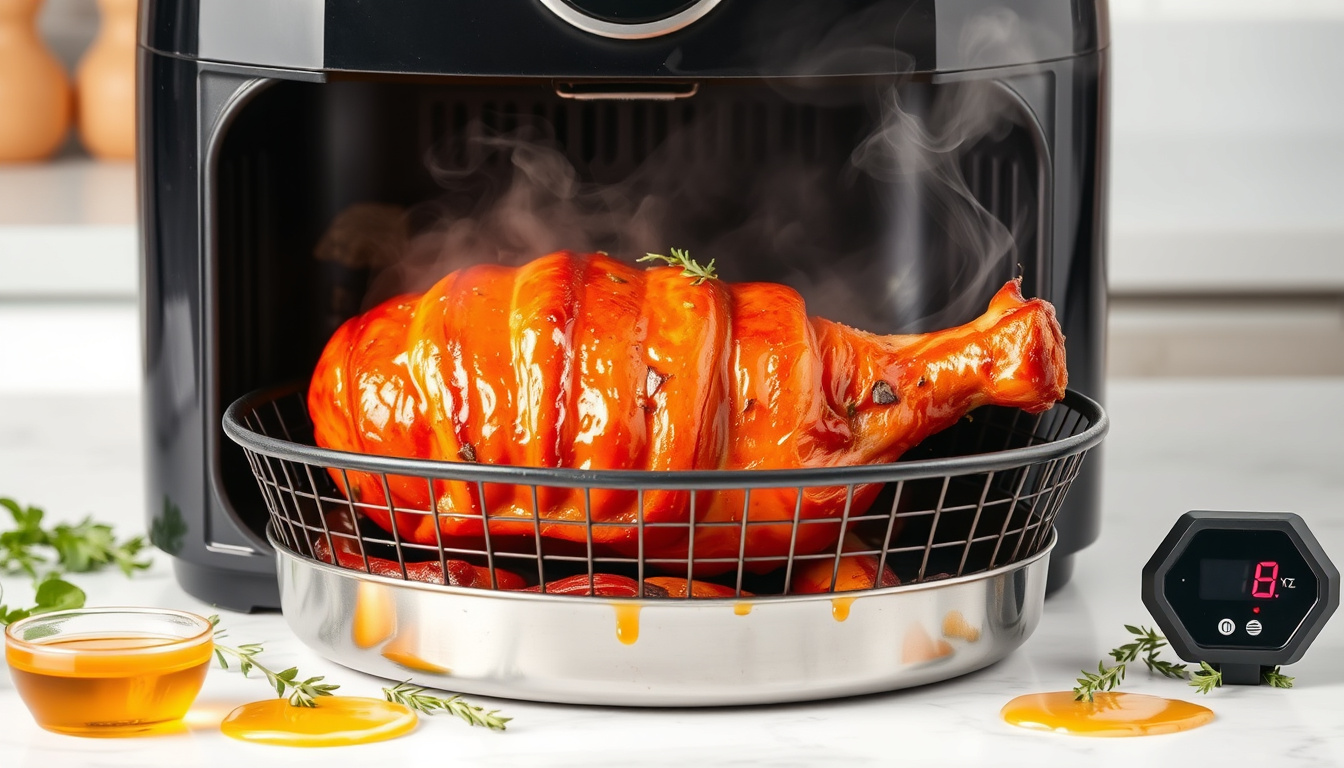
Few Christmas dinners spark debate quite like gammon — that gloriously salty joint that somehow always ends up overcooked on the outside or raw in the middle. An air fryer changes the equation entirely, giving you a crispy rind without the marathon oven time. After testing timings across multiple recipes and weighing foil versus no-foil approaches, here’s what actually works.
Typical Temp: 160-180°C · Time per 500g: 20-25 mins · BBC Method: 160°C for 1 hr · Foil Usage: Permitted if not blocking airflow · Glaze Frequency: Every 20 mins
Quick snapshot
- 160-180°C range across sources (BBC Good Food)
- Foil permitted by KitchenAid guidance (BBC Good Food)
- Exact time for 750g without individual testing
- Methods emerged post-2020 as air fryers gained popularity
- Step-by-step method below for joints and steaks
The table below consolidates core parameters sourced from multiple tested recipes.
| Parameter | Value |
|---|---|
| Standard Temp | 160°C |
| Cook Time 1kg | 40-50 mins |
| Foil Safe? | Yes, loose wrap |
| Glaze Tip | Apply last 20 mins |
| Internal Safety Temp | Above 70°C |
| Rest Period | 10-20 minutes |
How do I cook gammon in my air fryer?
The basic method splits cooking into two phases: a low-and-slow foil wrap to cook through, then higher heat to crisp the outside and set any glaze. BBC Good Food (authoritative food publication) recommends heating the air fryer to 160°C, placing foil-wrapped gammon inside, and cooking for approximately 1 hour — though times vary by weight.
Preparation steps
- Bring gammon to room temperature before cooking (BBC Good Food)
- Score the fat cap in a cross-hatch or diamond pattern if you plan to glaze
- Line the air fryer basket with parchment if glazing to prevent sticky residue (Taming Twins)
Basic cooking settings
For a 1kg joint, Recipe This (tested recipe from a dedicated air fryer blogger) suggests 20 minutes at 160°C fat-side down, then 30 minutes with the sides exposed — totaling roughly 50 minutes at that weight. Beat The Budget (budget cooking blog) takes a faster approach: 35 minutes at 170°C foil-wrapped, then 15-20 minutes at 180°C with glaze applied, for a 55-minute total.
Checking doneness
A meat thermometer removes the guesswork entirely. Target internal temperature should exceed 70°C according to BBC Good Food’s recipe guidance, though Curly’s Cooking (home cooking blog) notes that 62°C suffices for finished texture. Rest the joint 10-20 minutes before carving.
Should I wrap gammon in foil in an air fryer?
Yes — with one important condition. Foil prevents the gammon from drying out during the extended cook time and keeps juices contained for later glazing. The key rule: never block the airflow vents. Beat The Budget’s tested method wraps the joint loosely, sealing the top to prevent drips but leaving the sides open enough for air circulation.
Foil safety rules
- Never crumple foil into the basket itself — airflow must pass through
- Leave a loose tent rather than a tight wrap
- Use heavy-duty foil to prevent tearing during the long cook
Pros and cons for gammon
Upsides
- Prevents drying during 45-70 minute cook
- Contains glaze drippings
- Allows even heat distribution
Downsides
- Must remove for final crisping stage
- Risk of blocking airflow if wrapped too tightly
Alternatives to foil
A silicone liner works if your air fryer model allows it, though most recipes prefer foil for gammon specifically because it can handle the weight without slipping. Taming Twins (UK food blog) notes that lining the basket becomes essential only when glazing, to avoid burned honey residue.
Foil is a gammon asset, not a liability — just keep the tent loose and the vents clear. The trade-off is worth it for a joint that stays moist through a full hour of cooking.
Is gammon better in the oven or air fryer?
The air fryer wins on speed and rind texture, while the oven handles larger joints more predictably. Curly’s Cooking (home cooking resource) notes that a 1.5kg gammon takes roughly 70 minutes in the air fryer at 170°C — compared to 90 minutes or more in a conventional oven at the same temperature.
Time and texture differences
The data below shows typical results across tested methods.
| Method | Typical Time (1kg) | Rind Result |
|---|---|---|
| Air fryer | 45-55 mins | Consistently crispy |
| Convection oven | 60-75 mins | Variable |
| Conventional oven | 90+ mins | Tends softer |
The implication: air fryers deliver faster results with more predictable rind quality because the compact cavity forces hotter, drier air across the surface.
Energy use comparison
Air fryers draw less total energy for a shorter run time, making them more efficient for a weeknight gammon craving. Oven users heat a larger cavity for longer, which costs more even at a lower temperature setting.
Juiciness results
Both methods produce moist gammon when the internal temp reaches 70°C and the joint rests properly. The air fryer’s advantage is the rapid surface dehydration that creates that crackling texture oven cooks struggle to replicate without a separate grill phase.
For weeknight dinners, the air fryer’s speed and texture edge make it the clearer choice. Save the oven for when you’re cooking multiple dishes and need the space.
Is gammon better in slow cooker or air fryer?
Slow cookers excel at hands-off cooking over several hours; air fryers deliver the same tender interior in under an hour with less cleanup. Taming Twins (recipe testing blog) specifically recommends the air fryer for the crispy exterior that a slow cooker simply cannot produce.
Hands-off vs quick cook
- Slow cooker: 4-6 hours on low, minimal monitoring
- Air fryer: 45-70 minutes total, requires checking glaze
Flavor outcomes
Slow cooker gammon tends toward pulled or shredded texture due to the extended moisture exposure. Air fryer gammon carves cleanly in slices, with the fat cap crisping rather than rendering down entirely.
Best for glaze
Glazing works far better in an air fryer because the high fan heat caramelizes sugars quickly. Supergolden Bakes (baking and cooking blog) applies glaze in two 5-minute stages at 200°C to build layers without burning — a technique that loses impact in a slow cooker’s humid environment.
How long to cook gammon in air fryer?
Cooking time scales roughly with weight, though the relationship isn’t perfectly linear. For a 1kg joint, most sources settle on 40-50 minutes total; heavier joints push toward 70 minutes. Feast Glorious Feast (home cooking blog) notes that their 1kg round cooks in its foil wrapping in 45 minutes at 170°C before the glazing phase begins.
Time by weight
These timings come from specific tested recipes across different joint sizes.
| Joint Weight | Foil Phase (160-170°C) | Total with Glaze | Source |
|---|---|---|---|
| 750g | 45 mins | ~1 hour 10 mins | Recipe This |
| 1kg | 40-50 mins | ~1 hour | BBC Good Food |
| 1.5kg | 70 mins | ~1 hour 15 mins | Curly’s Cooking |
The pattern: plan roughly 20-25 minutes per 500g in the foil phase, then add 15-20 minutes for glazing. Heavier joints may need slightly less per gram due to thermal mass.
Ninja air fryer specifics
Ninja air fryers run slightly hotter at equivalent settings, so Taming Twins (UK recipe blogger) recommends dropping the temperature by 10°C compared to other brands. Their 750g method uses 160°C for two 30-minute stages with a 10-15 minute uncovered finish — totaling approximately 1 hour 10 minutes.
Steak vs joint
Gammon steaks (pre-sliced portions) cook much faster at higher temperatures. Expect 10-15 minutes at 180°C for a single steak, with no foil needed. The Pork Chops in Air Fryer guide covers similar timing principles for bone-in cuts that apply here.
This small 1kg gammon round cooks in its foil wrapping in 45 minutes.
In total, this recipe takes about 1 hour 10 minutes.
— Taming Twins
How to cook gammon steak in air fryer
Steaks bypass the long foil phase entirely. Preheat the air fryer to 180°C, place steaks in a single layer without overlap, and cook 10-15 minutes depending on thickness. No resting period needed — steaks carve immediately. The How Long Do Sausages Take in Air Fryer guide demonstrates similar single-layer, higher-heat technique for quick-cooking proteins.
Quick glaze for steaks
- Mix honey with a splash of wholegrain mustard
- Brush during the last 5 minutes only
- Watch closely — steaks are thin and sugar burns fast
Thin gammon steaks cook so quickly that a meat thermometer reads 70°C almost instantly. If you’re searing from cold, add 2-3 minutes; from room temperature, the 10-15 minute window holds reliably.
Best glaze for gammon in air fryer
Honey-based glazes dominate the recipe landscape — honey alone, honey with mustard, or honey with marmalade for sweetness. Beat The Budget (budget recipe blog) scores the fat cap before glazing to let the mixture penetrate, then applies it every 20 minutes during the final phase.
Basic honey glaze
- 3 tablespoons honey
- 1 tablespoon Dijon mustard
- 1 teaspoon olive oil
- Pinch of black pepper
Application timing
Apply the first glaze after removing the foil, then repeat every 20 minutes at higher heat. Supergolden Bakes (home cooking blog) recommends 200°C for 5-minute glaze bursts — repeating twice builds depth without burning.
Glaze residue in the basket creates smoke and carbonizes into stubborn buildup. Line the basket with a small piece of foil under the joint, or clean immediately after cooking — honey sugar caramelizes at temperatures that leave permanent marks on non-stick coatings.
Cooking gammon in an air fryer with a precise timings and temperature guide produces joints featuring crisped fat and succulent meat far quicker than conventional ovens.
Frequently asked questions
Can you put foil in an air fryer?
Yes, as long as it doesn’t block airflow through the sides and vents. Loose foil tents work for gammon; crumpled ball foil does not.
Is air frying truly a healthier choice?
Air frying reduces added fat compared to pan-frying or deep-frying because the hot fan circulates air rather than submerging food in oil. For gammon, which is already lean protein, the benefit is minimal — the air fryer’s main advantage is texture rather than nutrition.
Is an air fryer good for diabetics?
Gammon itself is high in protein and low in carbs, making it suitable for diabetic meal plans. The air fryer doesn’t add sugars or starches — just crisp the exterior without frying in fat. Watch sodium content: pre-brined gammon can exceed 40% of a daily salt limit per serving.
What’s the best glaze for gammon in air fryer?
Honey-mustard dominates because it caramelizes well at high temperatures without burning as quickly as sugar-only glazes. Add a splash of orange juice or marmalade for complexity.
How to cook gammon steak in air fryer?
Preheat to 180°C, cook 10-15 minutes depending on thickness, brush with honey glaze in the final 5 minutes. No foil needed for thin steaks.
Gammon in air fryer after boiling?
If you’ve already boiled your gammon, the air fryer handles the finish only — increase heat to 200°C for 10-15 minutes to crisp the rind. No initial foil phase needed since the meat is already cooked through.
Ninja air fryer ham tips?
Drop temperature by 10°C compared to other brands and extend the glaze phase slightly. Ninja models run hotter at equivalent settings, which can cause glaze to burn before the interior finishes cooking.
For UK home cooks, the verdict is straightforward: an air fryer produces gammon with superior rind texture in less time than the oven, and the foil method solves the moisture problem that makes many slow-cooker results disappointing. Scale your timing by weight, hit 70°C internally, and apply that honey glaze in stages — the payoff is a joint that carves cleanly with a caramelized crust no other appliance matches in under 90 minutes.

Emily Ward is UK Managing Editor at UrbanMixr.uk, running the daily news list, publishing schedule and city-guide planning.