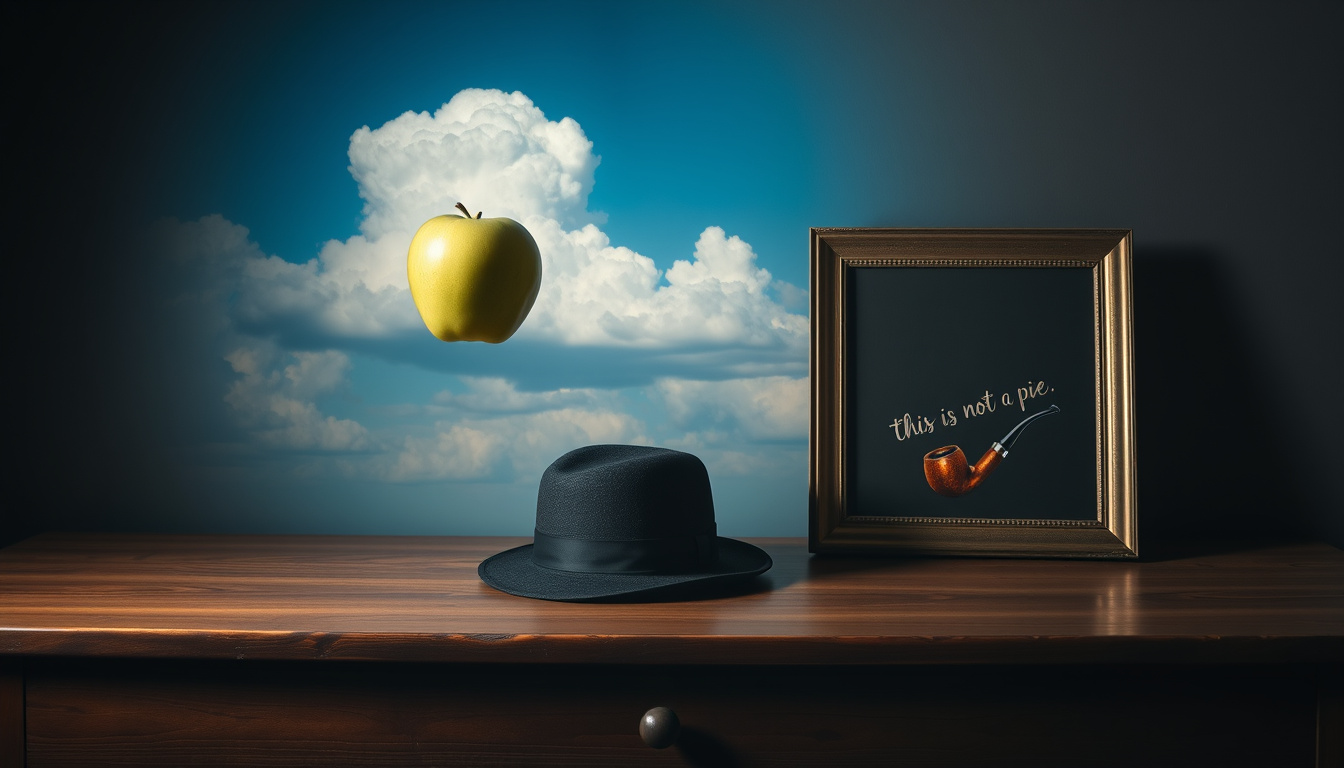
Few artists have left as puzzling a mark on modern culture as René Magritte. You’ve probably seen his work — a pipe labeled “This is not a pipe,” a man in a bowler hat with an apple in front of his face — even if you didn’t know who painted them. This article looks at the life, art, and enduring ideas of the Belgian surrealist who turned everyday objects into profound questions about reality and illusion.
Born: 21 November 1898 ·
Died: 15 August 1967 ·
Nationality: Belgian ·
Movement: Surrealism ·
Known for: Subverting everyday objects ·
Famous works: The Treachery of Images, The Son of Man, Golconda
Quick snapshot
- Born in Lessines, Belgium, on 21 November 1898 (Magritte Museum biography)
- Died of pancreatic cancer on 15 August 1967 (Magritte Museum biography)
- Married Georgette Berger in 1922 (Magritte Foundation)
- Studied at the Académie Royale des Beaux-Arts in Brussels from 1916 to 1918 (Museo Nacional Thyssen-Bornemisza)
- The exact interpretation of many paintings remains open to debate
- Magritte’s intentions behind the bowler hat symbol are not definitively documented
- 1898: Born in Lessines
- 1929: Painted The Treachery of Images
- 1967: Died in Brussels
- Magritte’s legacy continues through museums, exhibitions, and pop culture references
- The René Magritte Museum in Brussels preserves his home and studio
Eight key facts about the Belgian surrealist, pulled from primary sources.
| Attribute | Detail |
|---|---|
| Full Name | René François Ghislain Magritte |
| Born | 21 November 1898, Lessines, Belgium |
| Died | 15 August 1967, Brussels, Belgium |
| Nationality | Belgian |
| Movement | Surrealism |
| Known For | Familiar objects in unexpected contexts |
| Notable Works | The Treachery of Images, The Son of Man, Golconda, The Lovers |
| Spouse | Georgette Berger (married 1922) |
What is René Magritte best known for?
His signature style and surrealist approach
René Magritte is best known for his surrealist paintings that place familiar objects in unfamiliar contexts, challenging viewers’ perceptions of reality and illusion. The Magritte Museum biography describes him as a major figure in Belgian Surrealism. His work often subverts the ordinary — a pipe that is not a pipe, a man with an apple obscuring his face — to force a questioning of what we see.
Famous recurring motifs: bowler hat, apple, pipe
Recurring motifs like the bowler hat, the apple, and the pipe become visual shorthand for Magritte’s philosophical play. The Magritte Foundation notes that his childhood, marked by his mother’s suicide, influenced his fascination with concealment and revelation. The bowler hat, in particular, appears in multiple works as a symbol of anonymity and the ordinary man.
Influence on popular culture
Magritte’s imagery has seeped into advertising, film, and music. The apple in The Son of Man and the caption “Ceci n’est pas une pipe” are instantly recognizable, even to those who don’t know the artist’s name. His influence extends from album covers to movie posters, cementing his place as one of the most quoted surrealists in popular culture.
Magritte’s most famous image — a pipe that is not a pipe — encapsulates his entire project: the representation of an object is not the object itself, yet we continue to treat it as if it were.
The implication: Magritte’s defamiliarization forces viewers to confront the gap between language, image, and reality.
Why does René Magritte cover his face?
The hidden face in The Son of Man
Magritte’s 1964 painting The Son of Man depicts a man in a bowler hat with a green apple floating in front of his face. The Museo Nacional Thyssen-Bornemisza notes that Magritte often obscured faces to represent the human desire to see what is hidden. The apple blocks the subject’s face, inviting curiosity about what lies beneath.
Bowler hat as a symbol of anonymity
The bowler hat appears in many of Magritte’s works — Golconda, The Son of Man, The Mysteries of the Horizon — as a self-referential symbol of the ordinary man. According to the René Magritte Museum, the bowler hat became a visual signature, representing anonymity and the Everyman. When paired with a concealed face, it amplifies the theme of hidden identity.
Philosophical intent behind concealment
Magritte once said, “Everything we see hides another thing, we always want to see what is hidden by what we see.” This quote, widely attributed to the artist, speaks to his philosophical intent: the act of covering is an invitation to look deeper. The Wikipedia entry on The Son of Man notes that the painting explores the tension between the visible and the hidden.
For viewers, Magritte’s hidden faces are not just a stylistic quirk — they are a direct challenge to accept that our perception of others is always incomplete.
The catch: Magritte’s concealment refuses to resolve into a single meaning, keeping the mystery intact.
What are some of Magritte’s most famous paintings?
The Treachery of Images (Ceci n’est pas une pipe)
Painted in 1929, The Treachery of Images is an oil-on-canvas work that shows a pipe with the caption “Ceci n’est pas une pipe” (This is not a pipe). The Wikipedia article explains that the painting explores the difference between an object and its representation. It is held at the Los Angeles County Museum of Art.
The Son of Man
Painted in 1964, The Son of Man features a man in a bowler hat with an apple obscuring his face. The Museo Nacional Thyssen-Bornemisza notes that this work is one of Magritte’s most iconic, encapsulating his themes of concealment and identity.
Golconda
Golconda (1953) depicts men in bowler hats raining down from the sky like a surreal hailstorm. The Magritte Museum biography describes this as part of his mature style, where repetition of the bowler-hatted figure creates a sense of both anonymity and absurdity.
The Lovers
In The Lovers (1928), two figures kiss while their faces are wrapped in white cloth. The Magritte Foundation notes that the painting is often interpreted as a commentary on the impossibility of true intimacy — we can never fully know another person.
The Human Condition
In The Human Condition (1933), a painting within a painting perfectly aligns with the landscape behind it. The Museo Nacional Thyssen-Bornemisza highlights how this work questions the boundary between art and reality.
The pattern: Magritte’s most famous works all share a common thread — they take something familiar and twist it just enough to make us stop and think.
What is a famous quote from René Magritte?
“Everything we see hides another thing…”
Magritte’s most quoted line, “Everything we see hides another thing, we always want to see what is hidden by what we see,” comes from his writings on art and perception. According to Wikipedia, this statement encapsulates his lifelong exploration of the gap between reality and representation.
“Art evokes the mystery…”
Another famous Magritte quote: “Art evokes the mystery without which the world would not exist.” This appears in many collections of his statements and reflects his belief that art should retain an element of the inexplicable.
“The mind loves the unknown.”
Magritte also said, “The mind loves the unknown. It loves images whose meaning is unknown, since the meaning of the mind itself is unknown.” These words, recorded in various biographical sources, echo his visual work’s core theme: the unknowable is what makes art compelling.
Magritte’s quotes are as elusive as his paintings — they offer a key to his philosophy, but never a complete answer. That ambiguity is precisely the point.
The pattern: His statements refuse closure, mirroring the open-ended questions his paintings pose.
How do you pronounce René Magritte?
Phonetic breakdown
The correct French pronunciation is /ʁəne maɡʁit/. In English, it is commonly rendered as “ruh-NAY muh-GREET.” The stress falls on the second syllable of each name. According to Wikipedia, the French pronunciation is the authentic one, given Magritte’s Belgian-French background.
Common mispronunciations to avoid
Many English speakers mistakenly say “REE-nee” or “ren-AY” for the first name. The correct “ruh-NAY” is closer to the French. The last name is often mispronounced as “muh-GRIT” (with a hard ‘t’ at the end) — the French ‘t’ is silent, so it should be “muh-GREE” (though the final ‘t’ is often lightly pronounced in English contexts).
Origin of the name
René is a French given name meaning “reborn.” Magritte is a French surname of Flemish origin. The Magritte Foundation notes that the artist was born into a French-speaking Belgian family, so the French pronunciation is the most appropriate.
Timeline
- 1898 – Born in Lessines, Belgium (Magritte Museum biography)
- 1916–1918 – Studied at the Académie Royale des Beaux-Arts in Brussels (Museo Nacional Thyssen-Bornemisza)
- 1922 – Married Georgette Berger (Magritte Foundation)
- 1926 – Produced his first surrealist painting, The Lost Jockey; became a driving force behind the Belgian Surrealist group (Museo Nacional Thyssen-Bornemisza)
- 1927–1930 – Lived in Paris, interacting with French surrealists (Museo Nacional Thyssen-Bornemisza)
- 1929 – Painted The Treachery of Images (Wikipedia)
- 1930–1954 – Lived and worked in the Brussels apartment that now houses the René Magritte Museum (Brussels Museums)
- 1940s – Experimented with impressionism and fauvism (his “Renoir period” and “vache period”) (Magritte Museum biography)
- 1964 – Painted The Son of Man
- 1967 – Died in Brussels of pancreatic cancer (Magritte Museum biography)
Clarity
Confirmed facts
- Magritte was a Belgian surrealist painter.
- He died on August 15, 1967.
- The Treachery of Images was painted in 1929.
- He married Georgette Berger in 1922.
- He lived and worked in the same Brussels apartment from 1930 to 1954.
What’s unclear
- The exact interpretation of many paintings remains open to debate.
- Magritte’s intentions behind specific symbols (e.g., the bowler hat) are not definitively documented.
- Whether his mother’s suicide directly influenced his artistic themes is speculative.
Quotes
“Everything we see hides another thing, we always want to see what is hidden by what we see.”
— René Magritte, as recorded in biographical sources
“Art evokes the mystery without which the world would not exist.”
— René Magritte, from his writings on art
“Magritte was a main driving force behind the Belgian Surrealist group that included Camille Goemans and Paul Nougé.”
— Museo Nacional Thyssen-Bornemisza, artist biography
For anyone seeking to understand the power of visual art to question reality, Magritte’s work remains a masterclass in turning the ordinary into the extraordinary. His challenge to accept that a pipe is not a pipe is a reminder that seeing is not always believing. For art lovers encountering his work for the first time, the invitation is clear: look closer, and question what you see.
en.wikipedia.org, guggenheim.org, musee-magritte-museum.be, musee-magritte-museum.be, musee-magritte-museum.be, magrittemuseum.be
Frequently asked questions
What is Magritte’s most expensive painting?
Magritte’s The Empire of Light sold for over $79 million at auction in 2022, making it his most expensive work to date.
Did Magritte have any children?
No, René Magritte and his wife Georgette did not have children.
Was Magritte influenced by Freudian psychoanalysis?
Yes, Magritte was aware of Freudian ideas, and some of his works, such as The Lovers, have been interpreted through a psychoanalytic lens. However, he did not explicitly align himself with Freud.
What materials did Magritte use for his paintings?
Magritte primarily used oil on canvas. He also produced drawings, gouaches, and sculptures. The Magritte Museum biography notes his experimentation with different techniques.
Why are there so many bowler hats in Magritte’s works?
The bowler hat appears as a symbol of anonymity and the ordinary man. Magritte used it to comment on the loss of individuality in modern society.
What is the meaning of the painting ‘The Lovers’?
The Lovers (1928) shows two figures kissing with cloth covering their faces. It is often interpreted as a meditation on the impossibility of truly knowing another person, even in moments of intimacy.
Where are Magritte’s works displayed?
Major collections are held at the René Magritte Museum in Brussels, the Magritte Museum (part of the Royal Museums of Fine Arts of Belgium), the Los Angeles County Museum of Art, and the Museo Nacional Thyssen-Bornemisza in Madrid.
Related reading

George Thompson is Senior Reporter at UrbanMixr.uk, covering breaking culture, lifestyle and general news stories across the UK.