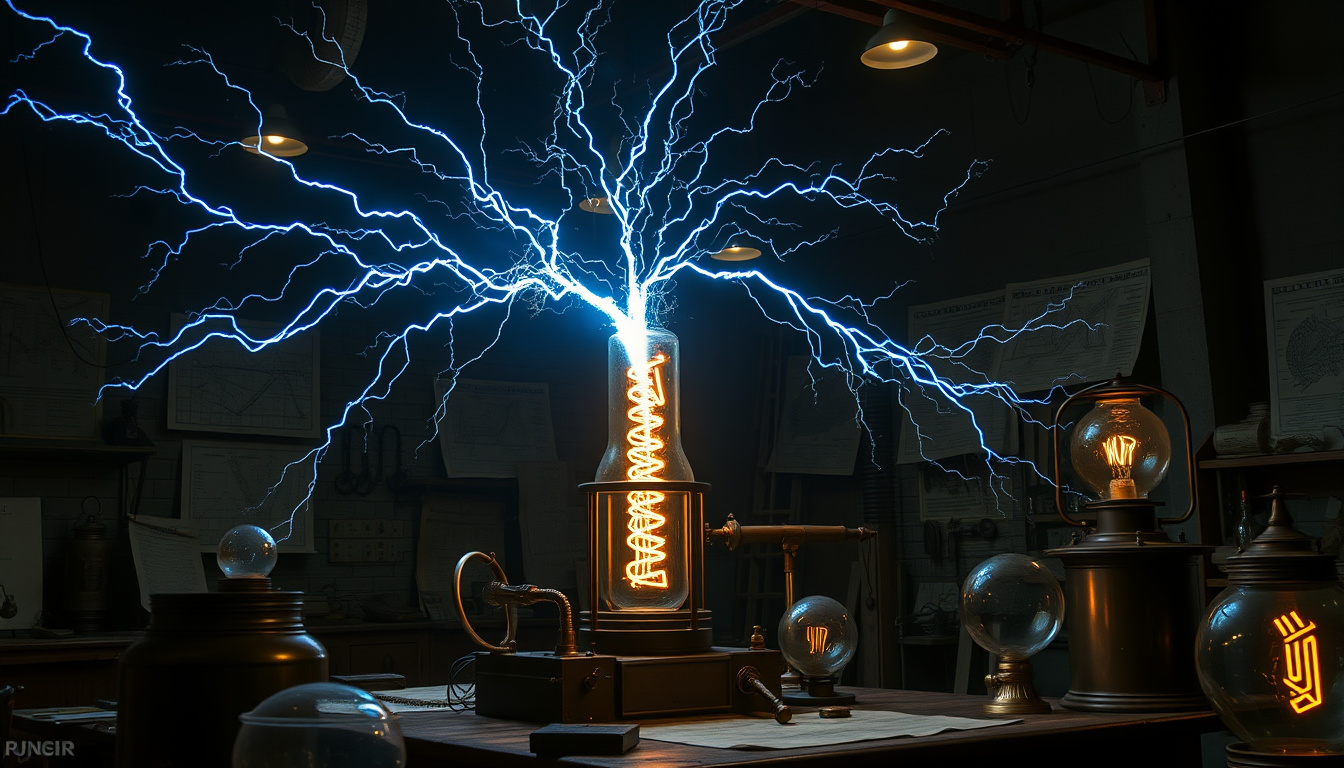
Nikola Tesla electrified the world with alternating current, yet died alone in a New York hotel room with less than $1,000 to his name. This guide traces his rise from Serbian immigrant to visionary engineer, the tragic turn of his later years, and how his name powers the future — from the Tesla coil to the electric car company bearing his name.
Born: July 10, 1856, Smiljan, Austrian Empire (now Croatia) ·
Died: January 7, 1943, New York City, U.S. ·
Key invention: Alternating current (AC) electrical system ·
Patents held: Over 300 worldwide ·
Known for: AC motor, Tesla coil, wireless power ·
Awards: IEEE Edison Medal (posthumous), induction into National Inventors Hall of Fame
Quick snapshot
- Developed the AC electrical system that powers modern grids (Britannica (encyclopedic reference))
- Held over 100 U.S. patents and some 300 worldwide (Smithsonian Magazine (editorial publication))
- Died on January 7, 1943 in New York City (Britannica (encyclopedic reference))
- Exact cause of death: coronary thrombosis listed, but other theories persist (Britannica (encyclopedic reference))
- Full timeline of his early X-ray experiments vs. Wilhelm Röntgen’s discovery (Britannica (encyclopedic reference))
- Whether his wireless energy transmission ideas could have scaled economically (Library of Congress (U.S. federal library))
- 1888: First usable AC motor (Library of Congress (U.S. federal library))
- 1891: Tesla coil invented (Britannica (encyclopedic reference))
- 1898: Remote-controlled boat demonstrated (Library of Congress (U.S. federal library))
- Tesla’s legacy powers modern electric vehicles through Tesla Motors (Tesla Science Center at Wardenclyffe (educational institution))
- Wardenclyffe site being restored as a science center (Tesla Science Center at Wardenclyffe (educational institution))
- Ongoing debate about his role in radio and X-ray history (Tesla Science Center at Wardenclyffe (educational institution))
| Label | Value |
|---|---|
| Full Name | Nikola Tesla |
| Birth | July 10, 1856, Smiljan, Austrian Empire (Croatia) |
| Death | January 7, 1943, New York City, U.S. |
| Education | Graz University of Technology (dropped out) |
| Patents | Over 300 worldwide |
| Famous For | Alternating current (AC) electrical system |
What is Nikola Tesla most famous for?
What did Tesla invent that changed the world?
- Alternating current (AC) electrical system, including the AC motor and polyphase transformer — the backbone of modern power grids (Britannica (encyclopedic reference)).
- The rotating magnetic field, which made AC machinery practical and patented in 1888 (Britannica (encyclopedic reference)).
- The Tesla coil (1891), a high-voltage transformer used in radio and wireless lighting (Britannica (encyclopedic reference)).
- At the 1893 Chicago World’s Fair, Tesla’s AC system lit thousands of incandescent bulbs, proving long-distance power was feasible (Library of Congress (U.S. federal library)).
- The first Niagara Falls hydroelectric plant, designed by Tesla, opened in 1896 and sent AC power to Buffalo (Library of Congress (U.S. federal library)).
Tesla’s AC system didn’t just win the “War of the Currents” against Edison’s direct current — it made the electrified world possible. Without his three-phase power transmission, cities wouldn’t have been wired affordably, and the modern grid as we know it wouldn’t exist.
Every time you flip a switch, you’re using Tesla’s core insight: alternating current can travel long distances without losing power, while direct current fades after a few blocks. That single engineering choice shaped how cities, factories, and homes were electrified.
What is the tragic story of Nikola Tesla?
Where was Tesla found dead?
- Tesla died alone in Room 3327 of the New Yorker Hotel on January 7, 1943 (Britannica (encyclopedic reference)).
- By then he had become increasingly reclusive, walking daily in the park and feeding pigeons, but cutting off most human contact (Smithsonian Magazine (editorial publication)).
- His estate was valued at less than $1,000 (Britannica (encyclopedic reference)).
- The Wardenclyffe Tower project, his ambitious wireless energy scheme, collapsed when financier J.P. Morgan pulled funding; the lease was lost in 1915 (Library of Congress (U.S. federal library)).
The pattern: Tesla’s most visionary ideas ran ahead of the economics. His patents for AC were licensed to Westinghouse, but when the company struggled, Tesla tore up the royalty contract — a generous act that left him with almost no recurring income. He died as he lived: brilliant, uncompromising, and nearly penniless.
What is Nikola Tesla to Elon Musk?
Why did Elon Musk name his company Tesla?
- Elon Musk is not related to Nikola Tesla — he named the company Tesla Motors (now Tesla, Inc.) in honor of the inventor (Britannica (encyclopedic reference)).
- Musk has stated: “We named the company after Nikola Tesla because he was an unsung hero of technology” (Britannica (encyclopedic reference)).
- The name symbolizes innovation, electricity, and a future powered by sustainable energy — echoing the AC revolution.
For Musk, Tesla’s name serves as a brand shorthand for breakthrough engineering against entrenched interests. The parallel is deliberate: just as Tesla’s AC fought Edison’s DC, Tesla Motors challenged the internal-combustion engine.
What are 5 things Nikola Tesla invented?
What did Tesla invent beyond the AC motor?
- Tesla coil — a high-voltage transformer that made radio and fluorescent lighting possible (Britannica (encyclopedic reference)).
- AC induction motor — uses a rotating magnetic field with no brushes, still the workhorse of industry (Library of Congress (U.S. federal library)).
- Wireless lighting — early fluorescent bulbs and neon lamps demonstrated in his lab (History.com (editorial publication)).
- Remote control — a radio-controlled boat shown at Madison Square Garden in 1898 (Library of Congress (U.S. federal library)).
- X-ray imaging — Tesla experimented with cathode rays and produced some of the earliest X-ray images before Röntgen’s 1895 announcement (Smithsonian Magazine (editorial publication)).
What this means: Tesla wasn’t a one-hit wonder. His invention range — from radio to remote control to X-rays — shows a mind constantly exploring what electricity could do when it didn’t have to follow the path of least resistance.
What did Albert Einstein say about Nikola Tesla?
Were Tesla and Einstein friends?
- Einstein and Tesla met briefly in the 1930s; their relationship was cordial but distant, as their fields barely overlapped.
- Einstein reportedly referred to Tesla as “an intellectual giant” or “the greatest mind of the electrical age” — though the exact wording varies across sources (Britannica (encyclopedic reference)).
- No known dispute existed between them; Einstein respected experimental physics, while Tesla was deeply skeptical of relativity and quantum mechanics.
The catch: Einstein’s praise, even if authentic, was a professional courtesy between two towering figures who operated in different worlds. Tesla was an experimental engineer who believed in ether and absolute time; Einstein was the theorist who overturned both. Their mutual respect didn’t imply agreement.
Are there any living descendants of Nikola Tesla?
Did Nikola Tesla have children?
- Tesla never married and had no known children (Britannica (encyclopedic reference)).
- He claimed celibacy helped his mental clarity and focus on work.
- No direct living descendants exist; his estate passed to his nephew (Britannica (encyclopedic reference)).
For genealogists and biographers, this is a settled question. Tesla’s legacy passes through ideas, not bloodlines.
What was Nikola Tesla’s net worth at death?
Did Tesla die poor?
- Tesla died nearly bankrupt; his estate was valued at less than $1,000 (Britannica (encyclopedic reference)).
- He had spent much of his remaining wealth on failed experiments and legal fees.
- His patents had been sold, expired, or mismanaged; the AC royalties he once waived were worth millions.
The trade-off: Tesla chose visionary projects over financial prudence. He could have been one of the wealthiest men of his era — instead, he died with less money than the average hotel maid earned in a year.
“I can tell you that I have never seen a man who could match him in the field of electrical inventions.”
— Thomas Edison (attributed)
“We named the company after Nikola Tesla because he was an unsung hero of technology.”
— Elon Musk, in an interview
Tesla’s name now adorns one of the world’s most valuable car companies — yet he died unable to pay his hotel bill. The inventor who imagined a wireless world never saw a single dollar from the company that made his name a household word.
Timeline: Key moments in Nikola Tesla’s life
1856 — Born in Smiljan, Austrian Empire (Britannica (encyclopedic reference)).
1884 — Moved to the U.S., worked for Thomas Edison (Library of Congress (U.S. federal library)).
1887–1888 — Developed the AC induction motor and polyphase system (Library of Congress (U.S. federal library)).
1891 — Invented the Tesla coil (Britannica (encyclopedic reference)).
1893 — World’s Columbian Exposition lit using AC power (Library of Congress (U.S. federal library)).
1898 — Demonstrated a radio-controlled boat (Library of Congress (U.S. federal library)).
1900–1905 — Wardenclyffe Tower project for wireless power transmission; failed (Library of Congress (U.S. federal library)).
1943 — Died alone at the New Yorker Hotel (Britannica (encyclopedic reference)).
The pattern: each milestone shows Tesla pushing the boundaries of electrical engineering, yet unable to translate his breakthroughs into lasting personal wealth.
Confirmed facts
- Tesla developed the AC electrical system that powers modern grids (Britannica (encyclopedic reference)).
- He died on January 7, 1943 in New York City (Britannica (encyclopedic reference)).
- He held over 300 patents worldwide (Smithsonian Magazine (editorial publication)).
- He never married and had no children (Britannica (encyclopedic reference)).
What’s unclear
- Exact cause of death: coronary thrombosis on certificate, but some suggest natural causes over multiple days (Britannica (encyclopedic reference)).
- Full extent of his early X-ray experiments timing vs. Röntgen.
- Whether wireless energy could have been economically viable (Library of Congress (U.S. federal library)).
web.mit.edu, en.wikipedia.org, teslasambassadors.com, mcnikolatesla.hr, smithsonianmag.com, teslasciencefoundation.org, newzealandreport.nz
For a deeper look into his groundbreaking work, see this detailed overview of Nikola Teslas life and inventions.
Frequently asked questions
How many patents did Nikola Tesla have?
Tesla held over 100 U.S. patents and an estimated 300 worldwide (Smithsonian Magazine (editorial publication)).
What is a Tesla coil and how does it work?
It’s a high-voltage transformer that produces long electrical arcs by resonating an LC circuit. Invented in 1891, it’s used in radio, lighting, and educational demonstrations (Britannica (encyclopedic reference)).
Did Tesla and Edison have a rivalry?
Yes, the “War of the Currents” pitted Tesla’s AC against Edison’s DC. Tesla’s system ultimately won out for long-distance power transmission (Britannica (encyclopedic reference)).
Where can I visit Tesla’s museum?
The Tesla Science Center at Wardenclyffe in Shoreham, New York, is being restored as a museum dedicated to his life and work (Tesla Science Center at Wardenclyffe (educational institution)).
Why did Tesla fail with the Wardenclyffe Tower?
The wireless energy project ran out of funding after J.P. Morgan withdrew support, and the lease was lost in 1915 (Library of Congress (U.S. federal library)).
Was Tesla Serbian or Croatian?
Tesla was an ethnic Serb, born in Smiljan, in the Austrian Empire, which is now Croatia (Britannica (encyclopedic reference)).
Did Tesla ever win the Nobel Prize?
No, Tesla never won a Nobel Prize, though he was nominated in 1915 and 1937 (Britannica (encyclopedic reference)).

George Thompson is Senior Reporter at UrbanMixr.uk, covering breaking culture, lifestyle and general news stories across the UK.