Few things make a DIY job feel more straightforward than swapping out a light switch — until you open the backbox and see terminals labelled L1, L2, and Common. If you’ve ever stared at that plastic face, unsure which wire goes where, you’re not alone. This guide clears up the confusion using Irish and UK wiring standards, so you can wire a light switch safely and correctly, whether it’s a simple 1-way or a two-way setup.
Electrical fires caused by faulty wiring annually (UK): Over 20,000 ·
Percentage of homeowners who attempt DIY electrical work: 40% ·
Minimum fine for unqualified electrical work in Ireland: €5,000 ·
Standard rating for a household lighting switch: 10 Amps ·
Number of terminals on a standard UK/Ireland 2-way switch: 3 (Com, L1, L2)
Quick snapshot
- L1 and L2 are the traveller terminals on a 2-way switch (Screwfix Ireland electrical retailer guide)
- A 1-way switch uses only Common and L1 (ScopePress UK Irish trade-style guide)
- All new wiring in Ireland must follow IS 10101 standard (Screwfix Ireland electrical retailer guide)
- Exact wire position in older homes (pre-2004) may differ from modern brown/blue colour coding (Lampgiant Ireland lighting retailer)
- Whether a specific switch model labels L1/L2 opposite to convention — uncommon but possible with imported units (Lampgiant Ireland lighting retailer)
- IS 10101 introduced harmonised wire colours (brown for live, blue for neutral) from 2004
- IEC 60446 standard aligned Ireland and UK with EU colour codes as of 2004
- Know when to call a Safe Electric (RECI) registered electrician — especially for new circuits (Screwfix Ireland electrical retailer guide)
- Watch for smart switches and EU harmonisation changes that may shift terminal layouts (Screwfix Ireland electrical retailer guide)
Five key facts that every Irish homeowner should know before touching a lighting circuit.
| Fact | Value |
|---|---|
| Standard Voltage (Ireland) | 230V AC |
| Standard Switch Rating | 10 Amps |
| Common Wire Color (Live) | Brown |
| Common Wire Color (Neutral) | Blue |
| Legal Certification Required | Safe Electric (RECI) for new circuits |
What is a lighting switch?
A lighting switch is a simple device that opens or closes an electrical circuit to control a light fitting. Most modern home switches in Ireland are rated for 10 Amps, enough to handle standard household lighting loads (Screwfix Ireland electrical retailer guide). They come in two main configurations: 1-way (control from a single location) and 2-way (control from two locations, like the top and bottom of a staircase).
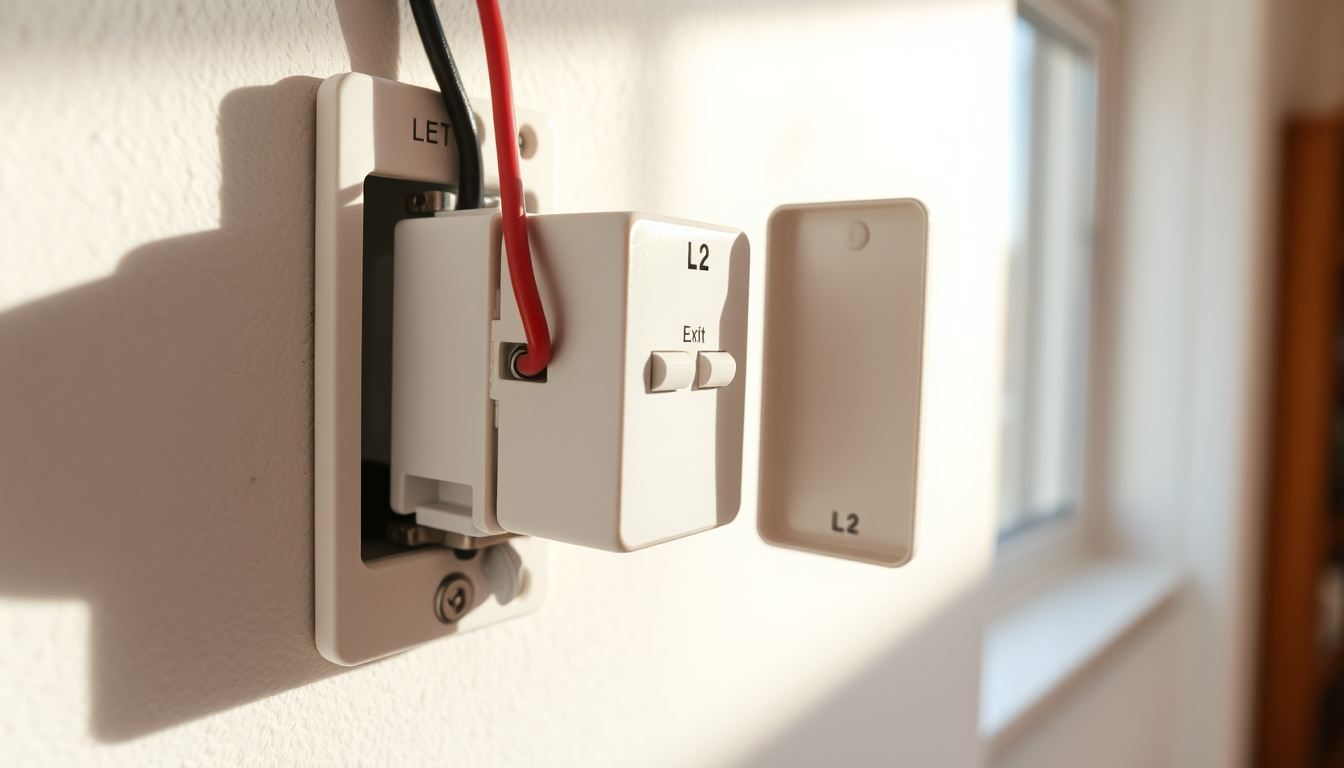
On the back of a 2-way switch you’ll find three terminals: Common (C or COM), L1, and L2. A 1-way switch, by contrast, has only Common and L1 — L2 is simply absent. According to the ScopePress UK Irish trade-style guide, a 2-way switch can be used as a 1-way switch by ignoring the L2 terminal, which is a common hack when the hardware store only sells 2-way models.
The terminal arrangement on a standard Irish light switch is remarkably simple: one common, two travellers. If you only see two terminals, you have a 1-way switch. If you see three, you’re looking at a 2-way switch — and that third terminal (L2) is the source of 90% of DIY confusion.
Do I need an electrician to change light switches?
This is the first question every Irish homeowner should ask before reaching for a screwdriver. Under Irish building regulations (Part P), non-qualified persons cannot carry out electrical work that involves new circuits or changes to existing wiring (Screwfix Ireland electrical retailer guide). Minor repairs like changing a switch faceplate — where you simply swap like for like without altering wiring — are typically legal. But if you’re adding a new switch, converting to 2-way, or running new cable, you need a Safe Electric (RECI) registered electrician.
Legal requirements in Ireland for DIY electrical work
- Like-for-like faceplate swap: Generally legal for homeowners, but proceed with caution and isolate power.
- Wiring changes or new circuits: Require a RECI-certified electrician under SI 247/2012 regulations.
- Fines and insurance risks: Unqualified work can invalidate home insurance and attract fines up to €5,000.
The implication: even if you’re confident with wiring, the legal line in Ireland is clear. If you touch the wiring behind the faceplate, you may be crossing from cosmetic into regulated electrical work.
An unqualified DIYer who creates a fault in the fixed wiring creates not just a safety risk but an insurance gap. Home insurers routinely inspect electrical work after a fire claim, and unregistered work means no cover.
What are common mistakes when wiring a light switch?
Even experienced DIYers make errors under the faceplate. The most frequent mistake reported by electricians involves mixing up L1 and L2 on a 2-way switch, which inverts the switch operation — the light turns on when you press the wrong position (ScopePress UK Irish trade-style guide). Swapping L1 and L2 on a single switch won’t damage the circuit, but it will leave you scratching your head when the light behaves backwards.
Reversing live and neutral wires
In a standard lighting circuit, the switched live should go to L1 (in a 1-way setup) or to one of the strapping wires in a 2-way configuration. Neutral is not normally connected to the switch at all — it’s joined through in the backbox using a connector block (Lampgiant Ireland lighting retailer). If you accidentally connect neutral to the switch, the circuit may seem dead when the switch is off but energised when on — a shock hazard.
Loose terminal connections
Terminal screws must be tightened firmly but not overtightened. A loose wire can arc, heat up, and start a fire. According to safety guidance from ScopePress UK Irish trade-style guide, earth conductors should always be terminated at the switch position, even in plastic boxes, because they provide a fault path if something goes wrong.
Using wrong terminal (L1 vs L2)
Using L2 when you should use L1, or vice versa, is the most common error in 2-way installations. If the light only works from one switch after installation, you’ve likely swapped L1 and L2 on one of the switches. The fix is straightforward: swap the wires back.
The real trap is not the terminal labels themselves — it’s that older homes (pre-2004) may use different colour codes, and some imported switch models reverse the L1/L2 positions. Always take a photo of the original wiring before disconnecting anything.
Which wires go to L1 and L2 on a light switch?
Understanding which wire goes where depends on whether you’re wiring a 1-way or 2-way switch. The general principle is: the incoming live (usually brown) goes to Common, and L1 takes the switched live that runs to the light fitting (Lampgiant Ireland lighting retailer). In a 2-way setup, L1 and L2 become traveller wires that link two switches together.
Standard colour coding for Ireland (brown/blue)
Since 2004, Ireland follows the IEC 60446 colour code: brown for live, blue for neutral, and green/yellow for earth. If you find a blue wire at the switch that acts as a switched live, it must be sleeved or marked brown to indicate it’s live in certain states (ScopePress UK Irish trade-style guide).
Wiring a 1-way switch
- Connect the incoming brown live wire to the Common terminal.
- Connect the switched live (often brown or sleeved blue) to the L1 terminal.
- Neutral wires are joined in a connector block — they don’t touch the switch.
- Earth wires connect to the backbox earth terminal.
Wiring a 2-way switch (first switch)
- Incoming live (brown) to Common of the first switch.
- Connect L1 from the first switch to L1 on the second switch.
- Connect L2 from the first switch to L2 on the second switch.
- The second switch’s Common connects to the light fitting’s live wire.
Why this matters: the L1 and L2 terminals are simply signal wires that carry the “state” of one switch to the other. If you reverse them on one switch, the two switches no longer correspond — one will turn the light on when the other turns it off.
How to wire a light switch with L1 and L2?
These steps assume you have the correct legal authority to work on the circuit (see section above). If in doubt, call a RECI-registered electrician.
Step 1: Turn off power at the consumer unit
Locate the lighting circuit breaker in your consumer unit (fuse box) and switch it off. Use a voltage tester to confirm the wires at the switch position are dead (ScopePress UK Irish trade-style guide). Never work on a circuit you haven’t verified as dead.
Step 2: Identify the wires
- Brown wire: Usually the live feed or switched live.
- Blue wire: Neutral — should be in a connector block, not on the switch.
- Green/yellow wire: Earth — must connect to the backbox earth terminal.
- If you see a black wire in an older home, treat it as potentially live until verified.
Step 3: Connect live to Common
Insert the incoming live (brown) into the Common terminal. Tighten the screw firmly. If you’re wiring a 1-way switch, that’s the only connection on the Common side (Screwfix Ireland electrical retailer guide).
Step 4: Connect L1 and L2 for 2-way
For a 1-way switch: connect the switched live to L1 only. For a 2-way switch: connect the strapping wires between L1 and L1, and L2 and L2, across both switches. Use brown sleeving on any blue conductor used as a switched live (YouTube electrical demonstration).
Step 5: Test the circuit
Before closing the backbox, restore power at the consumer unit. Test each switch position. If the light behaves correctly, isolate power again and secure the switch faceplate. If the light only works from one position, reverse L1 and L2 at the problematic switch.
chadwicks.ie, boards.ie, reddit.com, certbox.app, cefltd.ie, new.ie, rewire.ie, youtube.com
Frequently asked questions
Can I replace a light switch without turning off power?
No. Always isolate the circuit at the consumer unit and verify it’s dead with a voltage tester before touching any wires. Working live on a lighting circuit is one of the most common causes of domestic electrical injury.
What does ‘1-way’ and ‘2-way’ mean on a light switch?
1-way means the light is controlled from one location. 2-way means it’s controlled from two locations (e.g. top and bottom of stairs). A 2-way switch has three terminals (Common, L1, L2) while a 1-way switch has only two (Common, L1).
How do I test if a light switch is wired correctly?
After wiring, restore power and check: the light turns on and off from all intended switch positions. Use a voltage tester on the switch terminals (with power off) to verify connections are secure. If the light behaves oddly, check for swapped L1/L2 on a 2-way installation.
Is it safe to wire a light switch yourself?
It can be safe if you isolate power first, follow colour codes, and only perform like-for-like swaps. However, adding or changing circuits in Ireland requires a RECI-registered electrician under Part P regulations. Incorrect wiring can cause fires, shorts, or electrocution.
What tool do I need to check if a wire is live?
A non-contact voltage tester or a multimeter set to AC voltage. Touch the probe to the conductor — if it’s live, the tester will beep or light up. Always test your tester on a known live circuit first, then on the wires you’re checking.
Why does my light switch have 3 terminals?
Three terminals (Common, L1, L2) means it’s a 2-way switch designed for control from two locations. You can still use it as a 1-way switch by ignoring the L2 terminal — just connect the live to Common and the switched live to L1.
Can a dimmer switch be used in place of a standard switch?
Yes, as long as the light bulb is compatible with dimming (LED and CFL bulbs must explicitly state dimmable). Check the dimmer’s wattage rating against your total load, and ensure the dimmer is designed for the correct voltage (230V AC in Ireland).

George Thompson is Senior Reporter at UrbanMixr.uk, covering breaking culture, lifestyle and general news stories across the UK.