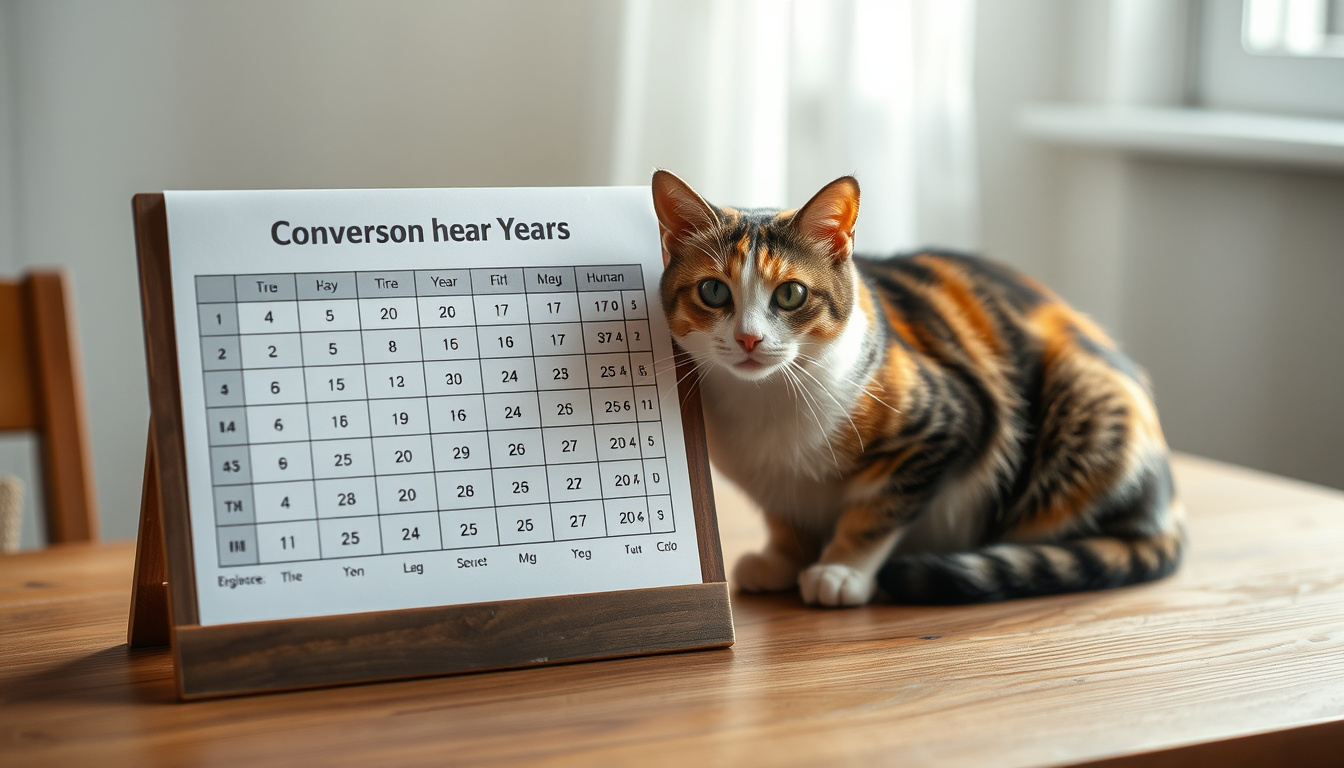
The old rule that one cat year equals seven human years is a myth, not a fact. Veterinarians and feline health organizations follow a different formula: the first year of a cat’s life equals about 15 human years, the second adds 9, and each subsequent year adds roughly 4.
First cat year in human years: 15 ·
Second cat year adds: 9 human years ·
Two cat years total: 24 human years ·
3 cat years: 28 human years ·
10 cat years: 56 human years ·
21 cat years: 100 human years
This guide explains the correct conversion, how it maps to life stages, and what it means for your cat’s health.
Quick snapshot
- First cat year = 15 human years (IAMS (pet nutrition brand))
- Second cat year adds 9 human years (Purina (veterinary-recommended pet food))
- Each subsequent year adds ~4 human years (PetMD (veterinary health network))
- Some sources use slightly different mappings for later years (e.g., Chewy maps 10 cat years to 60 human years instead of 56) (Chewy (pet retailer))
- The senior threshold can vary: AAHA says >10 years, but some cats may be considered senior as early as 8 years (Journal of Feline Medicine and Surgery (peer-reviewed journal))
- The 15-9-4 rule is a consensus guideline; individual cats may age differently. (Chewy (pet retailer))
- Extrapolation of human equivalents beyond 20 cat years is not backed by strong data. (Chewy (pet retailer))
- Some veterinary sources define senior starting at 8 years for certain breeds. (Chewy (pet retailer))
- Conversion milestones: 1 cat yr = 15 human yrs, 2 = 24, 3 = 28, 5 = 36, 10 = 56, 15 = 76, 20 = 96 (Purina) (AAHA (animal hospital association))
- Life stages: kitten (0–1 yr), young adult (1–6), mature adult (7–10), senior (>10) (AAHA (animal hospital association))
- Annual vet exams for cats aged 7–10; twice-yearly for 10–15; every 4 months for 15+ (RCVS Knowledge (veterinary knowledge resource))
- Early detection of kidney disease and arthritis can extend quality of life (RCVS Knowledge (veterinary knowledge resource))
The most widely accepted conversion is shown below.
| Cat age (years) | Human equivalent |
|---|---|
| 1 | 15 |
| 2 | 24 |
| 3 | 28 |
| 5 | 36 |
| 10 | 56 |
| 15 | 76 |
| 20 | 96 |
Is 1 year 7 years in cat years?
No, the common “multiply by 7” rule is inaccurate. The AVMA (American Veterinary Medical Association) endorses a different formula: the first year of a cat’s life equals about 15 human years, the second adds 9, and each year after that adds roughly 4. This is based on the faster maturation of cats in their early life.
What is the correct cat-to-human age conversion formula?
- 1 cat year = 15 human years (IAMS)
- 2 cat years = 24 human years (Purina)
- 3 cat years = 28 human years
- Each additional year = +4 human years
The formula is straightforward: 15 + 9 + (cat years – 2) × 4. For example, a 5-year-old cat is 15 + 9 + 3×4 = 36 human years.
10 cat years in human years
According to Purina (veterinary-recommended pet food), 10 cat years equal 56 human years. This places the cat in the mature adult stage, where health monitoring becomes more important.
12 cat years to human years
Using the 15-9-4 rule, 12 cat years = 15 + 9 + (10 × 4) = 64 human years. Some sources like Chewy (pet retailer) use a slightly different mapping, giving 12 cat years as 67 human years, but the 15-9-4 formula is the most widely used by veterinarians.
20 cat years in human years
20 cat years = 15 + 9 + (18 × 4) = 96 human years. This is an exceptionally old age for a cat.
How old is a 15-year-old cat in human years?
According to Purina (veterinary-recommended pet food), 15 cat years equal 76 human years. This is well into the senior stage, where cats need extra care.
What is 15 cat years in human years?
Applying the formula: 15 + 9 + (13 × 4) = 76 human years. The AAHA (animal hospital association) classifies cats over 10 years as senior, so a 15-year-old cat is a super senior.
A 15-year-old cat at 76 human years is at high risk for age-related diseases. The RCVS Knowledge (veterinary knowledge resource) recommends twice-yearly exams for cats aged 10–15 years, and every four months for those over 15.
The pattern: senior cats need more frequent veterinary attention.
Is 20 years old old for a cat?
Yes, 20 cat years is extremely old—equivalent to 96 human years. Only a small percentage of cats reach this age.
What age is considered senior for cats?
According to the AAHA (animal hospital association) and RCVS Knowledge (veterinary knowledge resource), cats are considered senior at 10 years and older. Some cats may show signs of aging as early as 8 years, depending on breed and genetics.
Is 12 years old considered old for a cat?
Yes, 12 cat years (64 human years) is well into the senior stage. At this age, regular vet checkups are essential to catch common issues like arthritis and kidney disease.
The RCVS Knowledge (veterinary knowledge resource) recommends twice-yearly exams for cats aged 10–15 years.
At what age do cats start declining?
Most cats begin to show signs of age-related decline around 11–12 years old. This is when common conditions like arthritis, kidney disease, and dental problems become more prevalent.
What percentage of cats live past 15?
According to Purina (veterinary-recommended pet food), only about 10% of cats live past 15 years. This makes reaching 15 cat years a milestone that requires attentive care.
Regular vet checkups after age 10 are crucial. The RCVS Knowledge (veterinary knowledge resource) guidelines recommend annual exams for cats 7–10 years, twice-yearly for 10–15, and every four months for those over 15.
Decline isn’t just about age—it’s also about breed and genetics. Some cats may show signs earlier, while others remain spry into their late teens. The key is regular veterinary monitoring starting at age 10.
The takeaway: regular monitoring from age 10 can catch problems early.
What is the silent killer of cats?
Chronic kidney disease (CKD) is often called the “silent killer” because it progresses slowly with few symptoms until the kidneys are severely damaged. It is one of the leading causes of illness in older cats.
What is the number one cause of death in cats?
According to RCVS Knowledge (veterinary knowledge resource), kidney disease is a top cause of death in senior cats. Early detection through blood tests can extend life by years.
Do boy or girl cats live longer?
Female cats tend to live slightly longer on average, though the difference is small. Neutering and indoor lifestyle have a bigger impact on lifespan than sex alone.
The AAHA (animal hospital association) guidelines emphasize that preventive care—not just age—is the most important factor in longevity.
Comparison of conversion formulas
Different sources use slightly different formulas, but the 15-9-4 rule is the most widely accepted by veterinarians. Here’s how three common sources compare:
| Cat age (years) | IAMS / Purina / PetMD | Chewy |
|---|---|---|
| 1 | 15 | 15 |
| 2 | 24 | 24 |
| 5 | 36 | 36 |
| 7 | 44 | 47 |
| 10 | 56 | 60 |
| 15 | 76 | 78 |
| 20 | 96 | 100 |
The difference is small for most ages, but the 15-9-4 rule is the most consistent with veterinary guidelines. For a different kind of age comparison, see our guide on Gen Xers: Age, Traits, and Key Differences from Millennials.
Feline life stage chart
The 2021 AAHA/AAFP Feline Life Stage Guidelines define five stages, each with distinct health recommendations:
| Life stage | Cat age | Human equivalent | Key care |
|---|---|---|---|
| Kitten | 0–1 year | 0–15 years | Vaccinations, spay/neuter, socialisation |
| Young adult | 1–6 years | 15–40 years | Annual checkups, dental care |
| Mature adult | 7–10 years | 44–56 years | Weight management, baseline bloodwork |
| Senior | 10–15 years | 56–76 years | Twice-yearly exams, early disease screening |
| End-of-life | Any age | Variable | Palliative care, comfort measures |
Source: AAHA (animal hospital association)
Understanding these stages helps tailor care to your cat’s needs.
Clarity: What we know and what’s still uncertain
Confirmed facts
- The 15-9-4 conversion rule is endorsed by AVMA and used by Purina, IAMS, and PetMD.
- AAHA/AAFP guidelines define kitten (0–1), young adult (1–6), mature adult (7–10), senior (>10), and end-of-life stages.
- Twice-yearly exams are recommended for cats 10–15 years old (RCVS Knowledge).
- 10 cat years = 56 human years (Purina).
- 15 cat years = 76 human years (Purina).
What’s unclear
- Chewy uses a slightly different mapping for later years (e.g., 10 cat years = 60 human years).
- The exact senior threshold varies: some cats may be considered senior as early as 8 years (Journal of Feline Medicine and Surgery).
- Exact lifespan statistics by sex are not consistently reported across sources.
- The 15-9-4 rule is a consensus guideline; individual cats may age differently.
- Extrapolation of human equivalents beyond 20 cat years is not backed by strong data.
Acknowledging uncertainty allows owners to make informed decisions.
Expert perspectives
The AVMA says cats reach the equivalent of 15 human years in the first year and 24 by the second year.
PetMD (veterinary health network)
Kitten means birth to 1 year. Young adult means 1 to 6 years. Mature adult means 7 to 10 years. Senior means greater than 10 years.
AAHA (animal hospital association) – 2021 Feline Life Stage Guidelines
The 2021 AAFP Feline Senior Care Guidelines recommend annual exams with baseline diagnostics for cats aged 7 to 10 years, and twice-yearly exams for cats aged 10 to 15 years.
RCVS Knowledge (veterinary knowledge resource)
These expert opinions reinforce the importance of accurate age assessment.
Understanding your cat’s true age in human years is more than a curiosity—it’s a tool for better care. For cat owners, the choice is clear: follow the 15-9-4 rule, schedule regular vet checkups based on life stage, and watch for early signs of illness. Your cat’s longest, healthiest life depends on it.
pmc.ncbi.nlm.nih.gov, petaginghub.com, aaha.org, catvets.com, journals.sagepub.com
Frequently asked questions
What is the human equivalent of 10 cat years according to the 15-9-4 rule?
Using the 15-9-4 rule, 10 cat years equal 56 human years. This is the most common conversion used by veterinarians.
How many human years are 12 cat years?
12 cat years equal 64 human years (15 + 9 + 10×4). Some sources like Chewy give 67, but the 15-9-4 formula is standard.
Is a 20-year-old cat considered very old?
Yes, 20 cat years is extremely old, equivalent to 96 human years. Only a small percentage of cats live that long.
Is 12 cat years considered senior?
Yes, 12 cat years (64 human years) is well into the senior stage. Regular vet checkups are recommended at this age.
When do cats typically begin to show age-related decline?
Most cats begin to show age-related decline around 11–12 years old, with common issues like arthritis and kidney disease.
What condition is known as the silent killer in cats?
Chronic kidney disease (CKD) is often called the silent killer because it progresses slowly with few symptoms until advanced stages.
Which gender of cat tends to live longer?
Female cats tend to live slightly longer on average, but neutering and indoor lifestyle have a bigger impact on lifespan.

George Thompson is Senior Reporter at UrbanMixr.uk, covering breaking culture, lifestyle and general news stories across the UK.