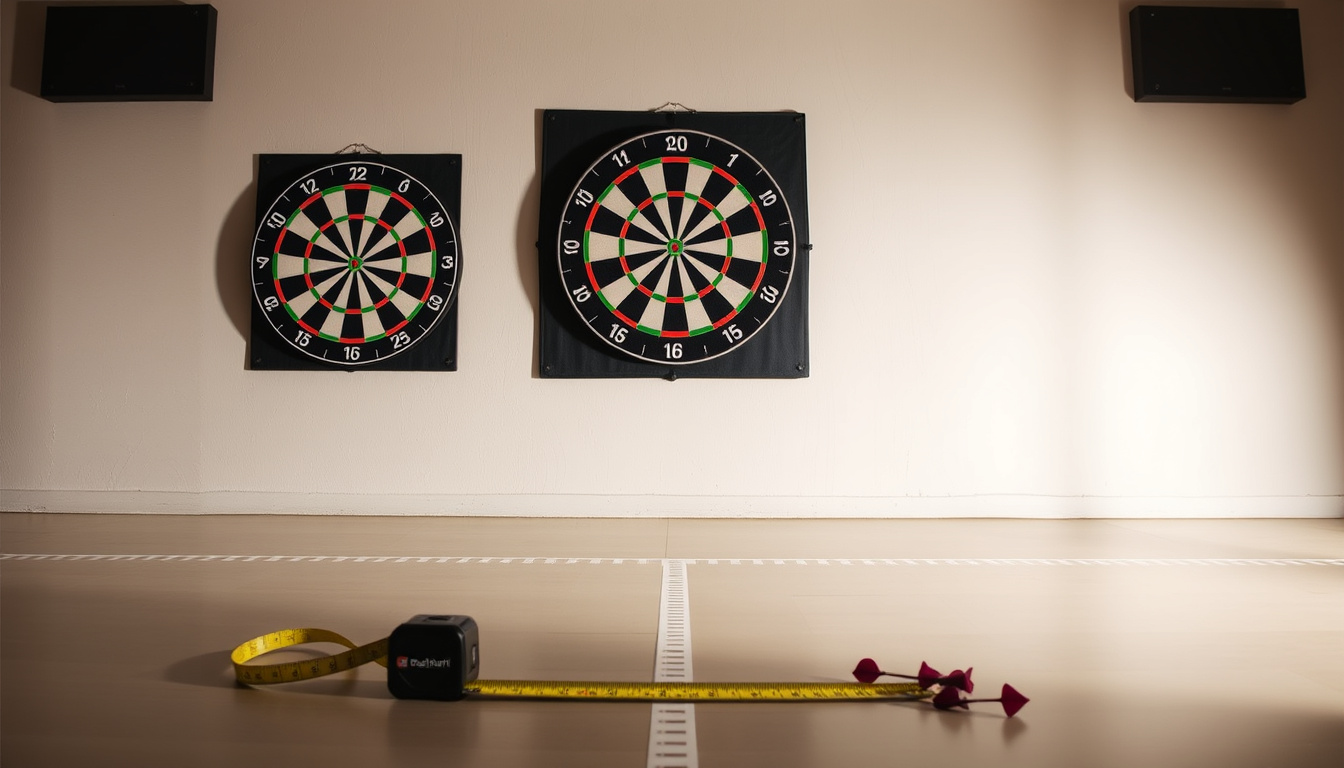
Few things in darts are as essential as the distance between the oche and the dartboard. Get it wrong, and your practice sessions won’t translate to match play. Get it right, and you’re playing on the same field as the pros. The official steel-tip distance is 2.37 m (7 ft 9.25 in), a number that traces back to British pub traditions. This guide covers the official standards, the historical reasons behind them, and how to set up your own board correctly.
Standard throwing distance (steel tip): 2.37 m (7 ft 9.25 in) ·
Standard throwing distance (soft tip): 2.44 m (8 ft) ·
Bullseye height from floor: 1.73 m (5 ft 8 in) ·
Dartboard diameter: 45.1 cm (17.75 in)
Quick snapshot
- Steel-tip distance: 2.37 m (7 ft 9.25 in) (Lakeside World Darts, tournament rulebook)
- Soft-tip distance: 2.44 m (8 ft) (Wikipedia, darts equipment reference)
- Bullseye height: 1.73 m (5 ft 8 in) (Darts Aim, setup guide)
- Exact historical reason for 7 ft 9.25 in is debated; some sources attribute it to a specific pub measurement, but no primary record survives (Lakeside World Darts, historical footnote)
- WDF adopted the metric conversion of 2.37 m in 1977 (Lakeside World Darts, timeline data)
- Learn the step-by-step measurement process for a regulation home setup (Dartshopper, official guide)
Five key measurements define a regulation dartboard setup. One pattern: the same distances appear across all major organizations, with a single split between steel-tip and soft-tip codes.
| Measurement | Value | Source |
|---|---|---|
| Standard Throwing Distance (Steel Tip) | 2.37 m (7 ft 9.25 in) | Lakeside World Darts, official rules |
| Standard Throwing Distance (Soft Tip) | 2.44 m (8 ft) | Wikipedia, oche reference |
| Bullseye Height | 1.73 m (5 ft 8 in) | Darts Aim, setup guide |
| Dartboard Diameter | 45.1 cm (17.75 in) | Net World Sports, buyer’s guide |
| Oche Length (Minimum) | 1.52 m (5 ft) | Dartscorer Club, regulation setup |
What is the standard distance for darts?
What is the distance from the dartboard to the oche?
- The distance is measured from the face of the dartboard to the front edge of the oche (Darts-Oche, setup instructions).
- For steel-tip darts, that distance is 2.37 m (7 ft 9.25 in) (Lakeside World Darts, official rulebook).
- For soft-tip darts, it is 2.44 m (8 ft) (Wikipedia, oche article).
What is the distance in feet and meters?
- Steel-tip: 7 ft 9.25 in (2.37 m) (Lakeside World Darts, official measurements).
- Soft-tip: 8 ft (2.44 m) (Wikipedia, oche distance).
- A common mistake: measuring from the wall behind the board instead of the board face. The wall-to-oche distance will be about 30 cm longer depending on the board thickness (Dartshopper, setup warning).
The implication: the difference between steel-tip and soft-tip distances is just 7 cm (about 2.75 in), but it’s enough to affect your throw if you’re used to the other format.
Why is darts 2.37 m?
What is the historical origin of the 2.37 m distance?
- The 2.37 m distance originates from the imperial 7 ft 9.25 in, a standard that emerged from British pub traditions (Lakeside World Darts, historic notes).
- The World Darts Federation (WDF) adopted the metric conversion in 1977, rounding to 2.37 m (Lakeside World Darts, timeline).
- Some sources suggest the exact 7 ft 9.25 in came from a specific pub’s floorboard length, but the precise origin remains debated (Lakeside World Darts, historical footnote).
Why are both metric and imperial used?
- Darts originated in the UK, where imperial measurements were standard. As the sport went global, metric equivalents were needed for international play (Wikipedia, oche history).
- The conversion from 7 ft 9.25 in to meters is not exact – 2.37 m is actually 7 ft 9.307 in, but the regulation rounds to 2.37 m (Lakeside World Darts, conversion note).
- Most tournament rulebooks now list both measurements, and the WDF explicitly recognizes both systems (Lakeside World Darts, official rules).
The trade-off: purists argue for the imperial original, but the metric version is now the de facto standard outside the UK.
What is the correct dartboard height and distance from the floor?
What is the height of the bullseye?
- The center of the bullseye must be 1.73 m (5 ft 8 in) above the floor (Darts Aim, height specification).
- This measurement is taken vertically from the floor to the center of the bullseye (Dartscorer Club, setup guide).
- The dartboard is hung so that the 20 segment is at the top (Dartshopper, board orientation).
How to measure dartboard height?
- Use a tape measure from the floor to the center of the bullseye (Darts Aim, measurement method).
- Mark the exact point on the wall before mounting the bracket (Score Darts, setup tips).
- After mounting, verify with a level to ensure the board is not tilted (Darts-Oche, leveling advice).
Why this matters: if the bullseye height is off by even 1 cm, your throwing angle changes and your muscle memory from practice won’t match tournament conditions.
How to measure dart distance for beginners?
How to set up a dartboard at home?
- Mount the dartboard so the center of the bullseye is 1.73 m (5 ft 8 in) from the floor (Darts Aim, step 1).
- Mark the oche (throwing line) on the floor. The front edge of the oche should be 2.37 m (7 ft 9.25 in) from the face of the dartboard for steel-tip darts (Lakeside World Darts, official setup).
- Use a long tape measure, straight from the board face to the oche. Do not measure from the wall (Dartshopper, common mistake).
- Optionally, use the diagonal check: from the bullseye to the oche, the distance should be 2.93 m (9 ft 7.5 in) for steel-tip darts (Score Darts, diagonal method).
What tools are needed to measure dart distance?
- A tape measure (at least 3 m long) (Darts-Oche, tool list).
- A spirit level to check the board is straight (Darts Aim, leveling tip).
- A marking tool (chalk, tape, or a proper oche strip) to define the throwing line (Score Darts, oche marking).
The catch: most measurement errors happen because people forget to measure from the board face, not the wall. Always double-check.
Are there different distances for steel tip and soft tip darts?
What is the standard steel tip dart distance?
- Steel tip: 2.37 m (7 ft 9.25 in) from the board face to the oche (Lakeside World Darts, steel-tip standard).
- This is the distance used by the PDC, BDO, and WDF for all steel-tip tournaments (Wikipedia, darts regulations).
What is the standard soft tip dart distance?
- Soft tip: 2.44 m (8 ft) from the board face to the oche (Wikipedia, soft-tip distance).
- This distance is standardized by the World Darts Federation for electronic dartboards (WDF, official regulations).
Why is soft tip distance longer?
- Soft-tip boards have smaller segments and lighter darts, so a slightly longer distance compensates for the reduced weight and different flight characteristics (Wikipedia, rationale).
- Historically, soft-tip darts emerged in the US and Japan, where the 8 ft (2.44 m) standard was already in use for other dart games (Dartshopper, soft-tip history).
The pattern: the 7 cm difference means you cannot practice on a steel-tip setup and expect the same accuracy in a soft-tip tournament without adjusting your throw.
Steel-tip and soft-tip darts share the same bullseye height but differ in throwing distance. The table below shows the key differences side by side.
| Feature | Steel Tip | Soft Tip |
|---|---|---|
| Throwing distance | 2.37 m (7 ft 9.25 in) | 2.44 m (8 ft) |
| Bullseye height | 1.73 m (5 ft 8 in) | 1.73 m (5 ft 8 in) |
| Board type | Bristle (sisal) | Electronic (plastic) |
| Governing body | PDC, BDO, WDF | WDF, national associations |
| Common in | UK, Europe, Australia | USA, Japan, Asia |
For a complete setup, another six specifications beyond distance and height matter. The table below lists them all.
| Specification | Value | Source |
|---|---|---|
| Dartboard diameter | 45.1 cm (17.75 in) | Net World Sports, product spec |
| Bullseye size (inner bull) | 12.7 mm (0.5 in) | Wikipedia, dartboard dimensions |
| Outer bull size | 31.8 mm (1.25 in) | Wikipedia, dartboard dimensions |
| Oche minimum length | 1.52 m (5 ft) | Dartscorer Club, regulation |
| Diagonal check (steel tip) | 2.93 m (9 ft 7.5 in) | Score Darts, diagonal method |
| Diagonal check (soft tip) | 2.98 m (9 ft 9.5 in) | Score Darts, diagonal method |
| Board mounting height | 1.73 m to center of bull | Darts Aim, setup guide |
| Board tilt | None (must be level) | Darts-Oche, leveling advice |
Step-by-step: How to set up a regulation dartboard
- Choose a location with at least 3 m of clear floor space from the wall to allow for the throw and follow-through.
- Measure and mark the bullseye height: 1.73 m (5 ft 8 in) from the floor. Use a level to ensure the mark is vertical (Darts Aim, height marking).
- Install the wall bracket so that the dartboard’s center aligns with the mark. Hang the board with the 20 segment at the top.
- From the front face of the board, measure horizontally to the floor. Mark the point exactly 2.37 m (7 ft 9.25 in) away for steel-tip or 2.44 m (8 ft) for soft-tip (Lakeside World Darts, distance marking).
- Apply a tape or oche strip at that mark, perpendicular to the board. The front edge of the oche is the throwing line.
- Check the diagonal: from the bullseye to the oche, the distance should be 2.93 m (9 ft 7.5 in) for steel-tip (Score Darts, diagonal verification).
- If the diagonal check is off, re-measure the horizontal distance before adjusting the board height.
The trade-off: if you’re using a multi-game board that combines steel and soft tip, set the distance to the steel-tip standard (2.37 m) and adjust your throw for soft-tip games – or mark a second oche line.
For home players, the most common mistake is measuring from the wall instead of the board face. That error alone can add 25-30 cm to your throwing distance, making your practice effectively useless for tournament play (Dartshopper, common mistake warning).
The diagonal check for steel-tip darts is sometimes listed as 9 ft 7 3/8 in instead of 9 ft 7.5 in. This rounding difference of about 3 mm won’t affect your setup, but it shows that even official guides disagree on the exact value. Stick to the horizontal measurement as your primary check.
What we know and what’s still debated
Confirmed facts
- Standard steel-tip distance: 2.37 m (7 ft 9.25 in) (Lakeside World Darts)
- Standard soft-tip distance: 2.44 m (8 ft) (Wikipedia)
- Bullseye height: 1.73 m (5 ft 8 in) (Darts Aim)
- Distance measured from board face to oche, not wall (Darts-Oche)
- Diagonal check alternative: 2.93 m for steel-tip (Score Darts)
- WDF adopted metric standard in 1977 (Lakeside World Darts)
What’s unclear
- The exact historical reason for 7 ft 9.25 in – some say it came from a specific pub’s floorboard length, but no primary source confirms this (Lakeside World Darts).
- Whether the diagonal check measurement should be 9 ft 7 3/8 in or 9 ft 7 1/2 in – rounding differences exist across guides (Score Darts vs Wikipedia).
Expert perspectives on the oche distance
The throwing distance shall be 2.37 m (7 ft 9.25 in) from the oche to the dartboard face.
BDO official rulebook, as cited by Lakeside World Darts
The front edge of the oche is treated as the legal throwing line, meaning a player’s toe must remain behind it while throwing.
A diagonal check measurement can be used on uneven surfaces when measuring from the bullseye to the oche.
The takeaway: professional bodies agree on the numbers, but small rounding variations in the diagonal check show that even the experts have minor disagreements.
For anyone setting up a dartboard at home, the choice is clear: use the steel-tip standard of 2.37 m if you plan to play in most leagues, or the soft-tip standard of 2.44 m if you’re part of the growing electronic board community. The 7 cm difference may seem small, but it’s the difference between a throw that feels natural and one that feels off. For the home player who wants to practice seriously, measuring from the board face – not the wall – is the single most important step. Everything else follows from there.
darts-oche.com, anglejournal.uk, dartscorer.club, anglepress.co.uk, dartrankings.co.uk, darts501.com
Frequently asked questions
Can I measure the distance from the wall to the oche?
You can, but it’s not recommended unless you know the exact depth of your dartboard. The official distance is measured from the board face, so you’d need to add the board’s thickness (typically 30-40 mm) to the wall measurement. It’s much safer to measure directly from the board face (Dartshopper, measurement warning).
What happens if the distance is off?
If the distance is too short, the dartboard will appear larger and your throwing angle will be steeper, potentially causing darts to bounce out. If it’s too long, you’ll have to throw harder, reducing accuracy. In both cases, your muscle memory will not transfer to tournament play (Darts-Oche, setup advice).
Do professional tournaments use the same distance?
Yes. The PDC, BDO, and WDF all use the same 2.37 m (7 ft 9.25 in) distance for steel-tip darts. For soft-tip tournaments, the distance is 2.44 m (8 ft) as per WDF regulations (Lakeside World Darts, tournament rules).
Is there a minimum oche length?
Yes, the oche should be at least 1.52 m (5 ft) long to give players enough room to stand side by side. Some tournament setups use longer oches (Dartscorer Club, oche specification).
How do I convert feet to meters for dart distance?
To convert 7 ft 9.25 in to meters: divide inches by 39.37. The exact result is 2.370 m, which rounds to 2.37 m. For 8 ft, it’s 2.438 m, rounded to 2.44 m (Net World Sports, conversion guide).
Why do soft tip darts have a longer distance?
Soft-tip darts are lighter and the boards have smaller segments, so a longer distance compensates for the reduced momentum and helps maintain accuracy parity with steel-tip games (Wikipedia, soft-tip rationale).
What is the distance for electronic dartboards?
Electronic dartboards (soft tip) follow the same 2.44 m (8 ft) standard. The diagonal check for these boards is approximately 2.98 m (9 ft 9.5 in) (Score Darts, electronic board setup).
What is an illegal throw in darts?
An illegal throw occurs when a player’s foot crosses the front edge of the oche while releasing the dart. The toe must remain behind the line. Repeated violations can result in warnings or loss of turn (Man Cave Insider, oche rule).

George Thompson is Senior Reporter at UrbanMixr.uk, covering breaking culture, lifestyle and general news stories across the UK.