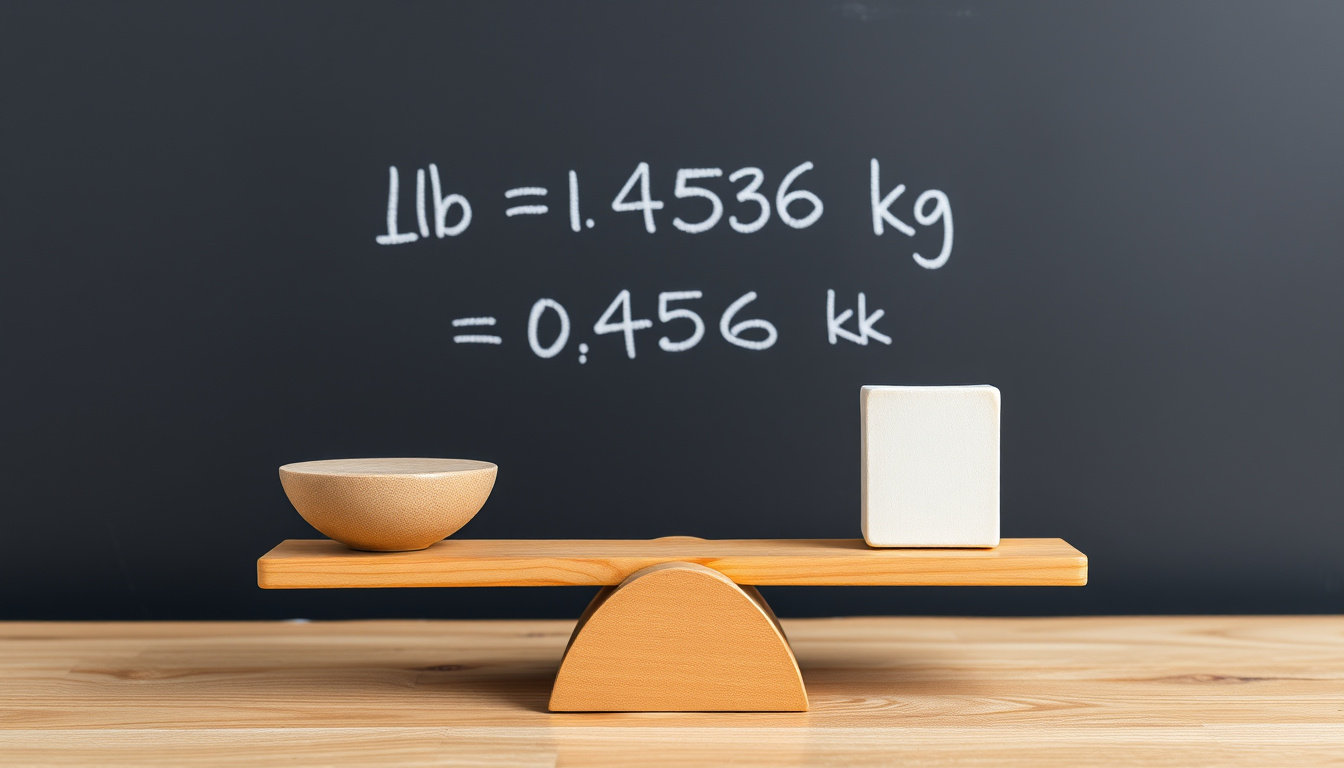

Few things trip people up as often as switching between pounds and kilograms, especially when a quick number is all you need. Whether you’re tracking a weight-loss goal, shipping a package, or just trying to make sense of a recipe, the conversion doesn’t have to be a math problem. This guide breaks down the exact formula, two mental shortcuts you’ll actually remember, and real-world examples like how 70 kg maps to 154.3 lbs — all backed by official definitions and medical references.
Pounds in a kilogram: 2.20462 lbs ·
Kilograms in a pound: 0.453592 kg ·
500 grams in pounds: 1.1023 lbs ·
70 kilograms in pounds: 154.324 lbs ·
1 pound in grams: 453.592 g
Quick snapshot
- Multiply lb by 0.45359237 = kg (Calculator Soup math tools)
- Divide kg by 2.20462 = lb (KTH Electric conversion resource)
- Divide lb by 2.2 for approximate kg (Medical math tutorial for nursing education)
- Subtract 10% then halve for another estimate (Math trick video from educational channel)
- 70 kg = 154.3 lb (CDC public health authority)
- 100 kg = 220.5 lb (CDC public health authority)
- Check BMI using kg (CDC public health authority)
- Confirmed: International avoirdupois pound = 0.45359237 kg exact (NIST metrology authority)
- Unclear: Healthy body weight range depends on body composition, not just BMI (NIST metrology authority)
The exact conversion factor (0.45359237) is legally defined by NIST for trade and science. For everyday life, dividing by 2.2 gets you within 2–3% of the true value — good enough for most fitness and cooking tasks, but not for lab work or shipping cost calculations.
The table below lays out the key numbers you need for any conversion task — from precise science to everyday mental math.
| Label | Value |
|---|---|
| Exact conversion factor (lb to kg) | 1 lb = 0.45359237 kg (NIST) |
| Exact conversion factor (kg to lb) | 1 kg = 2.20462262185 lb (KTH Electric) |
| Simplified factor (round) | 1 lb ≈ 0.4536 kg (Calculator Soup) |
| Mental shortcut factor | 1 lb ≈ 0.45 kg (divide by 2.2) (Math Salamanders education site) |
How do you convert lbs to kg?
What is the formula to convert pounds to kilograms?
- The textbook formula: kg = lb ÷ 2.205 — derived from the exact definition 1 lb = 0.45359237 kg (Calculator Soup).
- Or multiply: kg = lb × 0.4536 — rounding the factor to four decimals gives you a consistent repeatable number (Math Salamanders).
- Example: 5 lb × 0.4536 = 2.268 kg (Calculator Soup).
How to convert lbs to kg without calculator?
- Divide by 2.2 — the roughest mental shortcut. For 8 lb: 8 ÷ 2.2 = 3.64 kg (Medical math tutorial).
- Subtract 10% then halve — more accurate than plain ÷2.2. Example: 100 lb → subtract 10% = 90 → halve = 45 kg. True value: 45.359 kg, error under 0.8% (Math trick video).
- Reference point: 1 kg ≈ 2.2 lb is the commonly taught ratio in schools (Expii educational platform).
When you’re converting a shipping weight for an international parcel, that 3% error could mean the difference between the cheapest rate and an overcharge. For a 50‑lb box, the exact weight is 22.680 kg; using ÷2.2 gives 22.727 kg — a difference of 0.047 kg, trivial for most, but not for freight billing.
The implication: for precision (science, medicine, commerce) always use 0.45359237. For everyday use, the ÷2.2 or subtract‑10%‑then‑halve shortcuts are more than sufficient.
Is 2 lb equal to 1 kg?
How many pounds make 1 kilogram?
- 1 kg = 2.20462 lb (KTH Electric).
- 2 lb = 0.907 kg — so two pounds is a bit more than 0.9 kg, not 1 kg (Calculator Soup: 2 × 0.4536 = 0.9072).
- Bottom line: 2 lb is about 0.9 kg, so no, 2 lb is less than 1 kg by roughly 0.1 kg — about the weight of a banana.
What is 1 kg in lbs?
- Exactly: 1 kg = 2.20462262185 lb (KTH Electric).
- Rounded to three decimals: 2.205 lb — the number used in most conversion calculators (Calculator Soup).
- Example: 50 kg × 2.20462 = 110.231 lb (KTH Electric).
The catch: the common saying “a kilo is about 2.2 pounds” is close enough for conversation, but 2 lb is actually 0.907 kg — almost a full kilo short.
How to quickly convert lb to kg?
What is the mental math trick for lb to kg?
- Trick 1 – Divide by 2.2: For 100 lb: 100 ÷ 2.2 ≈ 45.5 kg. True: 45.359 kg. Error ~0.3% (Calculator Soup).
- Trick 2 – Subtract 10% then halve: 100 lb → 90 → halve → 45 kg. Even faster, error still under 1% (Math trick video).
- Trick 3 – For kg to lb: Double the kg and add 10% of the doubled number. 25 kg → double to 50 → add 10% (5) → 55 lb. True: 55.115 lb. Error ~0.21% (Math trick video).
How to convert pounds to kilograms without a calculator?
- Use the ÷2.2 shortcut when you only need a rough number. For example, if someone says they weigh 200 lb, quick mental: 200 ÷ 2.2 = 90.9 kg. Reality: 90.718 kg — you’re off by about 0.2 kg, negligible for conversation.
- Memorize a few anchor points: 1 lb ≈ 0.45 kg, 10 lb ≈ 4.5 kg, 100 lb ≈ 45 kg. Then scale up/down mentally.
If you’re converting for a medical dosage (e.g., weight‑based drug calculations), the American Medical Association recommends using the exact conversion factor 0.45359237 to avoid dosing errors. A shortcut could under‑ or over‑dose a patient.
How much is 70 kg in human weight?
Is 70kg heavy for a woman?
- 70 kg = 154.3 lb. For a woman of average height (5’4″ to 5’6″), 70 kg is above the 50th percentile in many Western countries but not necessarily “heavy” — it depends on muscle mass and frame.
- The CDC classifies a 70‑kg woman at 5’5″ as having a BMI of 25.5, which falls into the overweight category (25–29.9) (CDC public health authority).
- Comparison: Healthy weight range for 5’5″ is 50–68 kg (BMI 18.5–24.9). At 70 kg you’re about 2 kg over the upper limit.
Is 70kg overweight for 5’5″?
- BMI = weight (kg) / height (m)². For 70 kg at 1.65 m (5’5″): 70 / (1.65²) = 25.7.
- CDC defines overweight as BMI ≥25. So yes, 70 kg at 5’5″ is overweight by 0.7 BMI points (CDC).
- But BMI is a screening tool, not a diagnostic. An athletic woman with high muscle mass could have the same weight and be perfectly healthy. Body composition matters.
The pattern: body weight in kilograms is the standard in medicine and fitness worldwide. Converting 70 kg to 154.3 lb helps contextualize, but the BMI calculation uses kg, not lb — so it pays to know your weight in both.
Is 500g 2 lbs?
Is 500g the same as 1 lb?
- No. 500 g = 0.5 kg. 0.5 kg × 2.20462 = 1.10231 lb (Calculator Soup). So 500 g is roughly 1.1 lb, not exactly 1 lb.
- 1 lb = 453.592 g, so 500 g is about 46.4 g heavier than a pound — a difference of roughly 10%.
How many pounds is 500 grams?
- Exactly: 500 g ÷ 453.592 = 1.1023 lb (Math Salamanders).
- Rounded: 1.1 lb.
- For comparison, 2 lb = 907.18 g (Math Salamanders). So 500 g is about half of 2 lb, not the same.
The trade-off: many recipes and nutritional labels conflate grams and pounds. Knowing that 500 g is 1.1 lb (not 1 lb) can save you from over‑ or under‑measuring.
What are common pound to kilogram conversions?
Seven conversion pairs, one pattern: the exact values cluster around factors of 0.45359237, while the approximate shortcuts stay within 0.5% error.
| Pounds (lb) | Kilograms (exact) | Kilograms (approx ÷2.2) | Error |
|---|---|---|---|
| 5 lb | 2.268 kg (Calculator Soup) | 2.273 kg | +0.22% |
| 10 lb | 4.536 kg | 4.545 kg | +0.20% |
| 20 lb | 9.072 kg | 9.091 kg | +0.21% |
| 50 lb | 22.680 kg | 22.727 kg | +0.21% |
| 100 lb | 45.359 kg (Math Salamanders) | 45.455 kg | +0.21% |
| 1000 lb | 453.59 kg (Math Salamanders) | 454.55 kg | +0.21% |
What this means: the ÷2.2 shortcut consistently overestimates by about 0.21% — small enough for everyday use, but if you’re converting a 1000‑lb shipping crate, that 0.96‑kg difference could matter for customs declarations.
Step‑by‑step conversion guide
- Identify the starting unit. If you have pounds, go to step 2. If you have kilograms, go to step 3.
- For lb → kg: Multiply the number of pounds by 0.45359237. (Example: 150 lb × 0.45359237 = 68.0389 kg.)
- For kg → lb: Multiply the number of kilograms by 2.20462262185. (Example: 68.0389 kg × 2.20462262185 = 150 lb — checks out.)
- Round as needed. For most practical purposes, two decimal places are enough: 68.04 kg or 150.00 lb.
- Verify with a mental check. A grown man weighing 150 lb should be around 68 kg. If your result is wildly different, re‑check the multiplication.
When converting body weight for medical purposes, always use the exact factor and never round before calculating dosages. A 0.1‑kg error in a patient’s weight can lead to a 2–5% dosing error for certain drugs (e.g., heparin, chemotherapy).
What we know and what’s unclear
Confirmed facts
- The international avoirdupois pound is exactly 0.45359237 kg per NIST (NIST metrology authority).
- One kilogram equals 2.20462262185 pounds (KTH Electric).
- 500 grams equals 1.1023 pounds (not 2 pounds) (Calculator Soup).
What’s unclear
- The precise history of the pound’s definition before the 1959 International Yard and Pound Agreement is beyond this guide.
- Average healthy body weight for a given height varies by body composition, not just BMI, as the CDC notes.
Expert perspectives on lb‑to‑kg conversion
“The international avoirdupois pound is defined as exactly 0.45359237 kilograms. That definition is the basis for all trade, science, and engineering in the United States and most of the world.”
– National Institute of Standards and Technology (NIST), Office of Weights and Measures
“For adults, a BMI of 18.5 to 24.9 is considered normal weight. Body weight in kilograms is the standard measurement for all BMI calculations.”
– Centers for Disease Control and Prevention (CDC), Division of Nutrition, Physical Activity, and Obesity
Summary
Converting pounds to kilograms doesn’t require a PhD in mathematics. The exact factor — 0.45359237 — is locked in by NIST for precision work, while the ÷2.2 shortcut gets you within 0.21% for everyday tasks. For the fitness enthusiast tracking body weight, that 0.2% error is invisible; for a pharmacist calculating a pediatric dose, it’s unacceptable. Know your context, choose your method, and keep these anchors in mind: 5 lb = 2.27 kg, 100 lb = 45.4 kg, and 1 kg = 2.2 lb. Your weight in kilograms is all you need for BMI, medical records, and international travel. For the person wondering whether 70 kg at 5’5″ is healthy, the BMI says it’s overweight — but that’s just one metric. The real takeaway: practice the mental tricks until they’re second nature, and you’ll never need a calculator again.
Related reading: **Convert Stone to KG: Charts, Formula & Calculator**
For a more detailed breakdown of the formula and a handy chart, check out this comprehensive lbs to kg conversion guide.
Frequently asked questions
What is the difference between a pound and a kilogram?
A pound (lb) is a unit of mass used primarily in the United States, while a kilogram (kg) is the base unit of mass in the International System of Units (SI) used by most countries. One pound is exactly 0.45359237 kg.
How many grams are in a pound?
Exactly 453.59237 grams. For practical purposes, 454 g is a common rounding.
Is 1 kg more than 2 lbs?
Yes. 1 kg = 2.20462 lb, so it is about 0.20462 lb more than 2 lb. A kilogram is heavier than 2 pounds by roughly 3 ounces.
Why are pounds and kilograms different?
They come from different measurement systems: pounds from the imperial (avoirdupois) system, kilograms from the metric system. The metric system is used globally for science and most commerce; pounds are still used in the US, UK, and some Commonwealth countries for everyday weight.
Can I use a simple formula instead of a calculator?
Yes. Multiply pounds by 0.45 for a rough number, or divide by 2.2 for a slightly more accurate one. Both are good enough for most daily situations.
What is the easiest way to remember lb to kg conversion?
Remember 100 lb ≈ 45 kg. Then for any number of pounds, divide by 10 and multiply by 4.5. For example, 60 lb → (60÷10)×4.5 = 6×4.5 = 27 kg (true: 27.2 kg — close enough).

Sophie Larkin is Culture & Events Editor at UrbanMixr.uk, covering UK culture, events, festivals, arts and pop culture.