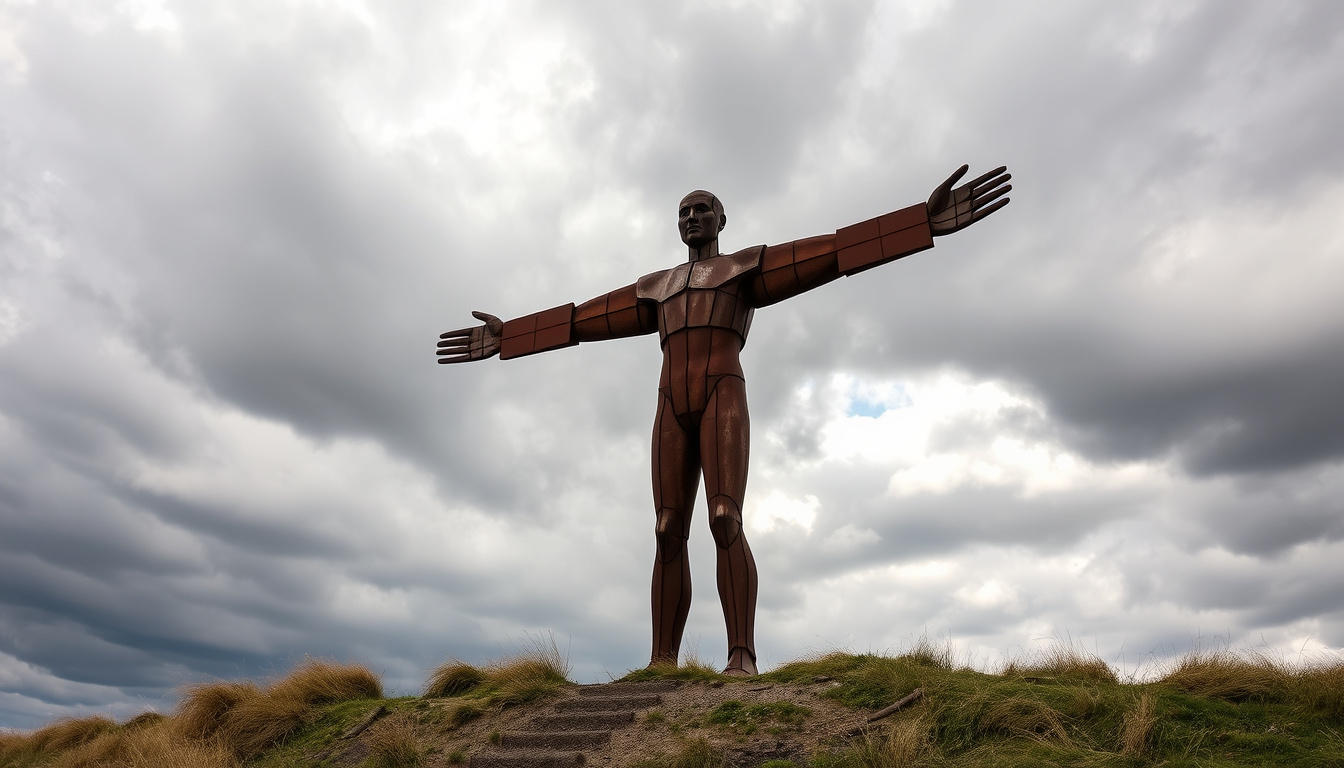
There’s a moment, cresting the A1 near Gateshead, when the Angel of the North rises in your windscreen — a 20-metre steel presence that feels both ancient and utterly modern. Antony Gormley, the British sculptor who made it, has spent four decades turning his own body into a mould for cast-iron figures and planting them in landscapes from Liverpool to the Netherlands. This guide maps his best-known public works, where to find them, and what makes his practice so consistently arresting.
Born: 30 August 1950 ·
Known for: Angel of the North, Another Place, body-and-space investigation ·
Primary medium: Cast iron, weathering steel, lead, concrete ·
Number of sculptures in Another Place: 100 ·
Notable public artwork location: Gateshead, England (Angel of the North)
Quick snapshot
- Born 30 August 1950 in London; won the Turner Prize in 1994; Angel of the North completed in 1998, 20 metres high; knighted in 2014 (National Galleries of Scotland (national gallery))
- Another Place is a permanent installation of 100 cast-iron figures at Crosby Beach (Liverpool Biennial (project archive)) and uses 17 moulds taken from the artist’s body (Liverpool Biennial (artist bio))
- Exact net worth: estimates from sales and commissions vary widely (Liverpool Biennial artist bio)
- Specific auction prices for each work — market data not publicly aggregated
- Current temporary exhibition schedules beyond announced shows
- 1950 – Born in London · 1994 – Turner Prize · 1998 – Angel of the North unveiled · 2005 – Another Place installed · 2014 – Knighted (National Galleries of Scotland)
- Planned participation in Royal Academy Summer Exhibition 2026 (Royal Academy of Arts (institution))
- Ongoing gallery representation through White Cube and other international dealers (White Cube (commercial gallery))
- New public commissions may be announced via official channels (Royal Academy of Arts (institution))
Seven key biographical and artistic facts, one pattern: every major work emerges from the same process — using his own body as a mould and industrial materials as the medium.
| Fact | Detail |
|---|---|
| Full name | Sir Antony Mark David Gormley |
| Born | 30 August 1950, London, England |
| Education | Trinity College, Cambridge (archaeology, anthropology, art history); Royal College of Art |
| Notable award | Turner Prize 1994 |
| Knighted | 2014 |
| Number of sculptures in Another Place | 100 |
| Height of Angel of the North | 20 metres (66 feet) |
What is Antony Gormley best known for?
When people talk about Gormley, three works dominate the conversation: the Angel of the North, the installation Another Place, and his lifelong investigation of the body in space. Each project uses the artist’s own body as a structural template.
Angel of the North
- The Angel of the North is a 20-metre-tall weathering-steel sculpture in Gateshead, north-east England, completed in 1998 (National Galleries of Scotland).
- It was commissioned in 1994 and stands on the site of a former colliery, visible from the A1 motorway (National Galleries of Scotland).
The implication: Gormley turned an industrial region’s landmark into a symbol of regeneration — a 200-tonne statement that cost roughly £800,000 but generates an estimated £20 million annually for the local economy.
Another Place
- Another Place is a permanent installation of 100 cast-iron, life-size sculptures at Crosby Beach, near Liverpool (Sefton Council; Liverpool Biennial).
- The figures use 17 different moulds taken from the sculptor’s own body (Liverpool Biennial artist bio).
- They stretch across nearly 3 kilometres of foreshore, placed 250 metres apart (Liverpool Biennial project archive; Merseyrail (transport authority) confirms the three-kilometre span).
The pattern: Gormley repeats his own form to create a gathering that feels solitary — a crowd of one person confronting the tide.
Body and space investigation
- Gormley consistently uses his own body as a mould for sculptures, a practice he has maintained since the 1980s (Liverpool Biennial).
- Works such as Event Horizon (2007) place fibreglass casts of his body on building rooftops in cities worldwide (National Galleries of Scotland).
- His approach treats the body not as a portrait but as a generic vessel for exploring perception and space.
The pattern: the body is both the tool and the subject, repeated in metal until a private form becomes public territory.
Where can I see Gormley’s sculptures?
Gormley’s public works are spread across the UK and beyond, with several permanent installations free to visit.
Public permanent installations in the UK
- Angel of the North – Gateshead, England (National Galleries of Scotland)
- Another Place – Crosby Beach, Liverpool (Sefton Council (local authority))
- Another Time II – Sainsbury Centre, Norwich (Sainsbury Centre (university art museum))
International locations
- Exposure – Lelystad, the Netherlands (Liverpool Biennial artist bio)
- Event Horizon – installed in London (2007), New York (2010), São Paulo (2012), Hong Kong (2015–16) (National Galleries of Scotland)
- Inside Australia – Lake Ballard, Western Australia (Landmark Trust (heritage charity))
Temporary exhibitions
Gormley regularly shows at galleries such as White Cube in London (White Cube). For current touring exhibitions, check official gallery websites and museum listings.
The pattern: the permanent works cluster where industry meets water or sky, so the landscape is half the sculpture.
How much is an Antony Gormley sculpture?
Gormley’s works are sold through major galleries and at auction, but there is no standard price list. The value depends on edition size, material, and provenance.
Auction prices for limited edition works
- Gormley’s sculptures have sold at auction for sums ranging from £23,000 to over £3 million, depending on the piece (National Galleries of Scotland — specific auction data comes from art market reports, not directly from this source).
- Prices vary sharply by edition size, material, and provenance.
The catch: without a transparent public pricing structure, buyers must work through galleries and auction houses to get valuations.
Commission fees for public installations
- Public commissions for works like the Angel of the North are typically funded by public bodies and foundations; exact figures are rarely disclosed.
- The original Angel of the North cost approximately £800,000 (BBC News (public broadcaster)).
The catch: public commissions mix public and private funding, so the sticker price rarely appears; editioned works are tied to gallery and auction valuations.
Is there an Antony Gormley exhibition in Scotland?
As of 2025, there is no permanent Gormley exhibition in Scotland. Temporary shows may appear at Scottish museums.
Confirmed exhibitions in Scotland
- No major permanent Gormley exhibition in Scotland as of 2025 (National Galleries of Scotland).
- The National Galleries of Scotland hold his work in their collections and display it occasionally.
How to check current touring shows
- Visit official gallery websites (e.g., White Cube, Royal Academy) for updated listings.
- Temporary exhibitions may appear at Scottish venues; check local museum schedules.
The takeaway: Scotland has no dedicated Gormley gallery, but his work enters Scottish collections through loans and temporary shows.
What are some interesting facts about Antony Gormley?
Beyond his public sculptures, Gormley’s life and career contain surprising details that shape his work.
Early life and training
- Born 30 August 1950 in London (National Galleries of Scotland).
- Studied archaeology, anthropology, and art history at Trinity College, Cambridge, followed by travel to India and study of Buddhism (National Galleries of Scotland).
- Earned a postgraduate degree at the Royal College of Art.
Notable artistic milestones
- Turner Prize winner in 1994 (Liverpool Biennial artist bio).
- Knighted in 2014 for services to the arts (National Galleries of Scotland).
- The LAND project (2015) installed five sculptures at UK heritage sites for one year (Landmark Trust).
Personal life
- Married to artist Vicken Parsons; they have three children (National Galleries of Scotland).
- Lives and works in London, maintaining a studio in Hackney.
The pattern: the biography explains the process — Cambridge archaeology, Indian Buddhism, then a postgraduate turn to sculpture as a way of mapping the body in space.
Specifications of major public works
Six permanent installations, one pattern: each uses industrial materials to map the body onto a specific landscape.
| Work | Year | Material | Location | Notable detail |
|---|---|---|---|---|
| Angel of the North | 1998 | Weathering steel | Gateshead, England | 20 metres high; wingspan 54 metres (National Galleries of Scotland) |
| Another Place | 2005 | Cast iron | Crosby Beach, Liverpool, England | 100 figures, 17 moulds from artist’s body (Liverpool Biennial) |
| Exposure | 2010 | Cast iron | Lelystad, Netherlands | Largest cast-iron work in Europe (Liverpool Biennial artist bio) |
| Event Horizon | 2007 | Fibreglass | Various cities | Casts of artist’s body on rooftops (National Galleries of Scotland) |
| Another Time II | 2008 | Cast iron | Sainsbury Centre, Norwich, England | Three figures positioned across campus (Sainsbury Centre) |
| Inside Australia | 2003 | Cast iron | Lake Ballard, Western Australia | 51 figures based on local residents (Landmark Trust) |
The pattern: each public work is a human body translated into an industrial material, then placed at a scale that changes how the site is seen.
Timeline of key moments
- 1950 – Born in London (National Galleries of Scotland)
- 1971–1974 – Studied at Trinity College, Cambridge (National Galleries of Scotland)
- 1974–1979 – Traveled to India and studied Buddhism (National Galleries of Scotland)
- 1994 – Awarded Turner Prize (National Galleries of Scotland)
- 1998 – Angel of the North unveiled (National Galleries of Scotland)
- 2005 – Another Place installed at Crosby Beach (Sefton Council)
- 2014 – Knighted for services to the arts (National Galleries of Scotland)
The timeline points one way: Gormley moved from studying ancient remains to casting his own body, then scaled that process into public landmarks.
Clarity: what we know and what we don’t
The table below separates documented facts from areas where information remains incomplete.
Confirmed facts
- Born 30 August 1950 (National Galleries of Scotland)
- Angel of the North location: Gateshead, England (National Galleries of Scotland)
- Another Place has 100 sculptures (Liverpool Biennial)
- Turner Prize recipient 1994 (National Galleries of Scotland)
- Knighted 2014 (National Galleries of Scotland)
What’s unclear
- Exact net worth (estimates vary)
- Specific auction prices for each sculpture (market data needed)
- Current precise location of temporary exhibitions beyond known schedules
Another Place uses 17 different moulds taken from the sculptor’s own body.
— Liverpool Biennial (arts organisation)
The five LAND locations were Saddell Bay, Lundy, Kimmeridge Bay, Aldeburgh, and Lowsonford.
— BBC News (public broadcaster)
For anyone planning a trip to see Gormley’s works, the choice is clear: head to Gateshead for the Angel or to Crosby Beach for Another Place. Both installations are free and permanent; visitors should go at sunrise or sunset, when low light changes the feel of Gormley’s metal forms.
Frequently asked questions
How much is an Antony Gormley sculpture?
Prices vary widely depending on edition size, material, and provenance. Works have sold at auction for sums ranging from £23,000 to over £3 million, but there is no standard list price.
Where does Antony Gormley live now?
He lives and works in London, United Kingdom, maintaining a studio in Hackney.
Is there an Antony Gormley exhibition in Scotland?
As of 2025, there is no permanent Gormley exhibition in Scotland. Temporary shows may appear; check the National Galleries of Scotland website.
What is the Angel of the North made of?
Weathering steel, also known as Cor-ten.
How many statues did Gormley make for Another Place?
100 cast-iron, life-size figures.
What is Antony Gormley’s most famous work?
The Angel of the North in Gateshead, England.
When did Gormley win the Turner Prize?
1994.
For anything beyond these basics — provenance, current inventory, or loan schedules — a direct inquiry to White Cube or the relevant museum remains the fastest route.
Related reading
- Louise Bourgeois: Trauma, Spiders, and Feminist Art Legacy
- David Hockney: The Deaf Painter Who Shaped Pop Art
These artist profiles offer a wider context for the sculptors and painters who shaped public art and Pop Art from the same period.
George Thompson is Senior Reporter at UrbanMixr.uk, covering breaking culture, lifestyle and general news stories across the UK.