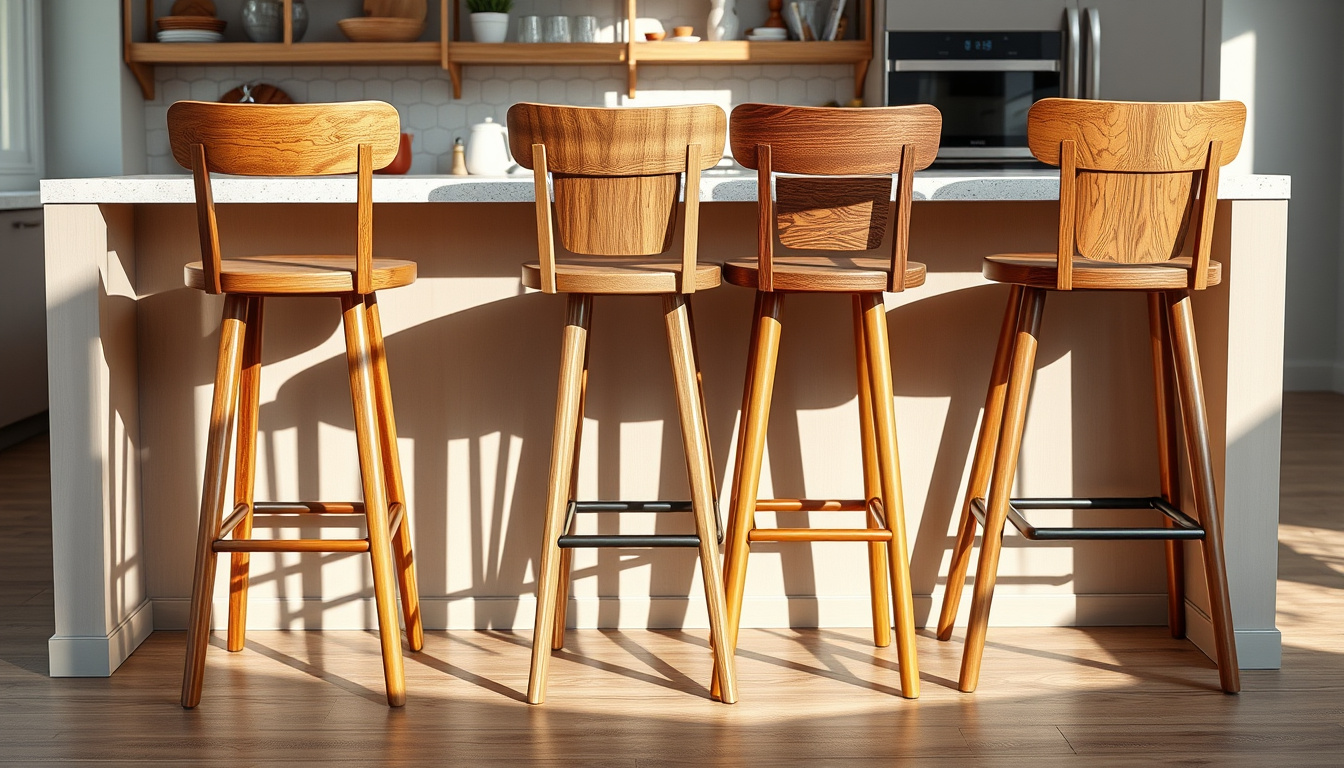
Standard bars run about 107 cm (42 inches) high, according to Frontgate, a home furnishing retailer, and the right stool leaves legroom without making you perch like a child at an adult table. Measure first, shop second: the height math, back support, wood choices, and set-buying logic below make the right call much easier to see.
Standard bar height: 107 cm ·
Bar stool seat height: 71–81 cm ·
Counter stool seat height: 61–69 cm ·
Recommended leg clearance: 25–30 cm ·
Common set size: 2
Quick snapshot
- Bar stools are taller than counter stools (Dimensions.com, a furniture measurement database)
- Wood bar stools come in backless and with-back versions (Povison’s wood-stool guide)
- Solid wood is generally more durable than plywood or MDF (Povison’s wood-stool guide)
- Many retailers sell bar stools in sets of 2 (Wayfair’s height guide)
- Whether “bar bar stool” names a specific product or a duplicated search phrase
- Which exact IKEA model a shopper means by “bar bar stool”
- Current clearance availability or discount depth at any retailer
- Whether a low spindle back adds real lumbar support
- The 71–81 cm seat-height band is stable across retail guides
- Clearance sales follow discontinued finishes and floor-model turnover
- Set pricing changes when retailers refresh a range
- Measure surface height, then subtract about 25 cm (10 in) for the seat target (The Home Depot measuring guide)
- Check 23–25 cm of clearance between seat and counter underside (Frontgate, a home furnishing retailer)
- Compare sets of 2 to bring the per-stool cost down (Wayfair’s height guide)
A few numbers explain most bar stool mistakes, one pattern: the seat height has to match the surface, and the clearance has to match the person sitting in it.
| Measurement | Typical value | Source |
|---|---|---|
| Bar stool seat height | 71–81 cm | SU Office Space pairing guide |
| Counter stool seat height | 61–69 cm | Frontgate counter scale |
| Standard bar height | 107 cm (42 in) | Frontgate home furnishing guide |
| Recommended leg clearance | 25–30 cm | Retail fit guides |
| Common set size | 2 | Retailer set listings |
| Seat width check | Measure before buying a run of stools | The Home Depot measuring guide |
What is a bar bar stool?
A bar bar stool is a tall seat designed for casual dining and conversation at a raised counter, breakfast bar, or home bar. The doubled phrase isn’t a manufacturer’s model name — it’s the way people search for a category that spans hundreds of products.
How does a bar bar stool differ from a counter stool?
- Counter-height seats: 61–69 cm, built for 86–99 cm surfaces
- Bar-height seats: 71–81 cm, built for 107 cm bars
- Extra-tall seats: 84–91 cm, for oversized or commercial bars
The difference is geometry, not style. Frontgate, a home furnishing retailer, pairs counter stools with 34–39 in counters and bar stools with 40–42 in bars. That height shift changes posture: counter stools keep a near-dining position, while bar stools raise the knees into a more social, relaxed angle.
The implication: once you accept that “bar bar stool” is a search phrase rather than a product line, the decision narrows to height, support, materials, and set size.
What are the typical parts of a bar stool?
- Seat: wood, upholstered, or metal
- Legs: often with a cross brace for stability
- Footrest: near the floor or mid-height
- Backrest and armrests: optional, and they change how the stool fits under a counter
Most bar stools share the same core anatomy — a seat, legs, and a footrest — with a backrest and armrests as add-ons. Swivel and gas-lift mechanisms are the common upgrades when a stool needs to move between tasks.
The pattern: fewer parts means easier storage; more parts means more comfort over a long sit.
How do I choose the right bar stool height?
The Home Depot’s measuring guide is the fastest shortcut: take the height of your surface and subtract about 25 cm (10 in) to get a starting seat height. The formula works for bars and counters alike, which is why a 107 cm bar points to a seat near the top of the 71–81 cm band while a 91 cm counter points to a seat near 66 cm.
How much clearance should there be between the seat and the counter?
A stool that clears the height test can still fail the clearance test: keep at least 23–25 cm between seat and counter underside, per Frontgate’s home furnishing guide, or the breakfast bar becomes a knee-knocking zone.
Frontgate’s 9–10 in is the comfort floor, and leaving the fuller 25–30 cm feels noticeably better once your feet are on the rest. SU Office Space, a commercial furniture supplier, warns that aprons, drawers, rails, and brackets all shrink the usable gap — so measure the underside, not the floor-to-counter height.
The pattern: measure the underside before you fall in love with a seat height.
What is the difference between counter height and bar height?
- Counter surfaces: 86–99 cm (34–39 in), with seats around 61–69 cm
- Bar surfaces: 107 cm (42 in), with seats around 71–81 cm
- Oversized bars: seats around 84–91 cm
Dimensions.com, a furniture measurement database, logs counter-height seats at 23–28 in (58–71 cm), bar-height seats at 29–32 in (74–81 cm), and extra-tall seats at 33–36 in (84–91 cm). Retail ranges overlap because real surfaces vary: a 69 cm seat works at both a 91 cm counter and a 94 cm counter, and a 71 cm seat is the crossover into bar territory.
The formula — surface height minus 25 cm — stays reliable across all of them, because it starts from the only number that never changes: the height of the surface you already own.
Five centimeters in either direction decides whether a 107 cm bar feels like a proper seat or a child’s chair. The comfort window is narrow because the body notices small changes in knee angle.
The pattern: if the surface is 107 cm, the stool range picks itself — 71–81 cm seats, no guesswork.
What are the benefits of a bar bar stool with backs?
The backrest is the biggest comfort variable between two stools that look identical from the front. It is also the main trade-off with storage and tuck-away.
Are backless bar stools better for small spaces?
- Backless stools tuck fully under a counter and store closer together
- They keep a kitchen visually lighter
- They suit short, social sits at a breakfast bar
Povison’s wood-stool buying guide reaches the same conclusion: backless designs suit tight kitchens and slide completely under a counter. What they give up is lower-back support during anything beyond a quick coffee, which matters if the stool is for a dining spot rather than a drinks corner.
The pattern: backless is a space decision; with-back is a comfort decision.
Why choose a bar stool with a backrest?
A fuller back lets you lean back instead of bracing your posture; a backless stool keeps the silhouette clean and the counter view open. The right answer depends on how long you actually sit.
Povison’s guide ties fuller backs to longer meals, because a back allows the body to rest between bites rather than stay braced. A low spindle back offers some lumbar contact while keeping the design light, though how much real support it adds is less certain. Upholstered with-back stools are the luxury end of the kitchen spectrum, per the retail positioning that runs through most category pages.
- Check both seat height and total height under the counter (The Home Depot measuring guide)
- Check armrests — they can block a full tuck (Wayfair’s height guide)
The trade-off: every centimeter of back you add is a centimeter of tuck-away you lose — measure total height before you commit.
Which materials are best for wooden bar stools?
Wood is the default when buyers want a warm, natural look and joinery that lasts. The material decision splits into two parts: the wood itself and the finish on top of it.
Are solid wood bar stools more durable than plywood?
- Oak, beech, and walnut are hardwoods commonly used in wooden stools
- Solid wood can be re-sanded and re-finished when it wears
- Plywood and MDF cost less but dent and chip more easily
Povison’s wood-stool guide says buyers choose wood for a warm, natural appearance and durable joinery; the practical consensus is that solid wood outlasts plywood and MDF over years of daily use. Povison also reports a common seat depth of 36–46 cm (14–18 in) for wooden stools, and Telectronic Hub’s commercial furniture guide adds that a clearly stated weight capacity is a quality signal.
The implication: joinery and finish decide longevity more than the species name — a well-built beech stool outlasts a cheap walnut lookalike. The same rule drives other product calls: the Dr Martens Models Styling Alternatives guide picks boots on build, not badge.
How do you finish a wooden bar stool?
- Lacquer: hard, glossy, resistant to spills
- Oil: natural feel, needs periodic reapplication
- Wax: soft sheen, easy to refresh
Lacquer, oil, and wax are the standard sealing routes for wooden stools — sealed wood resists spills and scratches, while unsealed wood absorbs both within minutes.
A bar stool is a drink holder as much as a seat. An unsealed or cheaply finished wooden seat will show every spill, and the finish — not the wood species — is what actually takes the abuse.
Where can I find IKEA bar bar stools and clearance bar stools for sale?
The two most-typed variants of this search — “ikea” and “clearance” — map to two different buying strategies: using IKEA as a size and price reference, and waiting for a discount event.
Does IKEA sell bar stools?
- IKEA carries bar stools and bar-height chairs in multiple styles
- The range spans wood, metal, and upholstered seats
- Shoppers often use IKEA’s height specs as a comparison baseline
IKEA offers bar stools in multiple styles, which is why “bar bar stool ikea” behaves like a comparison search rather than a model search. The exact model a shopper means varies — no single IKEA product owns the phrase — so the smart move is to filter by height (71–81 cm seats for a 107 cm bar) and compare across the range.
The implication: if your search starts with “bar bar stool ikea”, you’re comparing heights and prices, not chasing one SKU.
When do retailers discount bar stools?
- Clearance events clear discontinued colors and finishes
- Floor models get discounted when ranges reset
- Sets of 2 often carry a lower per-stool price during sales
Retailers use clearance windows to move discontinued colors, finishes, and floor models, which is why “clearance bar stools sale” is a seasonal search rather than a year-round category. Danetti, Simply Bar Stools, and Atlantic Shopping all run dedicated bar-stool ranges in the UK, and each leads with a different motive — comfort copy, stock scale, or fast delivery.
A clearance stool is usually a discontinued finish, not a defective one — the discount is driven by stock turnover, and the condition note matters more than the tag.
Are bar bar stools sold as a set of 2?
Yes — set of 2 is the most common pack size online, and it is the fastest way to make an island look intentional instead of assembled.
What is the advantage of buying a bar stool set?
- Two identical stools create symmetry at an island
- Per-stool cost typically drops compared with singles
- One delivery covers both seats
The set of 2 format is common across retailer listings, and combining two sets gives a four-seat run without mixing models. The price advantage is straightforward: a pair usually costs less than two individually priced stools, and the match is guaranteed.
The pattern: sets solve the matching problem before it exists.
How do I match a set of 2 with a larger island?
- Combine two sets for a four-seat run
- Add a third set for six seats on a long counter
- Keep seat height and finish consistent across sets
For longer islands, the math is modular: two sets for four seats, three sets for six. Before scaling up, measure the width of the stools already in the room — The Home Depot’s measuring guide stresses checking seat width before buying multiple stools for one run of counter, the kind of mistake that only shows up once three sets are lined up.
The trade-off: sets guarantee consistency, but a long island still needs a width check before you commit to count four, five, and six.
Bar stool vs counter stool vs extra-tall at a glance
Three seat heights, one pattern: the stool category follows the surface category, and the mismatch — not the stool — is what usually fails.
| Stool type | Seat height | Matched surface | Typical setting |
|---|---|---|---|
| Bar stool | 71–81 cm (28–32 in) | 107 cm (42 in) bars (SU Office Space pairing guide) | Home bars, breakfast bars |
| Counter stool | 61–69 cm (24–27 in) | 86–99 cm (34–39 in) counters (Frontgate home furnishing guide) | Kitchen islands, counter-height dining |
| Extra-tall stool | 84–91 cm (33–36 in) (Dimensions.com furniture database) | Oversized or commercial bar heights | Tall bars, standing-height counters |
The pattern: bring the surface height, and the stool range picks itself — the table is just a shortcut for the same subtraction.
Bar stool fit specs that decide the purchase
Eleven fit specs, one pattern: the measurements you can take at home decide the purchase more than any label.
| Spec | Typical value | Why it matters |
|---|---|---|
| Seat-height formula | Surface height minus ~25 cm (10 in) | Turns surface height into a seat target (The Home Depot measuring guide) |
| Standard bar height | 107 cm (42 in) | The pairing target for bar stools (Frontgate home furnishing guide) |
| Standard counter height | 86–99 cm (34–39 in) | The pairing target for counter stools (Frontgate home furnishing guide) |
| Seat-to-counter clearance | 23–25 cm (9–10 in) | Comfort minimum between seat and underside (Frontgate home furnishing guide) |
| Extra-tall seat height | 84–91 cm (33–36 in) | For oversized bars (Dimensions.com furniture database) |
| Wood stool seat depth | 36–46 cm (14–18 in) | Reported by Povison as a common wooden-stool range |
| Weight capacity | Should be clearly stated | Quality signal for commercial stools (Telectronic Hub commercial guide) |
| Armrest effect | Can block sliding under a counter | Turns a fit problem into a clearance problem (Wayfair’s height guide) |
| Underside obstacles | Aprons, drawers, rails, brackets | All reduce usable legroom (SU Office Space guide) |
| Seat width | Measure before buying multiples | A run of stools needs a width check (The Home Depot measuring guide) |
| With-back total height | Check seat height and total height | Backrests change tuck-away (The Home Depot measuring guide) |
The pattern: if a listing can’t show a weight capacity or a real seat depth, treat the spec sheet as unfinished.
The upsides and downsides of bar stool shopping
Upsides
- Compact footprint fits narrow breakfast bars and islands
- Height options cover surfaces from 86 to 107 cm
- Sets of 2 keep symmetry and lower the per-stool cost
- Sealed wooden models resist daily wear and can be re-finished
- With-back versions support longer, more relaxed sitting
Downsides
- Tall seats feel unstable without a solid base or footrest
- Armrests can block tuck-away even when seat height is right (Wayfair)
- Mismatched height is the most common fit failure
- Clearance buys are limited to discontinued finishes
- Weight capacity is not always published (Telectronic Hub)
The trade-off: bar stools win on space and scale, and they lose on the same axis when the height math is ignored.
How to measure and choose the right bar stool
Six steps, one pattern: measure the surface before you measure the stool.
- Measure the surface height. Floor to the underside of the counter or bar (The Home Depot measuring guide).
- Subtract 25 cm (10 in) to find the starting seat height.
- Inspect the underside. Aprons, drawers, rails, and brackets shrink legroom (SU Office Space guide).
- Confirm the clearance. 23–25 cm between seat and underside is the comfort floor.
- Measure seat width before committing to a run of stools.
- Check total height for models with backs or armrests.
The habit carries beyond the kitchen: the Book Shelf Buying Guide applies the same measure-first logic to shelving depth and height.
What’s confirmed, what’s still unclear
Confirmed facts
- Bar stools are taller than counter stools (Dimensions.com)
- Bar stools are sold with and without backs (Povison)
- Wood is a common bar stool material (Povison)
- IKEA sells bar stools
- Many retailers offer bar stools in sets of 2
What’s unclear
- Whether “bar bar stool” names a specific product or a duplicated search phrase
- Which exact IKEA model a shopper means by the phrase
- Current clearance availability or discount depth at any retailer
- Whether a low spindle back provides true lumbar support (Povison)
- Real-world weight limits when a brand doesn’t publish them
The pattern: the confirmed facts are about the category; the unclear items are about specific products — which is exactly the state of a search phrase without a single product behind it.
What the retailers are saying
The first page of results for “bar bar stool” is mostly UK retail category pages, and their pitch reveals what sellers think you care about: height fit, stock scale, and delivery speed.
“Our bar stool range is built for comfort and conversation around kitchen islands and breakfast bars.”
— Danetti (UK furniture retailer)
“With over 30,000 stools held in stock, we position ourselves as the UK’s largest supplier.”
— Simply Bar Stools (specialist bar stool retailer)
“Free next-day delivery is part of the purchase, not an afterthought.”
— Atlantic Shopping (UK online furniture retailer)
The pattern: none of these retailers sells “bar bar stool” as a named product — they sell bar stools, and the doubled phrase is simply how the search arrives.
The takeaway
Everything about a bar bar stool comes back to one measurement: the height of the surface it serves. Match the seat to the surface with the 25 cm rule, protect the clearance and the finish, and the rest is style. For anyone shopping a 107 cm bar, the decision is clear: buy 71–81 cm seats — or plan a return trip before the first dinner party.
Frequently asked questions
How much space should I leave between bar stools?
Measure each stool’s seat width, add enough elbow room to sit and eat comfortably, then divide the counter run by the number of seats you want. A width check before buying multiples is the habit that prevents the “one too many stools” mistake.
Do bar stools need assembly?
Most stools sold online arrive with the seat, legs, and footrest separate, so expect some assembly. Check the listing’s “assembly required” note before ordering, and keep the hex key handy.
Can I use wooden bar stools outdoors?
Only if the finish is rated for outdoor exposure. Interior lacquers, oils, and waxes protect against spills, not rain and UV; a covered patio needs a weatherproof finish.
What type of floor protectors do bar stools need?
Felt glides suit wood, tile, and laminate; rubber or silicone tips grip better on stone. Because bar stools are tall, the base gets leverage, so protectors also cut down scraping when the footrest is in use.
Are gas-lift bar stools worth it?
Gas-lift models adjust seat height without tools, which helps when one stool serves different counters. Check the mechanism’s weight capacity first — as Telectronic Hub’s commercial furniture guide notes, a clearly stated limit is a quality signal.
How do I clean a bar stool?
For wood, wipe with a damp cloth and dry immediately — don’t soak the finish. Reapply oil or wax when the surface starts to look dry. For upholstered seats, spot-clean with an upholstery cleaner.

George Thompson is Senior Reporter at UrbanMixr.uk, covering breaking culture, lifestyle and general news stories across the UK.