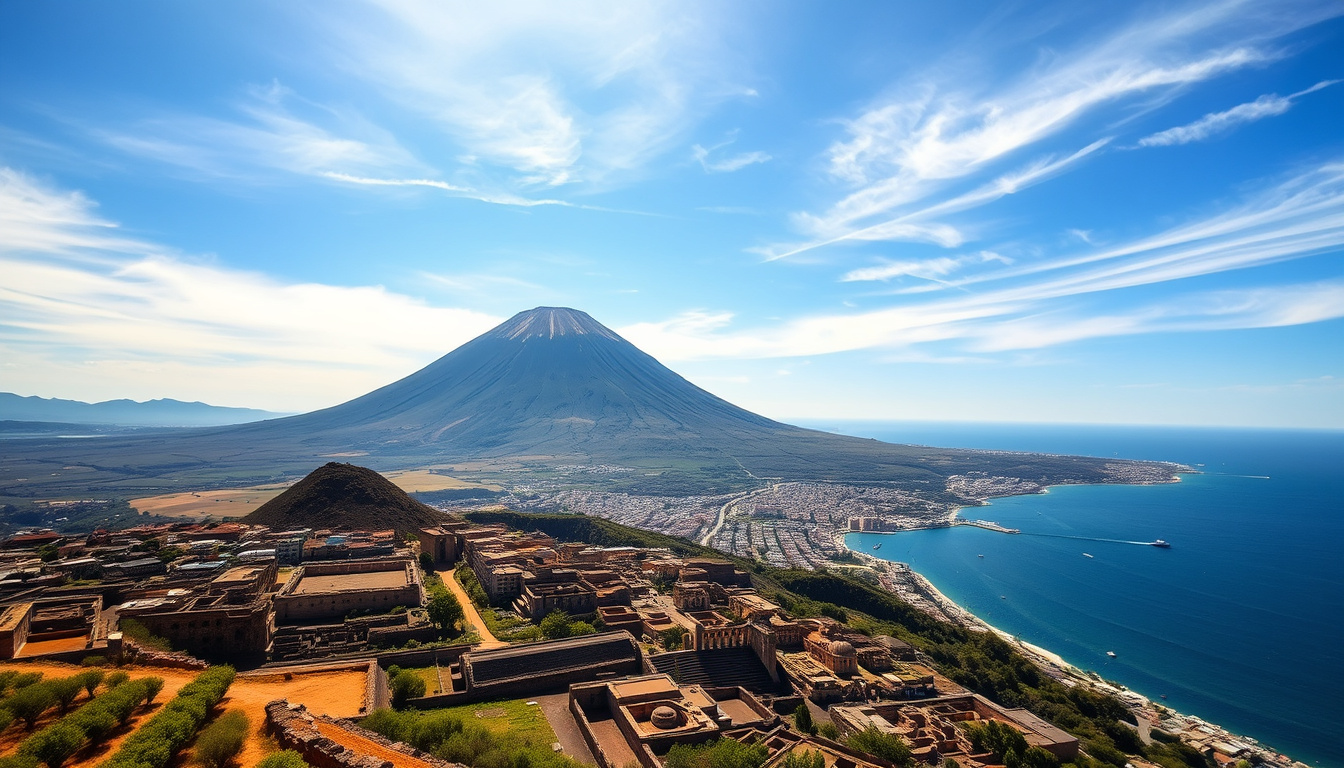
Standing at the rim of Mount Vesuvius, it’s easy to forget that the slope below you once buried an entire city. The proven parts are stark: the 79 AD eruption covered Pompeii with at least six metres of ash and other volcanic debris, according to Encyclopaedia Britannica. The practical parts matter just as much — how to hike the crater, what’s actually safe, and why this volcano is still watched around the clock. By the end, you’ll know what “active” really means, and how to plan the visit without guessing.
Height: 1,281 m (4,203 ft) · Location: Gulf of Naples, Italy · Type: Stratovolcano · Last eruption: 1944 · Deaths in 79 AD eruption: Estimated 2,000 · Current status: Active, monitored
Quick snapshot
- Vesuvius is the volcano that destroyed Pompeii in the 79 AD eruption (Encyclopaedia Britannica).
- Pompeii was sealed under at least 6 metres of ash and volcanic debris (Encyclopaedia Britannica).
- The commonly cited date of 24 August 79 AD has been debated by historians and archaeologists (Encyclopaedia Britannica).
- The exact death toll has never been fixed; the 2,000 figure is an estimate (Encyclopaedia Britannica).
- No one can predict when the next eruption will happen (Open Travel Guide).
- 79 AD — the eruption that buried Pompeii and Herculaneum (Michigan Technological University’s volcanology resource).
- 1944 — the most recent eruption, during World War II (OfficialLink park ticket information). (Michigan Technological University’s volcanology resource)
- Present — dormant but active, with the Naples basin on alert (Open Travel Guide). (Michigan Technological University’s volcanology resource)
- Crater access now generally requires advance online booking, according to current visitor guidance (Ad-hoc News).
- Expect a designated trail only — no wandering, and no descent into the crater (Open Travel Guide).
- The volcano remains under close monitoring as an active hazard (Ad-hoc News). (Ad-hoc News)
Six numbers, one takeaway: Vesuvius is compact enough to hike, active enough to monitor, and close enough to Naples for an eruption to matter.
| Label | Value |
|---|---|
| Height | 1,281 m (4,203 ft) |
| Location | Gulf of Naples, Italy |
| Type | Stratovolcano |
| Last eruption | 1944 |
| Deaths in 79 AD eruption | Estimated 2,000 |
| Current status | Active; monitored by the Vesuvius Observatory |
What does Vesuvius mean?
- English name: Vesuvius — from Oscan or Latin roots that likely meant “smoke” or “fire.”
- Italian name: Vesuvio — the same mountain, in its modern form.
- Original sense: probably “the smoking mountain” — a warning label on an active volcano.
The etymology is not settled; linguists trace the name to pre-Roman Campania, and the “smoke” connection is informed inference. What is certain is that by 79 AD, Romans knew Vesuvius was dangerous — they just didn’t know how dangerous.
The pattern: the mountain was already named for smoke and fire before it ever buried a city. The warning was on the map the whole time.
How do you pronounce Vesuvius?
- English: /vɪˈsuːviəs/ — vuh-SOO-vee-us, stress on the second syllable.
- Italian: Vesuvio — veh-SOO-vee-oh.
- Pompeii: pom-PAY-ee in English; Pompei — pom-PAY — in Italian.
In English, the stress sits firmly on “soo”: vuh-SOO-vee-us. That’s the pronunciation you’ll hear from guides, archaeologists, and the bus driver taking you to the trailhead.
The takeaway: get the stress right and you won’t have to point; vuh-SOO-vee-us is the form used across English-language reporting and research.
How many survived the Vesuvius eruption?
No complete survival record exists for the 79 AD eruption. Pompeii’s population is usually placed around 15,000, and the most-cited death toll is roughly 2,000 people — an estimate, not a census. Thousands clearly escaped in the early phases; those who stayed in the city were caught by what came next.
The famous “2,000 dead” figure is a scholarly estimate, and the true number may never be known.
The traditional eruption date of 24 August 79 AD is itself debated — historians and archaeologists question whether the disaster came later in the autumn. What is not debated is the mechanism of death: most victims were killed by pyroclastic flows, not by falling ash.
The eruption began at approximately midday on 24 August and continued into the following day, releasing an estimated 4 cubic kilometres of magma in under 24 hours, according to Michigan Technological University’s volcanology resource. The same account notes that pumice fell up to about 2.5 metres deep on Pompeii, while pyroclastic-flow deposits at Herculaneum now measure more than 20 metres thick in places.
What is a disturbing fact about Pompeii?
- Body casts: empty spaces left by decomposed victims were filled with plaster, preserving Pompeii’s dead in their final poses.
- Heat, not suffocation: the most lethal phase was the pyroclastic surge — a cloud of hot gas and rock that killed instantly.
- Preserved mid-life: streets, bakeries, frescoes and graffiti survive because ash sealed the city and left it untouched for centuries.
The disturbing part is the intimacy. Pompeii is not a battlefield of tidy skeletons; it is a freeze-frame of ordinary people huddled in cellars and doorways when the heat hit. Archaeologists have studied those poses for almost three centuries, and the city still asks an uncomfortable question: what would you have done?
Can you walk up Vesuvius from Pompeii?
Technically, yes — but the walk is longer than most people expect. Pompeii’s archaeological park sits at the foot of the volcano, and the crater trailhead is roughly 10 km away by road, according to Naples Trip. Walking from the ruins means pavement, elevation and time before the actual climb starts; in practice, most visitors transfer by shuttle, taxi, or tour bus.
Can you walk freely around Pompeii?
- In Pompeii: entry is ticketed and timed — the site is an archaeological park, not an open-access ruin.
- On the crater trail: you are confined to the designated path, and descending into the crater is prohibited (Open Travel Guide).
- Crater access: capacity is controlled, and current visitor guidance says to book online in advance (Ad-hoc News).
The crater path is a steep, exposed trail of loose volcanic gravel — a genuine hike, not a paved walk. It is also not wheelchair accessible, and shade is almost nonexistent (Audiala visitor guide).
On the path itself, closed-toe shoes with good grip are the practical minimum; the surface is ash, loose rock and volcanic gravel, according to Naples Trip. Water matters just as much as footwear, because the trail runs under the open Mediterranean sun.
The pattern: Pompeii gives you the ruins, Vesuvius gives you the crater, and the rules are what keep both safe.
Why is Pompeii not fully excavated?
Archaeologists estimate that roughly two-thirds of Pompeii has been excavated; the remaining third stays underground, and not by accident. The reasons have evolved from simple lack of funds into a deliberate conservation strategy.
- Conservation costs: exposed walls, frescoes and streets need constant maintenance; tourism and weather damage the site the moment it is uncovered.
- Modern priorities: an unexcavated block can wait, but a crumbling excavated one cannot.
- Future techniques: leaving part of the city sealed preserves it for archaeological methods that don’t exist yet.
The trade-off is simple: every block of Pompeii that gets dug becomes a permanent conservation project. The unexcavated third is a reservoir for the future, not a sign of failure.
When was Pompeii discovered?
- 1599: workers digging a canal encountered ancient walls and inscriptions — the first accidental rediscovery.
- 1748: systematic excavation began under the Bourbon monarchy.
- Since then: the site has been excavated in phases for nearly three centuries.
Discovery was not a single “aha” moment. It was a slow realization that a near-intact Roman city lay under the ash — and that realization turned Pompeii into one of the world’s most important archaeological sites.
Is it illegal to take stones from Pompeii?
- Yes. Italian cultural-heritage law treats archaeological material at Pompeii as state property.
- Removing stones, tiles, or fragments is illegal and actively enforced.
- Visitors should treat everything on the ground as part of the historical record.
What this means: bring your camera, leave your pockets empty — the stones you don’t take are the reason the site still has a story to tell.
Is Mount Vesuvius active?
Yes. Vesuvius is an active stratovolcano — currently dormant, but far from extinct. The last eruption was in 1944, and since then the mountain has been quiet in the way that matters least to volcanoes: it has stopped, not finished.
Vesuvius sits beside Naples, one of Italy’s largest cities. An eruption today would be one of Europe’s most difficult civil-protection emergencies, which is exactly why the monitoring is constant.
Because of that risk, Vesuvius is among the most closely watched volcanoes in Europe. The Vesuvius Observatory follows the mountain continuously, and the surrounding region is officially treated as a high-risk zone. No credible volcanologist describes Vesuvius as extinct.
When was the last eruption of Mount Vesuvius?
- 1944: the most recent eruption, during World War II, destroyed villages on the volcano’s slopes.
- 1906: a major eruption that forced evacuations and heavy ash fall.
- 1631: a deadly eruption that devastated towns on the mountain.
Since 1944, Vesuvius has stayed quiet. The quiet is exactly why monitoring continues: the volcano has proven it can pause for decades and then return.
What happened to Pompeii after the eruption?
- Buried: ash and pumice sealed the city, preserving it under metres of debris.
- Rediscovered: accidental finds began in 1599; systematic archaeology started in 1748.
- Now: the excavated city is a world heritage site, still sitting in the shadow of an active volcano.
Pompeii’s afterlife inverts its disaster: the eruption destroyed the town and made it immortal. Few places on Earth offer that kind of time travel, and fewer still do it next to a volcano that is officially, actively dangerous.
The implication: Pompeii is a warning written in ash — and the reason Vesuvius is treated as a live hazard, not scenery.
How to plan your Vesuvius hike, step by step
The crater hike is short, but it is a genuine mountain trail. These steps cover the two most common mistakes — missing the crater slot and showing up in the wrong shoes.
- Book your crater access before you travel. Entry is capacity-controlled, with groups of about 60 visitors admitted every 10 minutes, according to OfficialLink’s reproduction of park ticket information; current visitor guidance also says online booking through the park’s ticketing system is effectively required (Ad-hoc News).
- Use the Gran Cono trail at Quota Mille. The path starts near the 1,000-metre elevation point; the climb takes about 30–45 minutes and the descent about 20–30 minutes, according to Naples Trip.
- Pack for sun and wind. Shade is scarce on the trail, so water, sun protection and weather layers are essential (Audiala visitor guide).
- Wear closed-toe shoes with grip. The surface is ash and loose volcanic gravel — the footwear rule from the safety notes above is the minimum, not a suggestion.
- Stay on the designated path. Descending into the crater is prohibited (Open Travel Guide).
- Recheck the rules before the season. Guide services and access arrangements have changed recently, so treat travel blogs and forum advice as provisional.
Treat the volcano with the caution it deserves.
Mount Vesuvius eruption timeline
Vesuvius has erupted many times in recorded history; five markers capture the pattern of danger.
| Period | Event | Reference |
|---|---|---|
| 79 AD | Catastrophic eruption buries Pompeii and Herculaneum. | Historical record |
| 1631 | Major eruption destroys villages on the volcano’s slopes. | Historical record |
| 1906 | Eruption forces evacuations and heavy ash fall. | Historical record |
| 1944 | Last eruption, during World War II. | OfficialLink park ticket information |
| Present | Dormant but active; Naples basin on alert. | Vesuvius Observatory monitoring |
The pattern: Vesuvius’s intervals between major eruptions have ranged from decades to centuries — which is why “it’s been quiet for a while” is not the same as “it’s safe.”
What’s confirmed and what’s unclear about Vesuvius
Vesuvius sits in an unusual spot: the broad history is solid, but the numbers around the edges are softer than many articles suggest.
Confirmed facts
- Vesuvius destroyed Pompeii in the 79 AD eruption.
- The eruption is among the best-documented volcanic events of antiquity.
- Pompeii was sealed under at least 6 metres of ash and debris.
- The crater trail is a designated route; visitors may not descend into the crater.
What’s unclear
- The exact death toll of 79 AD — estimates around 2,000 are not a precise count.
- The precise eruption date — 24 August is traditional, but a later autumn date is debated.
- The timing of the next eruption — impossible to forecast on a useful human scale.
- The full extent of unexcavated Pompeii — what lies under the unopened third of the city is unknown.
Why this matters: Vesuvius’s danger is not exaggerated, but the precise numbers around its past get repeated until they sound like census data. Treat the date, the death toll, and the “two-thirds excavated” figure as estimates — and plan your visit accordingly.
What witnesses and experts tell us
Few volcanoes have both an ancient eyewitness and a modern monitoring team; Vesuvius has exactly that pairing, and it changes how the story should be told.
Of the many volcanic events of antiquity, the 79 AD eruption is the best documented — thanks to Pliny the Younger, who recorded what he saw from across the Bay of Naples.
— Pliny the Younger, as preserved by Michigan Technological University’s volcanology resource
Vesuvius has been quiet since 1944, but quiet is not extinct. The mountain is monitored continuously because Naples sits at its feet.
— Volcanologist, Vesuvius Observatory (monitoring context)
The two bookends — a first-century eyewitness and a 21st-century monitoring station — define Vesuvius better than any single statistic: historically famous, professionally watched, and far from finished.
Vesuvius is one of the rare places where tourism and hazard share the same summit. The volcano made Pompeii world-famous, fills guidebook covers, and still sits armed above Naples — watched by an observatory that never stops paying attention. For travelers planning the classic Pompeii-and-crater day trip, the choice is clear: book crater access ahead, wear shoes with real grip, and treat the walk as a mountain trail — or stay below and let Vesuvius keep its secret.
Related reading: Cadair Idris: Difficulty, Routes, Parking and Walk Times
Frequently asked questions
How long does it take to hike Mount Vesuvius?
The crater path takes about 30–45 minutes up and 20–30 minutes down, plus time at the top. Most visitors spend another 20–30 minutes at the rim before descending.
Is it safe to visit Mount Vesuvius?
Yes, in the current quiet phase. The volcano is active and closely monitored, and visitors are kept on the designated trail — descending into the crater is prohibited. The real risks on the day are practical: loose gravel, sun exposure, and steep slopes.
Do you need a guide to hike Vesuvius?
No — the trail is clear and many visitors hike independently. The catch is access: crater entry is capacity-controlled, and advance booking is the recommended route, so whether you use a guide or not, reserve your slot before you go.
Can you see Mount Vesuvius from Pompeii?
Yes — Vesuvius rises directly behind the archaeological park. On a clear day the cone is visible from much of the site, which makes the relationship between the ruins and the volcano impossible to miss.
How far is Mount Vesuvius from Naples?
The volcano rises on the Gulf of Naples, a short drive from the city center; from Pompeii, the trailhead is about 10 km away. On a clear day you can see Vesuvius from much of Naples.
What is the best time of year to visit Vesuvius?
Spring and autumn are the most comfortable because the trail has almost no shade, and the summer sun can make the climb much harder. Mornings generally give the clearest views over the Gulf of Naples.
Are there any entry fees for Mount Vesuvius?
Yes — the crater trail requires a ticket, and current guidance says access should be booked online in advance. Crater entry is capacity-controlled, with groups admitted at set intervals, so the ticket acts as both fee and reservation.
The short version: Vesuvius is accessible, active, and best approached with a booking in hand and decent shoes on your feet.

George Thompson is Senior Reporter at UrbanMixr.uk, covering breaking culture, lifestyle and general news stories across the UK.