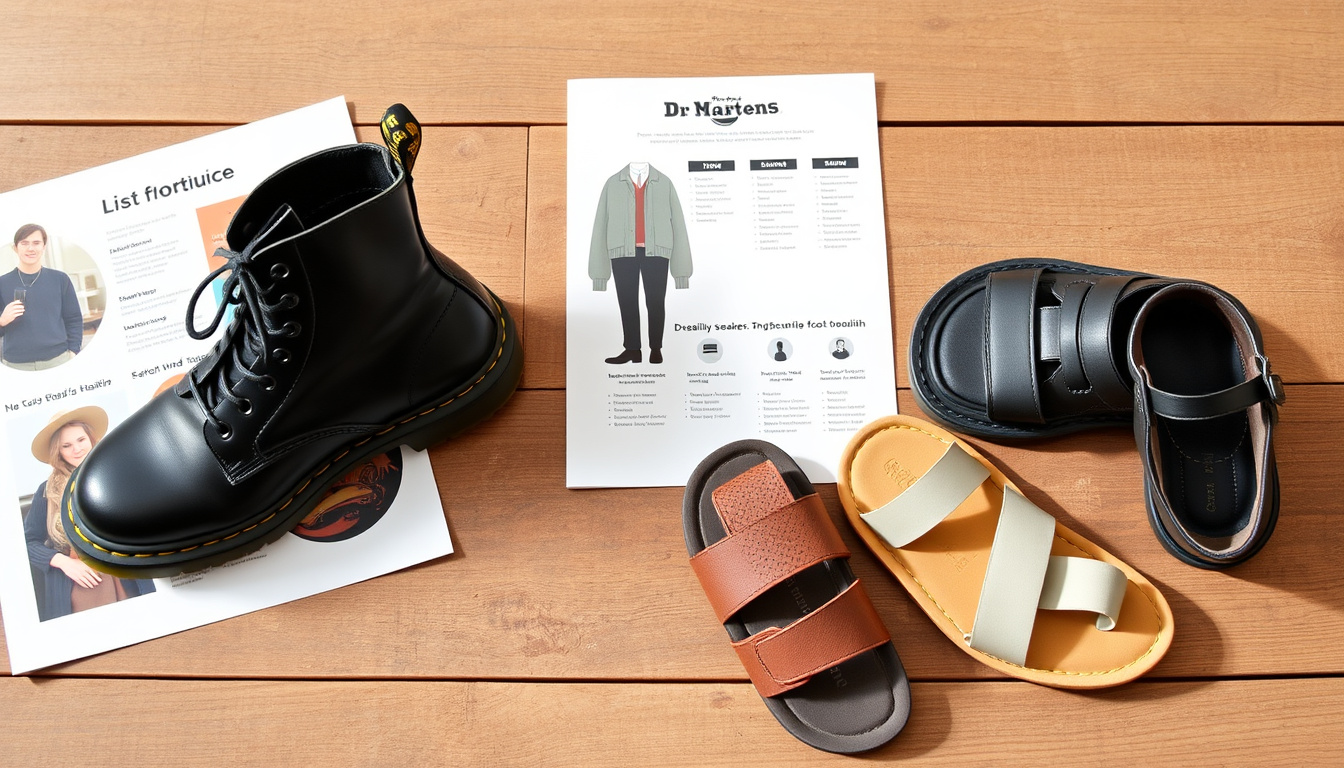
Anyone who has ever stared at a pair of 1460s in a shop window knows the pull: chunky, unapologetic, and stubbornly cool. Dr. Martens has kept that air-cushioned sole at the center of its range (Dr. Martens Support (official materials guide)), and the brand’s own buying guide still frames the choice around leather, sole, silhouette, and lacing (Dr. Martens (official buying guide)).
Founded: 1947 ·
Original boot model: 1460 ·
Sole type: Air-cushioned PVC ·
Cultural status: Workwear to punk to fashion
Quick snapshot
- Classic models like the 1460, 1461, and 2976 are made from genuine leather varieties (Dr. Martens Support (official materials guide)).
- Dr. Martens says most styles fit true to size, though some wearers find them roomier (Dr. Martens Help Centre (official sizing guidance)).
- The official buying guide frames choices around leather, sole, silhouette, care, lacing, and styling (Dr. Martens (official buying guide)).
- Dr. Martens does not publish a single global catalog, so the exact number of current models is hard to pin down.
- Whether the 1460 will remain a fashion staple beyond 2026 is still an open question.
- Long-term foot-health effects of wearing the same stiff boot daily without rotation are not covered in brand guidance.
- Whether Dr. Martens will maintain its cultural relevance against rising competition from heritage boot brands is uncertain.
- 1947: Dr. Klaus Maertens and Herbert Funck develop the air-cushioned sole (Dr. Martens (official buying guide)).
- 1960: The 1460 boot launches (Dr. Martens (official buying guide)).
- 1970s–80s: Punks, skinheads, and goths adopt the boots (Dr. Martens (official buying guide)).
- Limited-edition drops and collaborations continue to attract attention from fashion and resale circles.
- For comfort-focused buyers, rotating pairs and adding supportive insoles is the practical next step.
- UK-made alternatives like Solovair remain a talking point for purists.
The table below collates the foundational specs that define every classic Dr. Martens model.
| Label | Details |
|---|---|
| Founded | 1947 |
| Original boot model | 1460 (launched 1960) |
| Sole technology | Air-cushioned PVC, oil- and slip-resistant (Dr. Martens Support (official materials guide)) |
| Sizing system | Whole sizes only (Dr. Martens Help Centre (official sizing guidance)) |
| Core leathers | Smooth, Nappa, Virginia |
| Vegan options | Felix Rub Off synthetic leather |
| Classic models | 1460, 1461, 2976 |
| Break-in | Thick socks or insoles recommended |
What are all the Dr. Martens models?
Ask for Dr. Martens and most people picture the 1460 boot, but the range is wider than that one silhouette. The brand’s buying guide groups the lineup by leather, sole, silhouette, care, lacing, and styling — a more useful map than a single model list (Dr. Martens (official buying guide)).
Key model families: 1460, 1461, and more
- 1460: the original 8-eye boot.
- 1461: the 3-eye shoe.
- 2976: the Chelsea boot.
- Sandals, platforms, loafers, and seasonal silhouettes.
Industrial and safety boots: FS57, 7A52, Steel Toe
- FS57: a cap-toe work boot in classic Doc styling.
- 7A52: an industrial boot with added protection.
- Steel Toe: safety-rated versions built for work environments.
The pattern: every other model is compared with the 1460. If you want the pure Dr. Martens experience, start there; if you want the same air-cushioned feel in a different shape, the rest of the range follows that logic.
Why are they called Dr. Martens?
Dr. Klaus Maertens was a German doctor who, after an ankle injury, wanted a more cushioned sole. With engineer Herbert Funck, he developed an air-cushioned design in 1947, and the brand took his surname. The “Dr.” wasn’t a style flourish; it was a signal that comfort was the founding idea.
The origin story of Dr. Klaus Maertens
A medical experiment became a punk uniform. The air-cushioned sole was designed for sore feet before it became a style statement.
That same air-cushioned construction is still the technical backbone of most classic styles today, and it’s one reason the brand’s history keeps getting retold.
How to style Doc Martens boots?
Casual outfits with Dr Martens
- Straight-leg jeans: let the boot shaft show.
- Dresses and skirts: balance the heavy sole with a lighter hem.
- Cropped trousers: avoid bunching at the ankle.
The official buying guide treats styling as one of the core decisions, right alongside leather and sole choice (Dr. Martens (official buying guide)).
Dr Martens in workwear and streetwear
- Workwear: heavy denim, canvas trousers, and a tucked-in shirt keep the original labor boot vibe.
- Streetwear: oversized layers or technical jackets echo the 1460’s chunky silhouette.
The takeaway: Docs work best when you lean into contrast — soft fabrics against the hard sole, clean tailoring against the bulky shape.
What are the best alternatives to Doc Martens?
For buyers who want the classic look without the Dr. Martens name, Solovair is the most common suggestion, followed by Timberland and Thursday Boots in streetwear and entry-level heritage circles.
Four options, one pattern: each takes the chunky boot idea and pushes it toward a different priority.
| Boot | Construction angle | Best for |
|---|---|---|
| Dr. Martens 1460 | Air-cushioned PVC sole, smooth leather options | Iconic style and easy availability |
| Solovair 8-eye Derby | UK-made, Goodyear-welted construction | Classic silhouette with a more traditional build |
| Timberland 6-inch Premium | Leather upper, padded collar, rugged lug sole | Outdoor and work-leaning styling |
| Thursday Boot Company Captain | Leather, Goodyear welt, sleeker last | Dressier everyday wear |
Solovair is the closest historical cousin, but its materials are typically softer out of the box and the price is often higher. Timberland leans more utilitarian; Thursday leans more refined.
The trade-off: Dr. Martens gives you instant cultural recognition. Alternatives often give you softer leather, easier break-in, or resoleable construction — but none has the same catalog of cultural associations.
Are Doc Martens out of style in 2026?
Fashion calendars move fast, but the 1460 has enough momentum to keep showing up in street-style coverage. The more useful question is whether the boot still fits your life — and there, the brand’s core lineup hasn’t changed dramatically.
Current fashion trends and Dr Martens
The silhouette is no longer niche. When a boot becomes a blank slate for subcultures, fashion editors, and workwear fans at once, it usually sticks around longer than any single trend cycle.
There is no verified source saying the 1460 will be “out” in 2026. If anything, the recent cycle of limited editions and collaborations suggests the opposite: the boot’s visual weight is still being recycled into new styling languages.
The pattern: Docs are less a trend than a staple. Trends fade, but a staple gets reabsorbed.
What do podiatrists say about Doc Martens?
Podiatrists are unlikely to put a heavy 8-eye boot at the top of a “best walking shoe” list. The main concern is fit: if a boot doesn’t support your arch or fit your heel, the stiff sole can amplify pressure. Dr. Martens’ own sizing advice says thick socks or insoles can help with comfort during break-in (Dr. Martens Help Centre (official sizing guidance)).
Why do my feet hurt after wearing Dr. Martens?
- Stiff leather and a heavy sole need time to mold to your foot.
- Cramped toes are a warning sign; the brand says toes should have room to move comfortably.
- Wearing the same pair daily without rotation can turn pressure points into lasting soreness.
What is the 3 shoe rule?
Rotate. The 3-shoe rule is a habit, not a prescription: give a pair a day off so the sole, upper, and your feet can reset.
That’s why the common recommendation is to rotate between at least three pairs if you’re on your feet a lot.
What is the healthiest shoe for your foot?
- Removable insoles for custom orthotics.
- A wide toe box for toe splay.
- Arch support matched to your foot type.
- A stable heel cup and minimal midsole collapse.
The catch: Dr. Martens can absolutely be part of a healthy rotation, especially with an insole. But as an all-day everyday shoe for someone with flat arches or wide feet, it may not be the wisest pick.
What type of person wears Doc Martens?
Originally, laborers wore Dr. Martens because the air-cushioned sole was a functional upgrade on hard floors. Then the boots became uniforms for punks, skinheads, and goths. Now they’re equally at home on fashion editors, baristas, and office workers.
Demographics and subcultures
- Workers: the original audience for a cushioned, durable boot.
- Punks, skinheads, goths: subcultural adoption in the 1970s and 1980s gave the brand its rebellion.
- Fashion and streetwear: the 1460 is a recurring runway and street-style reference.
Each generation has claimed the boot for a different reason — comfort, defiance, or style. That flexibility is why the brand has outlasted most of its peers.
Dr Martens at a glance
Seven specs, one pattern: the brand is simpler than its subculture reputation suggests.
| Spec | Dr Martens detail |
|---|---|
| Sole | Air-cushioned PVC, oil- and slip-resistant |
| Sizing | Whole sizes only |
| Fit | Most true to size; leather stretches in width, not length |
| Materials | Smooth, Nappa, Virginia leather; Felix Rub Off vegan option |
| Classic models | 1460, 1461, 2976 |
| Break-in | Thick socks or insoles help |
| Sandals | Run larger than boots |
Pros and cons
Upsides
- Instantly recognizable silhouette
- Air-cushioned PVC sole is slip- and oil-resistant
- Clear official sizing guidance for whole sizes and fit quirks
- Leather and vegan options in the core range
Downsides
- Stiff leather can be uncomfortable before break-in
- Heavy sole is not ideal for long shifts without rotation
- Whole-size-only system can make half-size wearers guess
- No single global catalog makes comparisons harder
How to break in your Docs in 5 steps
Start with the official sizing advice and let the leather do the work.
- Use thick socks or insoles from day one.
- Wear them around the house for 30–60 minutes at a time.
- Remember that leather stretches in width, not length; choose your size based on length.
- If toes feel cramped, size up — the brand says feet need room to move.
- Rotate with another pair so the soles don’t take a beating daily.
Timeline: from medical sole to style staple
- : Dr. Klaus Maertens and Herbert Funck develop the air-cushioned sole.
- : The 1460 boot launches.
- : Punks and skinheads adopt Dr. Martens.
- : Grunge and alternative fashion embrace the brand.
- : Limited editions and collabs fuel a new wave.
Confirmed facts vs what’s unclear
Confirmed facts
- Dr. Martens was founded in 1947.
- The 1460 launched in 1960.
- The air-cushioned PVC sole is oil- and slip-resistant.
- Most styles fit true to size.
What’s unclear
- Exact number of models currently in production.
- Whether the 1460 remains a fashion staple after 2026.
- Long-term foot-health effects of daily Docs without rotation.
What the sources say
“Dr. Martens says most styles fit true to size, although some wearers find them roomier than other brands.”
Dr. Martens Help Centre (official sizing guidance)
“Dr. Martens identifies Smooth leather as a stiff, shiny leather associated with classic Docs.”
Dr. Martens Support (official materials guide)
For anyone buying their first pair of Dr. Martens in 2026, the decision is straightforward: treat the boot as a fashion icon with a long break-in period, not as a podiatric recommendation. If you’re on your feet all day, the honest move is to rotate with a supportive alternative — or your feet will likely make that argument for you.
Related reading: Book Shelf Buying Guide · Cadair Idris walk routes and difficulty
drmartens.com, help.drmartens.com, cnn.com, drmartens.tw, drmartens.com, eatingwell.com
Frequently asked questions
What is the best Dr Martens model for everyday wear?
The 1460 boot is the classic choice, while the 1461 shoe works well if you want a lower-profile look. Both share the same air-cushioned sole family.
How do I break in Dr Martens quickly?
Start with thick socks or insoles, wear them in short sessions, and remember that leather stretches in width, not length.
Are Dr Martens worth the price?
If you value the iconic silhouette and long-term repairability, yes. If you want softer leather and an easier break-in, an alternative like Solovair or Thursday Boots may be a better spend.
Can Dr Martens be resoled?
Dr. Martens describes its PVC outsoles as repairable across most of its footwear. Many cobblers can replace soles depending on the construction.
Do Dr Martens fit true to size?
Most styles fit true to size, but the brand only offers whole sizes. Leather can stretch in width, so fit should be based on length.
Are Dr Martens good for standing all day?
They can work if the fit is right and your feet have proper support. Rotating pairs and adding supportive insoles helps if you’re on your feet for long shifts.
What is the difference between 1460 and 1461?
The 1460 is an 8-eye boot; the 1461 is a 3-eye shoe. Both are classic silhouettes, but the 1461 has a lower profile and a dressier feel.
Why do Dr Martens have yellow stitching?
The yellow stitching is a brand signature, but Dr. Martens has not published an official explanation of its exact origin. It visually ties the classic models together.

George Thompson is Senior Reporter at UrbanMixr.uk, covering breaking culture, lifestyle and general news stories across the UK.