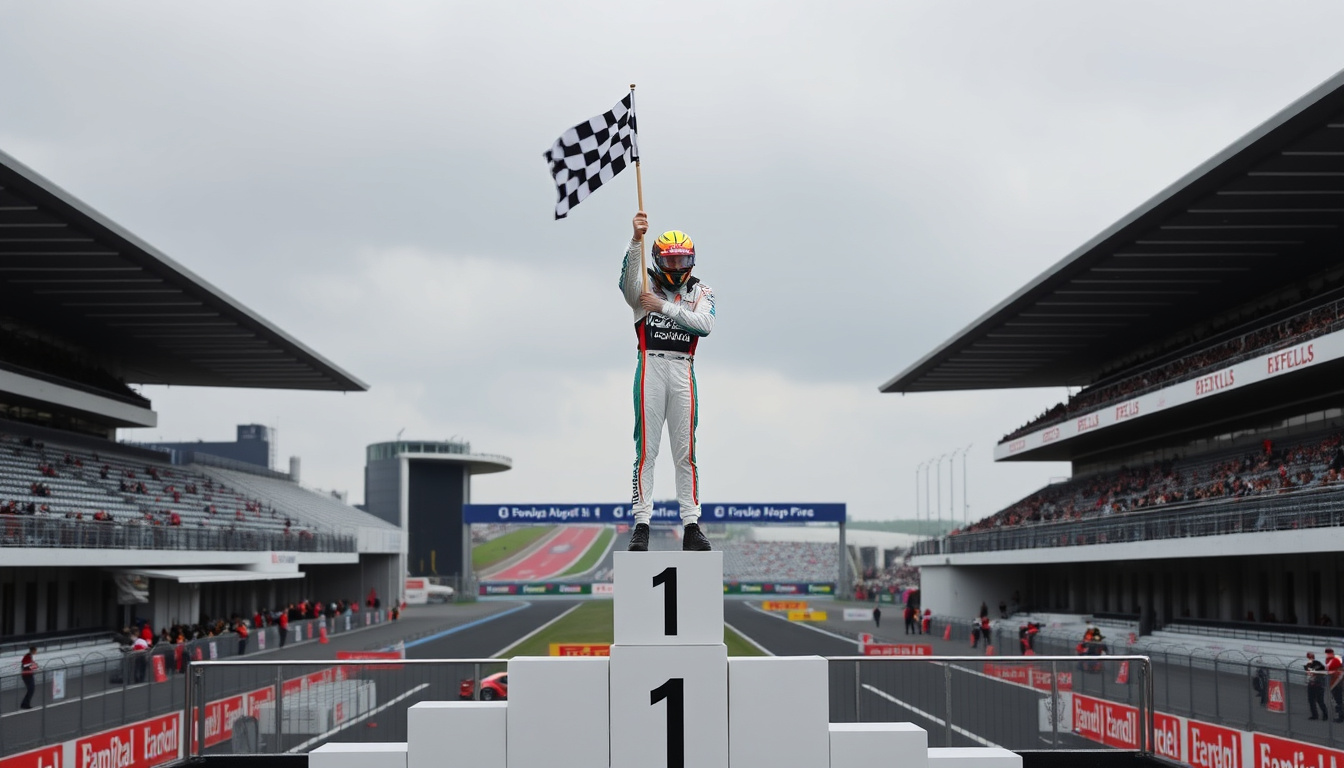
For 239 Grands Prix, Nico Hülkenberg carried a cruel label: the best Formula 1 driver never to reach the podium. On July 6, 2025, at a rain-soaked Silverstone, he erased it in one afternoon by finishing third from 19th on the grid.
Date of birth: August 19, 1987 · Nationality: German · Current team: Kick Sauber · Podium finishes: 1 (2025 British GP) · Pole positions: 1 (2012 Brazilian GP) · Grand Prix starts: 239 at first podium
Quick snapshot
- First F1 podium at the 2025 British Grand Prix, finishing third for Kick Sauber (Formula 1)
- Podium on his 239th start — the longest wait in F1 history (Associated Press)
- First Sauber podium since Kamui Kobayashi in 2012; first German podium since Sebastian Vettel in 2021 (BBC Sport)
- Exact salary: not officially disclosed; third-party estimates range around $2–5 million per year (F1 Salaries)
- Net worth: roughly $5 million by estimate, not by any official statement (F1 Salaries)
- Whether Audi’s 2026 works entry turns one podium into a regular habit (F1 Salaries)
- 19th on the grid to third place at Silverstone (Silverstone Circuit)
- 16 positions gained from start to finish (Motor Sport Magazine)
- Longest wait in career starts before a podium in F1 history (Frontstretch)
Eight career numbers, one pattern: Hülkenberg’s record was built on pace that rarely converted into trophies — until Silverstone changed the line.
| Category | Value |
|---|---|
| Full name | Nico Hülkenberg |
| Date of birth | August 19, 1987 (F1 Salaries) |
| Nationality | German |
| Current team | Kick Sauber (2025) |
| First race | 2010 Bahrain Grand Prix with Williams (BBC Sport) |
| Podium finishes | 1 (2025 British Grand Prix) |
| Pole positions | 1 (2012 Brazilian Grand Prix) |
| Grand Prix starts | 239 at the time of his first podium (Associated Press) |
Has Nico Hülkenberg ever had a podium finish?
Short answer: yes — as of July 6, 2025. Hülkenberg finished third at the British Grand Prix, and no driver in Formula 1 history had ever waited longer for a first top-three finish (Associated Press).
His best result before that afternoon was fourth place — a finish he recorded three times (Formula 1). Those near-misses built the reputation that followed him for more than a decade.
What are his closest podium near-misses?
- Fourth at the 2012 Belgian Grand Prix, the 2013 Korean Grand Prix and the 2016 Belgian Grand Prix (Frontstretch)
- Only pole position of his career, at the 2012 Brazilian Grand Prix, ended off the podium (Motor Sport Magazine)
- Multiple fourth-place finishes across midfield machinery, often in wet or chaotic races
Why the wait lasted so long
For more than a decade, Hülkenberg was fast enough to be hired and unlucky enough not to be rewarded. Silverstone didn’t make him quicker — it finally let luck catch up.
The reasons were rarely about his driving. He spent most of his career in midfield machinery — Williams, Sauber, Force India, Renault and Haas — where podiums needed a chaotic race and perfect timing. Strategy gambles, weather shifts and late incidents repeatedly left him in the no-man’s-land of fourth place.
The implication: Hülkenberg’s problem was never pace, it was timing. For one wet Sunday at Silverstone, the timing finally worked.
The pattern: after 239 races, the script finally flipped.
How much is Nico Hülkenberg paid?
Formula 1 does not publish driver contracts, so every salary figure is an estimate. The salary-tracking database F1 Salaries places Hülkenberg’s annual pay in the $2–5 million range (F1 Salaries).
What is his annual salary compared to other F1 drivers?
- Estimated 2024–25 pay: $2–5 million per year (F1 Salaries)
- Official figure: not disclosed by the team or the driver
- Peer group: solidly midfield for F1, well short of the sport’s biggest earners
What about endorsements and bonuses?
- Race bonuses are common in F1 contracts, but Hülkenberg’s are not public
- Endorsements are part of his income, according to career profiles, with no brand deals disclosed
- Treat any precise bonus total as speculation
F1 income is rarely just a base salary. Bonuses and personal sponsors fill out most contracts, but none of Hülkenberg’s supplementary numbers are public. The only hard estimate available is the salary range above.
Hülkenberg’s 2025 paycheck is the least interesting number in his contract. The value is the seat: he is in place for Audi’s works-team entry in 2026, which is where the real earning potential sits.
What this means: salary estimates will stay fuzzy until F1 changes its disclosure rules. What is clearer is that Hülkenberg’s timing — joining Sauber just before Audi’s takeover — is the financially significant part of the move.
Is Hulkenberg a good F1 driver?
The shortest honest answer is yes — and the résumé proves it better than the results page ever did.
How does his performance compare to teammates?
- 2009 GP2 Series champion, beating a grid stacked with future F1 drivers (Motor Sport Magazine)
- Out-qualified his teammates in most seasons across his career
- Consistently re-signed by midfield teams for over a decade
Hülkenberg raced for Williams, Sauber, Force India, Renault, Haas and filled in at Aston Martin — a run that reflects steady performance rather than flashes of brilliance. In a sport where one bad season can end a career, he was renewed again and again.
What do the statistics and experts say?
Hülkenberg’s Silverstone drive was not a one-lap wonder: he climbed from the back half of the grid, made the right calls in changing conditions and crossed the line ahead of cars with more pace. That is a skill set, not a stat.
The numbers support the reputation. One pole position, three fourth-place finishes, and then a Silverstone podium gained from 19th on the grid — the record describes a driver who extracted everything possible from the cars he was given.
The trade-off: consistency made Hülkenberg reliable rather than spectacular, until a wet Sunday required both and he delivered a near-perfect race.
Which car does Nico Hulkenberg drive?
For the 2025 season, Hülkenberg drives the Kick Sauber — the car at the center of Audi’s long-term F1 project (Formula 1).
What team does he drive for in 2025?
- 2025: Kick Sauber
- 2023–2024: Haas
- 2026: Sauber becomes Audi’s full works team
He joined Sauber after two seasons at Haas, a move that was always about positioning for the manufacturer era. Sauber is the operation Audi takes over as a full works team in 2026.
What does the Audi move mean?
Audi is betting its F1 credibility on a driver with one podium from 239 starts. The upside: he extracts results from midfield cars better than almost anyone. The risk: the 2026 car has to be good enough to let him.
No driver in the modern era has entered a works-team project with this kind of veteran patience, and few had a better demonstration of racecraft than Hülkenberg showed at Silverstone. The Audi chapter will decide whether his career ends as a great midfield story or something more.
Why this matters: Hülkenberg has spent his career proving he can extract results from midfield cars. Audi needs exactly that skill while its project ramps up — and he needs Audi’s rise to arrive before his own career winds down.
Is Nico Hulkenberg a millionaire?
Yes, by every available estimate. F1 Salaries, a database that tracks driver pay and career earnings, puts Hülkenberg’s net worth at around $5 million (F1 Salaries).
What is his estimated net worth?
- Estimated net worth: around $5 million (F1 Salaries)
- Status: an estimate, not confirmed by the driver or his management
- Context: real money for most people, but a modest figure at F1’s top table
How did he earn his wealth?
- F1 race contracts since 2010 with Williams, Sauber, Force India, Renault and Haas
- Endorsement and sponsorship income from his racing career
- Earnings from junior and formula racing before reaching F1
The wealth is not celebrity-level. Hülkenberg never chased controversy, never built a blockbuster personal brand, and never turned the unluckiest-driver tag into merchandise — which fits the quiet way he has always driven.
The catch: $5 million is a fortune by any normal standard and a footnote at F1’s top table. The next Audi contract is the one that decides which sentence describes him.
Nico Hülkenberg’s career timeline
Thirteen years of near-misses, one breakthrough: before Silverstone 2025, every chapter of Hülkenberg’s career stopped one step short of the podium.
| Period | Milestone |
|---|---|
| 2009 | Wins the GP2 Series championship |
| 2010 | F1 debut at the Bahrain Grand Prix with Williams |
| 2012 | Scores first and only F1 pole position, Brazilian Grand Prix |
| 2013–2016 | Drives for Sauber, then Force India |
| 2017–2019 | Drives for Renault |
| 2020–2022 | Aston Martin reserve role, out of F1 racing action |
| 2023 | Full-time F1 return with Haas |
| 2025 | First F1 podium, British Grand Prix, from 19th to third |
The pattern: every chapter ended one step short of the podium — until the chapter where it finally didn’t.
Confirmed facts and what’s still unclear
Confirmed facts
- Third at the 2025 British Grand Prix, scoring 15 points after starting 19th (Silverstone Circuit)
- 239 starts before a first podium — the longest wait in F1 history (Associated Press)
- First Sauber podium since Kamui Kobayashi at the 2012 Japanese Grand Prix, and first German podium since Sebastian Vettel in 2021 (BBC Sport)
What’s unclear
- Exact salary and net worth — estimates range around $2–5 million and $5 million, but nothing is officially confirmed
- Whether Hülkenberg overruled his team’s strategy call at Silverstone, as Motor Sport Magazine reported
- Whether Audi’s 2026 works car will be competitive enough to race for podiums
The pattern: almost everything about Hülkenberg’s career is confirmed except the numbers that define wealth — and whether Silverstone was a beginning or a peak.
Voices on the breakthrough
“At long last, Nico Hulkenberg scores an F1 podium at Silverstone.”
Frontstretch, headline on the 2025 British Grand Prix
“From P19 to first F1 podium: Hulkenberg’s sensational British GP drive.”
Motor Sport Magazine, headline on the race
Run the race reports together and one theme repeats: this was not a lucky podium. It was an aggressive, well-managed drive that started at the back of the grid and finished ahead of some of the sport’s best drivers.
The implication: after years of being called unlucky, Hülkenberg finally got headlines that matched his talent.
The takeaway
For Audi, the timing is almost too neat: a proven, fast, tireless driver who just erased the biggest asterisk in F1 history, arriving exactly as the German manufacturer needs a veteran to anchor its works-team era. For Hülkenberg, the pressure has flipped — the unluckiest-driver tag is gone, replaced by a harder question about what comes next. For Audi, the choice is clear: give him a car that can reach the podium without a wet-weather miracle, or watch the breakthrough become the peak.
Frequently asked questions
Why was Hülkenberg called the unluckiest driver in F1?
He went 238 races without a top-three finish — the longest wait of any driver in Formula 1 history — before finally breaking through at the 2025 British Grand Prix. The gap between his talent and his results created the label.
Did Hülkenberg ever finish on the podium before 2025?
No. His best result before the 2025 British Grand Prix was fourth place, which he recorded three times.
How old is Nico Hülkenberg?
He was born on August 19, 1987, and was 37 when he took his first F1 podium at Silverstone.
What team does Hülkenberg drive for in 2025?
He drives for Kick Sauber, the team Audi will convert into its full works operation in 2026.
Is Hülkenberg better than his teammates?
In most seasons, he out-qualified his teammates, and his 2009 GP2 title came against a grid of future F1 drivers. Teams kept re-signing him for over a decade, which is the strongest evidence.
Did Hülkenberg win a championship before F1?
Yes — the GP2 Series in 2009, the final step before Formula 1 and a title that has reliably predicted future F1 careers.

George Thompson is Senior Reporter at UrbanMixr.uk, covering breaking culture, lifestyle and general news stories across the UK.