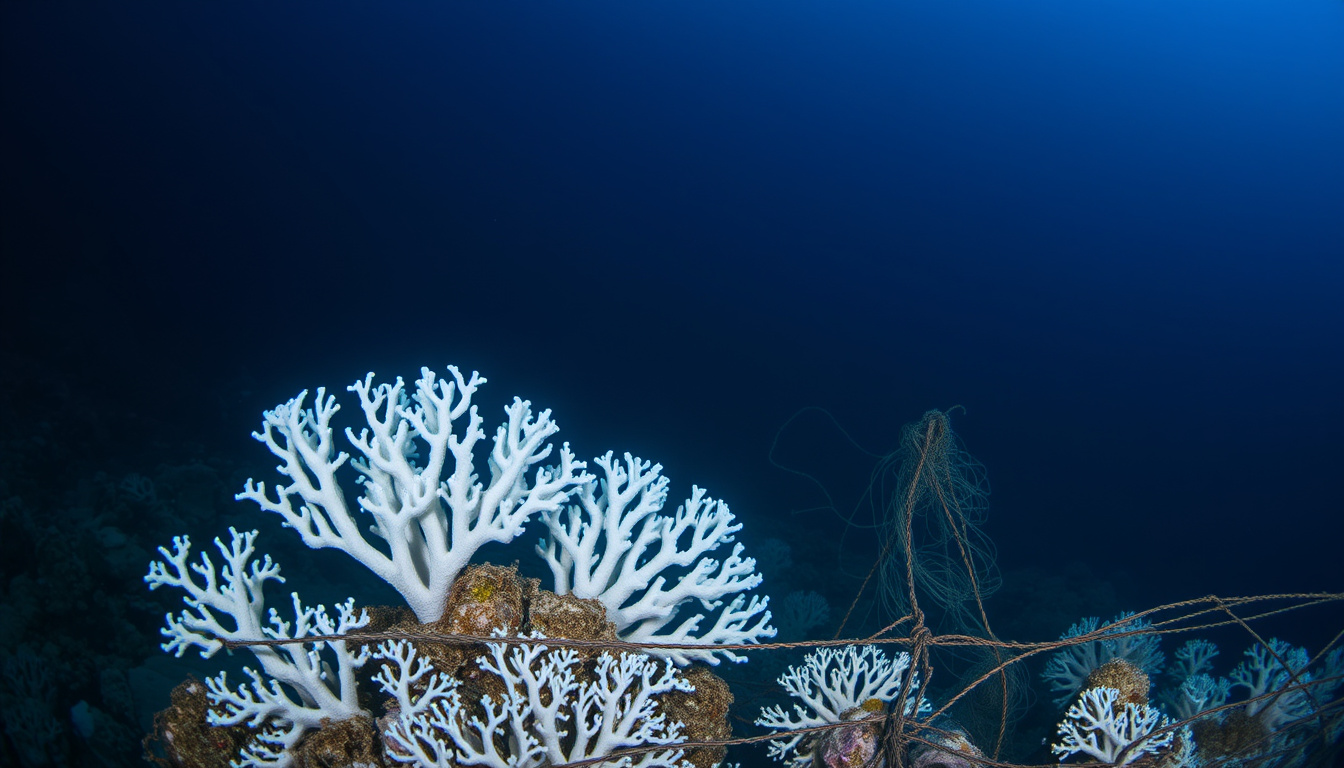
Few ecosystems hide in plain sight quite like coral reefs. Most people picture warm, turquoise water and colourful fish, but off the west coast of Ireland, at depths of more than 300 metres, cold-water corals build equally complex and fragile habitats. This guide covers what a coral reef actually is, why they are in trouble, and what Ireland’s deep-sea reefs reveal about the future of these ancient ecosystems.
Reef area: ~284,300 km² · Marine species supported: 25% · Loss since 1950: >50% · Projected loss by 2050: 90% · Irish cold-water depth: 300–1,000 m
Quick snapshot
- Coral reefs are underwater structures built by coral polyps (National Parks & Wildlife Service)
- Cold-water reefs off Ireland are formed by Lophelia pertusa and Madrepora oculata (National Parks & Wildlife Service)
- Corals have no brain or central nervous system (National Parks & Wildlife Service)
- Exact year of functional extinction depends on emission cuts
- Whether corals can adapt fast enough to warming oceans
- Full economic impact of reef loss is debated
- Whether deep-sea mining will add significant new pressure on cold-water coral habitats
- 1950s: Systematic monitoring begins
- 1998: First global bleaching event
- 2016–2017: Third global bleaching event
- 2050: 90% could be functionally extinct
- More stringent protection for Irish cold-water reefs
- Expansion of coral restoration research
- Potential for deep-sea mining to add new pressure
Five key numbers that frame the coral reef story, one pattern: the scale of the ecosystem is enormous, but so is the threat.
| Fact | Value |
|---|---|
| Total reef area | Approximately 284,300 km² worldwide |
| Number of coral species | Over 800 species of reef-building corals |
| Oldest known coral reef | Devonian period (~400 million years ago) |
| Irish cold-water reef depth | 300–1,000 meters below sea level |
| Annual economic value | $375 billion (fisheries, tourism, protection) |
What exactly is a coral reef?
A coral reef is an underwater ecosystem built by colonies of tiny animals called coral polyps. The polyps secrete calcium carbonate, which hardens into a skeleton that forms the reef structure. These structures can grow for thousands of years and are often called the ‘rainforests of the sea’ because of the extraordinary biodiversity they support.
What’s another name for a coral reef?
- Rainforests of the sea — a common nickname highlighting the biodiversity
- Biogenic reef — the scientific term for a reef built by living organisms
- Carbonate mound — especially for cold-water reefs, where the structure is a mound of calcium carbonate
The same polyps that build tropical reefs also build cold-water reefs in Irish waters. Lophelia pertusa, the main reef-builder off Ireland, creates carbonate mounds that can rise 300–500 m above the sea floor. That is taller than the Eiffel Tower.
Do corals have a brain?
No. Corals are cnidarians — simple animals with a nerve net but no brain or central nervous system. They respond to touch and light but do not process pain or consciousness the way vertebrates do.
The implication: corals are alive, but they do not feel. That makes the debate about harming them a matter of ecological impact, not animal welfare.
Are there any coral reefs in Ireland?
Yes, and they are not tropical. Ireland’s cold-water coral reefs lie at depths of 200–1,600 m off the west coast, on the continental shelf slope and on Rockall and Hatton Banks. Water temperature there hovers between 4 and 8°C, with salinity of 32–36%.
- Main builders: Lophelia pertusa and Madrepora oculata
- Depth range: 200–1,600 m
- Structure: Carbonate mounds rising 300–500 m above the seafloor
The catch: these reefs are slow-growing and fragile. The same report from the NPWS (2015) warns that cold-water coral habitats have low resilience — even small amounts of fishing gear contact can degrade them permanently.
Ireland hosts some of the most extensive cold-water coral reefs in the Atlantic. They are every bit as biologically important as tropical reefs, but far less visible.
The implication: protecting these deep-sea habitats requires different strategies than tropical reef conservation, with a focus on fishing gear restrictions rather than sunscreen bans.
Why are coral reefs dying?
Climate change is the primary driver. Rising sea temperatures force corals to expel the symbiotic algae living in their tissues, causing a phenomenon called bleaching. If the algae do not return, the coral starves and dies (OSPAR Commission).
What is the biggest killer of coral reefs?
- 1. Rising sea temperatures — cause mass bleaching events
- 2. Ocean acidification — reduces the ability of corals to build skeletons
- 3. Bottom trawling — the most severe immediate threat to cold-water reefs
- 4. Pollution and overfishing — weaken reef ecosystems
The pattern: warm-water reefs face heat and acidification; cold-water reefs face physical destruction from fishing gear. Both are losing the race against human impact.
What year will coral reefs be gone?
Projections vary. The University of Edinburgh estimates that under current warming trends, 90% of coral reefs could be functionally extinct by 2050. That is within the lifetime of most people reading this article. The exact year depends on how quickly emissions are reduced and whether corals can adapt.
Do corals feel pain?
Because corals lack a brain and central nervous system, they do not experience pain in any way humans would recognise. However, they do have a primitive nerve net that triggers contraction when touched — a reflex, not a conscious response.
Why shouldn’t you touch corals?
- Touching removes the protective mucus layer, exposing the coral to infection
- Sunblock or oils from human skin can poison the polyps
- Physical contact can break fragile branches, especially in cold-water species (NPWS)
The trade-off: a moment of curiosity can destroy decades of slow growth. Cold-water corals grow only millimetres per year.
Is black coral illegal?
Black coral (Antipatharia) is listed under the Convention on International Trade in Endangered Species (CITES), making it illegal to harvest or trade in many countries without permits. It is also protected under Irish law as part of the reef habitat.
What does the Bible say about coral?
- Job 28:18 mentions coral alongside rubies and topaz as a precious material
- Proverbs 8:11 says wisdom is more valuable than coral
The text treats coral as a luxury, but the modern context is conservation: black coral populations have been overharvested for jewellery, and trade restrictions now apply globally.
Who eats coral reefs?
Several species feed directly on coral polyps:
- Parrotfish — scrape algae and polyps from the reef surface
- Sea stars (e.g., crown-of-thorns starfish) — prey on polyps, sometimes in outbreak numbers
- Snails and worms — bore into coral skeletons
These predators are part of a complex food web. In healthy reefs, their impact is balanced; in stressed reefs, outbreaks can accelerate decline.
Timeline: The decline of coral reefs
- 1950s — Systematic monitoring begins; widespread decline first noted
- 1998 — First major global bleaching event, linked to El Niño (OSPAR)
- 2016–2017 — Third global bleaching event; Great Barrier Reef suffers severe damage
- 2020s — More than 50% of reefs already lost; continued ocean acidification (University of Edinburgh)
- 2050 (projected) — 90% may be functionally extinct under current emissions
Confirmed facts vs. what’s unclear
Confirmed facts
- Coral reefs are built by polyps secreting calcium carbonate
- Climate change is the primary cause of mass bleaching (OSPAR)
- Cold-water coral reefs exist off Ireland at depths of 200–1,600 m
- Corals lack a brain and central nervous system
- Bottom trawling is the most immediate threat to cold-water reefs (NPWS)
What’s unclear
- Exact year of functional extinction (depends on emission cuts)
- Whether corals can adapt to warmer oceans fast enough
- Full economic impact of total reef loss (estimates vary)
- Effectiveness of at-scale restoration techniques
- Whether deep-sea mining will add significant new pressure on cold-water coral habitats
Expert perspectives
When corals are stressed by changes in conditions such as temperature, light, or nutrients, they expel the symbiotic algae living in their tissues, causing them to turn completely white.
— National Oceanic and Atmospheric Administration (NOAA) on coral bleaching
We have shown that we can grow corals 50 times faster than normal in the lab and then outplant them. The survival rates are encouraging.
— Dr. David Vaughan, Mote Marine Laboratory on restoration techniques
Cold-water coral reefs are slow-growing habitats that are easily impacted by the mechanical effects of fishing gear. They are widely recognised as threatened marine ecosystems.
— OSPAR Commission on the vulnerability of Irish cold-water reefs
Under current emissions scenarios, most coral reef ecosystems will be functionally extinct by 2050. Ocean acidification compounds the problem.
— Intergovernmental Panel on Climate Change (IPCC) on projected loss
The consequence is clear: if fishing regulations are not enforced and carbon emissions continue rising, Ireland’s cold-water reefs will join their tropical counterparts in a steep decline. For the Irish fishing industry and marine conservation bodies, the choice is between protecting deep-sea habitats or losing them to trawl scars and acidified waters.
Related reading: Mam Tor Walk: Guide to the Shivering Mountain · Mam Tor Walk: Guide to the Shivering Mountain
npws.ie, universitytimes.ie, npws.ie, cora.ucc.ie, southernpulse.org, vliz.be, policyline.uk, theconversation.com, wwf.panda.org
Frequently asked questions
How long do coral reefs take to form?
A single reef can take thousands to millions of years to grow, with corals adding only a few millimetres per year in cold water.
Can coral reefs recover from bleaching?
Yes, if the stress is removed and the algae return. But repeated bleaching events make recovery unlikely (OSPAR).
What is the difference between warm-water and cold-water coral reefs?
Warm-water corals contain symbiotic algae and need sunlight; cold-water corals have no algae and live in deep, dark, cold water (4–8°C).
How deep can coral reefs grow?
Tropical reefs usually stop at 40–50 m. Cold-water reefs in Ireland have been recorded down to 1,600 m.
Are all corals protected by law?
No. Only certain species like black coral are listed under CITES. However, reef habitats in European waters are protected under the EU Habitats Directive.
What can individuals do to help protect coral reefs?
Reduce carbon footprint, avoid sunscreens containing oxybenzone, support sustainable seafood choices, and advocate for marine protected areas.
Do coral reefs exist in the Atlantic Ocean?
Yes, the Atlantic hosts extensive cold-water coral reefs off Ireland, Iceland, Norway, and along the US continental slope (University of Edinburgh).
Related reading: Mam Tor Walk: Guide to the Shivering Mountain

George Thompson is Senior Reporter at UrbanMixr.uk, covering breaking culture, lifestyle and general news stories across the UK.