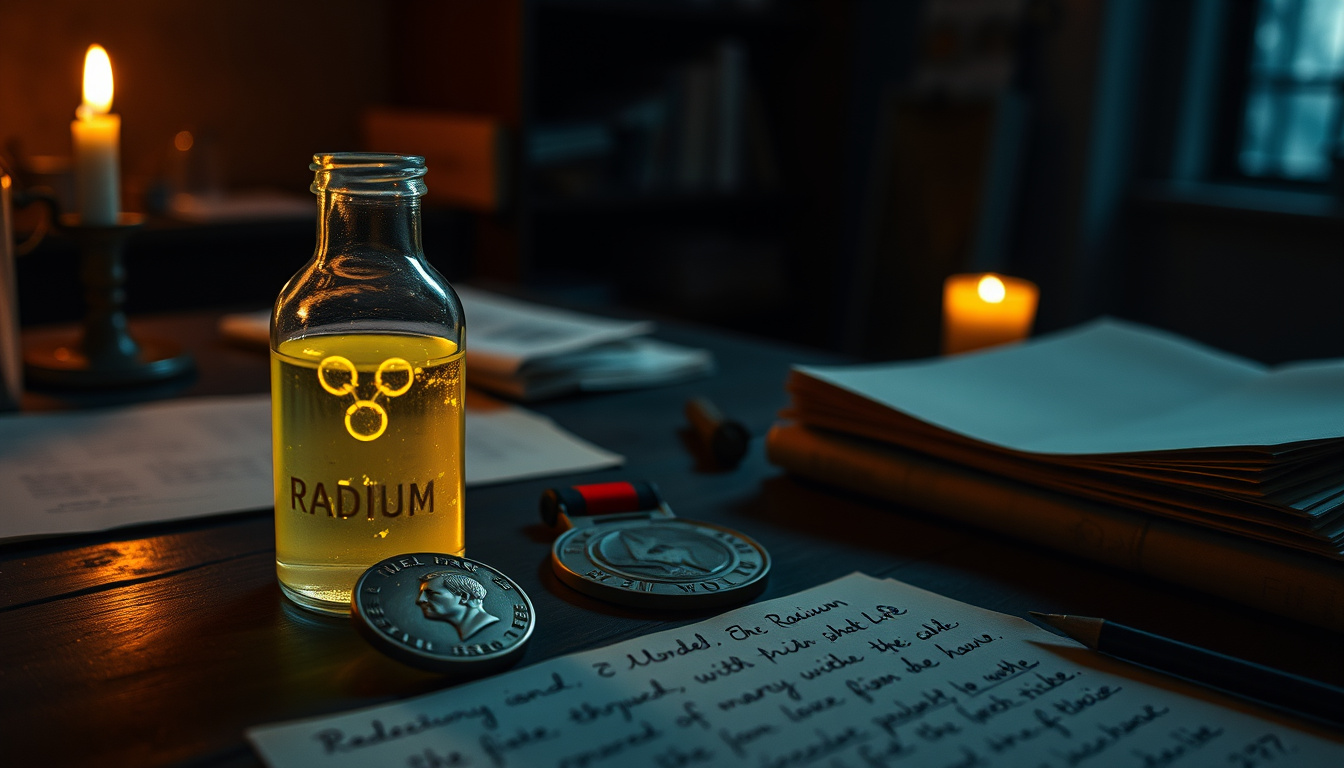

Few scientists paid such a literal physical price for their discoveries as Marie Curie did, her hands permanently scarred from handling radioactive materials telling the story of a life driven by relentless curiosity — and a death that scientists now know was written into her very cells. This is the story of what Marie Curie discovered, how she changed medicine and physics, and what her body revealed about the dangers of radiation long before the world fully understood them.
Nobel Prizes won: 2 · Elements discovered: 2 (polonium, radium) · First woman to win a Nobel Prize: 1903 (Physics) · Only person to win Nobel in two different sciences: Physics (1903), Chemistry (1911) · Year of death: 1934
Quick snapshot
- First woman to win a Nobel Prize (Encyclopaedia Britannica)
- Discovered polonium and radium (Encyclopaedia Britannica)
- Foundations of modern radioactivity theory (Wikipedia)
- Severe radiation burns on hands from handling radioactive materials (Physics Today)
- Aplastic anemia as cause of death (Encyclopaedia Britannica)
- Her body remained radioactive for decades (Wikipedia)
- Developed mobile X-ray units (Little Curies) during WWI (Marie Curie UK)
- Trained 150 women as radiology technicians (Marie Curie UK)
- Estimated 1 million wounded soldiers treated with her X-ray units (Marie Curie UK)
Seven key facts about Marie Curie, one pattern: her life was a single thread of discovery, physical sacrifice, and lasting legacy.
| Label | Value |
|---|---|
| Full name | Marie Salomea Skłodowska-Curie |
| Born | November 7, 1867, Warsaw, Poland |
| Died | July 4, 1934, Passy, France |
| Nobel Prizes | Physics (1903), Chemistry (1911) |
| Discoveries | Polonium (1898), Radium (1898) |
| Spouse | Pierre Curie (m. 1895–1906) |
| Children | Irene Joliot-Curie, Eve Curie |
What was Marie Curie known for?
Discovery of radium and polonium
In 1898, Marie Curie discovered two new chemical elements: polonium (named after her native Poland) and radium (Encyclopaedia Britannica). Her method involved systematically analyzing tons of pitchblende ore in a drafty shed at the Sorbonne to isolate these radioactive substances. The scale of the work was staggering — she processed eight tons of pitchblende to extract one gram of pure radium chloride.
By isolating radium, Curie gave the world a substance that could treat tumors and also burn the hands of the person who found it. That paradox defined her entire career.
Nobel Prizes in Physics and Chemistry
Marie Curie won the Nobel Prize in Physics in 1903 alongside her husband Pierre Curie and Henri Becquerel for their joint research on radiation phenomena (Wikipedia). Eight years later, in 1911, she won the Nobel Prize in Chemistry for her discovery of radium and polonium — an accomplishment no one else has replicated (Wikipedia).
The pattern: Curie didn’t just break a glass ceiling — she broke two, in different sciences. Each prize demanded a decade of hands-on work with materials that were slowly destroying her health.
What happened to Marie Curie before she died?
Aplastic anemia diagnosis
Marie Curie died on July 4, 1934 at the Sancellemoz sanatorium in Passy, France (Marie Curie UK). Her cause of death was officially recorded as aplastic pernicious anemia (Encyclopaedia Britannica). A historical account from the American Institute of Physics notes that a Geneva medical expert diagnosed her with a blood disorder with no cure before her death.
The sanatorium director told her family that her bone marrow had likely been injured by a long accumulation of radiations (American Institute of Physics). Some sources describe her death as radiation-induced leukemia — the U.S. National Park Service uses that language, while the BBC History entry says she died from leukemia caused by exposure to high-energy radiation.
Effects of prolonged radiation exposure
A peer-reviewed article indexed in the PubMed database catalogs Curie’s health problems: radiodermatitis, tinnitus, cataracts, tuberculosis, one abortion, and aplastic anemia. The same article attributes her death to aplastic anemia in 1934.
In her final years, Curie’s body sent unmistakable signals. She broke her wrist in 1932 and the break healed more slowly than expected (Stanford University). She noticed deteriorating vision and suffered painful radiation burns on her fingers (Stanford University). The New York Times obituary described her end as hastened by accumulated radiations.
The implication: Curie was a living dosimeter for radiation damage, and her body logged every microsievert of exposure six decades before safety limits existed.
What happened to Marie Curie’s hand?
Radiation burns and injuries
Marie Curie’s hands bore the most visible evidence of her dangerous work. She suffered severe radiation burns from handling radioactive materials with her bare hands (Physics Today). The same source notes that she carried test tubes of radium in her pockets and kept them in her desk drawer, exposing her skin to constant, cumulative radiation.
Her fingers became heavily scarred, and the skin damage was so pronounced that she had difficulty holding a pen in her later years (Stanford University). The radiation caused chronic radiodermatitis that left her hands permanently disfigured. She also developed double cataracts and underwent four operations to restore her eyesight (Physics Today). These symptoms — burned hands and clouded vision — were the visible markers of a body saturated with ionizing radiation.
Curie’s hands advanced medicine more than any scalpel could. The same hands that burned from radium also operated the X-ray machines that saved tens of thousands of soldiers. She saw the price clearly and paid it anyway.
The pattern: The hands that held the key to medical progress were also the first to show the price of that progress.
What did Albert Einstein say about Marie Curie?
Albert Einstein held Marie Curie in exceptional regard, calling her “the only person not spoiled by fame” (Wikipedia). He praised her intellectual and moral strength, writing a tribute in 1935 after her death that highlighted her character as much as her scientific achievements.
Einstein wrote: “The greatness of her intellectual achievement is matched only by the purity of her character.” Their correspondence reveals mutual respect — two giants of physics who understood the weight of their discoveries. Both had seen how scientific breakthroughs could be used for healing and destruction.
Why this matters: Einstein’s praise wasn’t just professional courtesy. He was describing a woman who stayed humble through two Nobel Prizes, personal tragedy when Pierre died in a street accident in 1906, and the physical decay that radiation inflicted on her body.
What were Marie Curie’s major discoveries and inventions?
Discovery of polonium and radium (1898)
Marie Curie discovered polonium in July 1898, naming it after her homeland Poland, which was under Russian partition at the time (Encyclopaedia Britannica). She discovered radium later that same year, in December 1898 (Wikipedia).
Her technique involved measuring the “activity” of radioactive samples using a piezoelectric electrometer invented by her husband Pierre. She systematically eliminated known elements from the ore until only the unknown radioactive ones remained.
Development of mobile X-ray units (Little Curies)
During World War I, Curie invented mobile X-ray units nicknamed “Little Curies” — vehicles equipped with X-ray equipment that could be driven to field hospitals (Marie Curie UK). She personally trained 150 women as radiology technicians (Marie Curie UK).
The impact was enormous: an estimated 1 million wounded soldiers were treated using her X-ray units (Marie Curie UK). Surgeons could locate bullets and shrapnel without exploratory operations, saving countless limbs and lives.
Who were Marie Curie’s husband and children?
Pierre Curie: husband and collaborator
Marie married Pierre Curie in 1895 (Wikipedia). They worked side by side on radioactivity research, sharing the 1903 Nobel Prize in Physics. Pierre’s death in a street accident in 1906 left Marie widowed with two young daughters.
Irene Joliot-Curie and Eve Curie
Marie and Pierre had two daughters. Irene Joliot-Curie followed her parents into science and won the Nobel Prize in Chemistry in 1935 (Wikipedia). Eve Curie became a noted author and wrote the definitive biography of her mother.
The catch: The Curie family holds the record for the most Nobel Prizes across generations — five total, shared between Marie, Pierre, Irene, and Irene’s husband Frederic Joliot-Curie.
Timeline: Marie Curie’s life and legacy
- 1867 — Born in Warsaw, Poland (Wikipedia)
- 1891 — Moved to Paris to study at the Sorbonne (Wikipedia)
- 1895 — Married Pierre Curie (Wikipedia)
- 1898 — Discovery of polonium and radium (Encyclopaedia Britannica)
- 1903 — Won Nobel Prize in Physics (shared with Pierre and Becquerel) (Wikipedia)
- 1906 — Pierre Curie died in a street accident (Wikipedia)
- 1911 — Won Nobel Prize in Chemistry (Wikipedia)
- 1914–1918 — Developed mobile X-ray units (Little Curies) for WWI (Marie Curie UK)
- 1934 — Died from aplastic anemia (Encyclopaedia Britannica)
- 1995 — Remains transferred to the Panthéon in Paris as first woman honored for her own achievements (Wikipedia)
The pattern: From the discovery of radium to her death, exactly 36 years passed — the same period it took for the radiation she carried to destroy the marrow that made her blood.
Confirmed facts and what remains unclear
Confirmed facts
- Marie Curie discovered polonium and radium (Encyclopaedia Britannica)
- She won two Nobel Prizes (Wikipedia)
- She died from aplastic anemia due to radiation exposure (Encyclopaedia Britannica)
- Her hands were heavily scarred from handling radioactive materials (Physics Today)
- Albert Einstein praised her character and intellect (Wikipedia)
What’s unclear
- Exact timeline of her hand injuries and treatment
- Full extent of radiation toxicity in her body at death
- Exact number of soldiers treated with her X-ray units is an estimate, not a precise count
- Exact timeline of her radiation exposure and its cumulative effect is not fully documented
- Exact progression of her hand burns over time is not fully detailed
Quotes from and about Marie Curie
“The greatness of her intellectual achievement is matched only by the purity of her character.”
— Albert Einstein, writing about Marie Curie after her death in 1935
“Nothing in life is to be feared, it is only to be understood. Now is the time to understand more, so that we may fear less.”
— Marie Curie, from her speeches and memoirs
Frequently asked questions
Was Marie Curie Polish or French?
She was born in Warsaw, Poland, but moved to France in 1891. She became a naturalized French citizen but never denied her Polish identity — she named the element polonium after her homeland.
What is the meaning of ‘radioactivity’?
Marie Curie coined the term “radioactivity” to describe the spontaneous emission of radiation from certain elements, such as uranium and radium.
How did Marie Curie’s discoveries impact medicine?
Radium became a key treatment for cancer through radiation therapy. Curie’s mobile X-ray units also transformed battlefield medicine during WWI.
Why are Marie Curie’s notebooks still radioactive?
Her personal notebooks and clothing absorbed radium during her decades of work. Traces of radiation persist in these materials today, and they are stored in lead-lined boxes at France’s Bibliothèque Nationale.
What awards did Marie Curie receive besides the Nobel Prize?
She received the Davy Medal (1903), the Matteucci Medal (1904), the Elliott Cresson Medal (1909), and the Albert Medal (1910), among other honors.
Did Marie Curie have any formal education in physics?
She studied at the Sorbonne in Paris where she earned degrees in physics and mathematics. Poland had limited opportunities for women in higher education at the time, which is why she moved to France.
What was Marie Curie’s role during World War I?
She developed and operated mobile X-ray units (Little Curies) that treated over 1 million wounded soldiers, and personally trained 150 women to operate the equipment.
What happened to Marie Curie’s Nobel Prize money?
She used the prize money from both Nobel awards to fund her research and to purchase radium for continued experiments. She also donated funds to various scientific causes.
For any researcher or science historian looking at the full arc of Marie Curie’s life, the decision about how to tell her story is clear: tell it as a straight line from discovery to consequence, or risk losing the lesson her hands still teach us about the physical cost of knowledge.

George Thompson is Senior Reporter at UrbanMixr.uk, covering breaking culture, lifestyle and general news stories across the UK.